

Transparent bidding processes for Texas homeowners

TL;DR:
- Transparent bidding requires providing contractors with the same detailed scope of work to enable apples-to-apples comparisons and prevent unexpected change orders.
- Open-book and cost-plus contracts increase cost transparency by sharing real invoices, allowing homeowners to verify costs and capture material savings.
- Comparing at least three bids with clear criteria helps homeowners identify realistic allowances, scope completeness, and change policies, reducing project disputes and budget overruns.
You receive three contractor bids for your bathroom remodel. One comes in at $18,000, one at $27,000, and one at $34,000. Most homeowners pick the lowest and call it a win. Six weeks later, the change orders start arriving, and that $18,000 project is tracking toward $29,000. This is one of the most predictable and avoidable problems in home renovation, and it almost always comes down to one thing: the bids were never actually comparing the same work. This guide will explain transparent bidding processes clearly, so you can evaluate contractor bids with confidence and protect your budget before a single nail is driven.
Table of Contents
- What is a transparent bidding process and why does it matter?
- How open-book and cost-plus bidding improve trust and savings
- Key elements to compare when reviewing multiple bids
- Using contracts to lock in transparent bidding and reduce disputes
- Practical tips for applying transparent bidding in your Texas renovation
- Why transparent bidding is often misunderstood but critical for Texas homeowners
- How BidWolf simplifies transparent bidding for Texas homeowners
- Frequently asked questions
Key Takeaways
| Point | Details |
|---|---|
| Identical scopes | Providing all contractors with the same detailed scope is essential for fair bid comparisons and reducing costly surprises. |
| Open-book contracts | Open-book bidding with detailed invoices builds homeowner trust and can return savings from material price drops. |
| Bid comparison checklists | Using comprehensive checklists covering scope, allowances, and change orders helps identify the most transparent and realistic bids. |
| Standardized contracts | Formal contracts like AIA documents lock in bidding transparency and reduce disputes by clearly defining roles and payment terms. |
| Practical application | Attaching full scopes to contracts and insisting on monthly payments documentation protects homeowners from scope creep and liens. |
What is a transparent bidding process and why does it matter?
Transparent bidding explained simply: every contractor you invite to bid receives the exact same written description of your project, and every bid they return covers the same items in a way you can verify and compare. This is not how most homeowners currently run the process. Most homeowners describe their project verbally or in a few sentences, let each contractor interpret what is needed, and then try to compare numbers that were never built from the same foundation.
The foundation of any transparent bidding process is the scope of work. A scope of work is a written document that spells out exactly what the project includes, what it excludes, what assumptions were made, and what allowances are built in. An allowance is a budget placeholder for items not yet selected, like light fixtures or tile. Including a $500 allowance for bathroom tile when realistic costs run $2,000 to $4,000 is a common low-ball tactic. A strong scope of work names real numbers based on real selections.
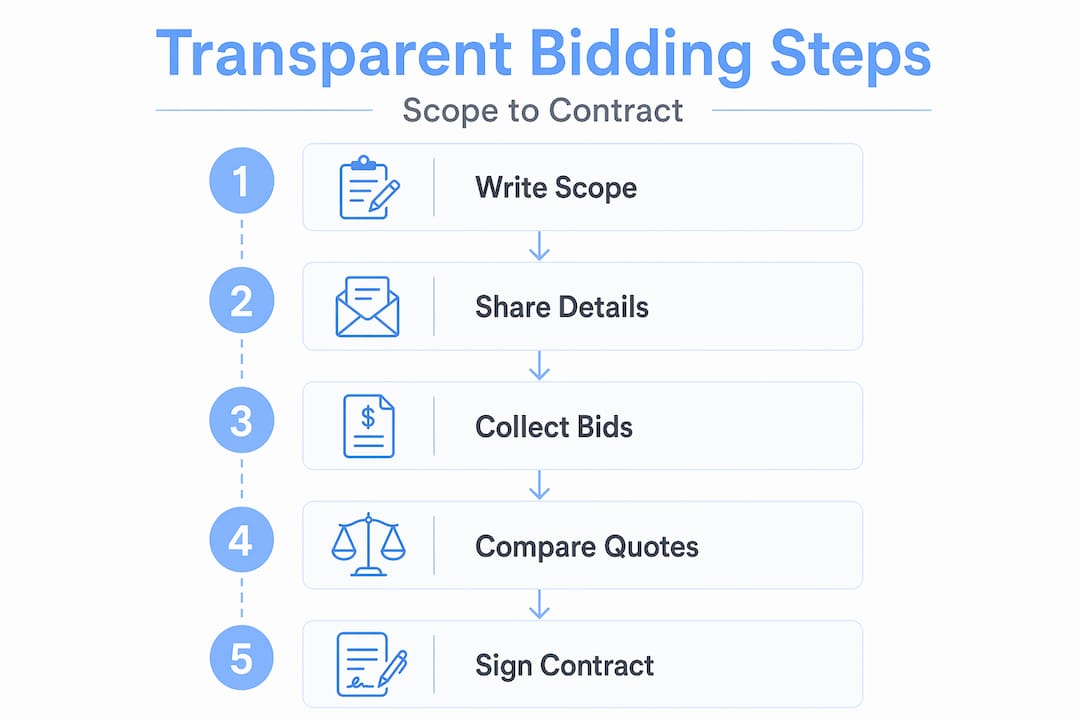
Transparent bidding processes require providing all contractors with the same detailed scope of work to enable apples-to-apples bid comparisons, which prevents 80% of early project change orders. That figure is not an accident. It reflects what happens when contractors fill in gaps differently. One contractor includes tile demo; another assumes you will handle it yourself. Neither told you. You find out when the second invoice arrives.
Here is what a complete, transparent bid scope must include:
- Inclusions: Every task, material category, and labor item the contractor will cover
- Exclusions: Work explicitly out of scope, such as permits, haul-away, or specialty trades
- Assumptions: Conditions the bid depends on, like existing plumbing being up to code
- Allowances: Budget placeholders for unselected items, with realistic dollar ranges
- Payment schedule: Milestone-based payments tied to project phases, not arbitrary dates
When you are comparing contractor bids for Texas projects, the scope of work is the document that makes honest comparison possible. Without it, you are comparing apples to car parts.
Pro Tip: Before sending your project description to any contractor, write it down in one document and send that same document to everyone. Even a one-page written description reduces bid variation dramatically.
How open-book and cost-plus bidding improve trust and savings
Beyond clear scopes, understanding the pricing model reveals how open-book bidding increases cost transparency and potential savings. Two pricing models stand above the rest for homeowner-friendly transparency: open-book contracts and cost-plus contracts.
A cost-plus contract means you pay the contractor’s actual documented costs, plus an agreed fee. That fee is either a fixed dollar amount or a percentage, typically between 10% and 20% of total costs. The key word is actual. The contractor is not marking up materials quietly inside a lump-sum price. You see the receipts. You can verify that the lumber cost what they say it cost. This model removes one of the biggest information imbalances in home renovation.
Open-book contracts disclose detailed line-item estimates and actual monthly invoices, allowing homeowners to verify costs and capture material price savings of 5 to 15%. That savings potential is real. Material prices in Texas fluctuate, particularly for lumber, copper, and tile. In a fixed-price contract, the contractor pockets savings when material prices drop. In an open-book arrangement, those savings flow back to you.

A fixed fee (rather than a percentage) protects you even further. When the contractor’s fee does not grow with total project cost, they have no financial incentive to let costs run high. Top Texas contractors provide monthly open-book reports during 16 to 22-week projects, which can surprise homeowners with savings from fluctuating material prices. Monthly reporting also lets you catch issues early rather than at final billing.
Here is what bidding process transparency looks like in a well-run open-book contract:
- Monthly invoices from subcontractors and material suppliers, with proof of payment
- Contractor’s fee stated as a fixed dollar amount in the contract
- Owner’s right to audit any cost claimed during the project
- A shared contingency fund, typically 10% of project budget, managed transparently
- Clear documentation when contingency funds are drawn
Pro Tip: Ask any contractor offering cost-plus terms to confirm their fee in writing as a fixed dollar amount rather than a percentage. A fixed fee of $8,000 on a $50,000 project gives the contractor zero reason to let costs climb.
You can also simplify the process of managing multiple renovation bids by creating a tracking sheet where you log each contractor’s stated fee structure, so you can spot immediately who is being straightforward and who is not.
Key elements to compare when reviewing multiple bids
Now that you understand bidding types and transparency, let’s look at how to practically compare contractor bids across the elements that actually matter.
Experts recommend comparing at least 3 bids using checklists covering scope completeness, realistic allowances, contingency buffers, and written change order policies. Three bids give you a reference range. Two bids leave you guessing. One bid gives you no information at all.
Use the table below to organize your comparison across the most critical elements:
| Comparison element | What to look for | Red flag |
|---|---|---|
| Scope completeness | Every trade, phase, and material category named | Vague descriptions like “general remodel” |
| Allowances | Dollar amounts matching realistic selections | Allowances below market value for your area |
| Exclusions list | Clearly stated items not covered | No exclusions listed at all |
| Change order policy | Written procedure, 48 to 72-hour approval window | Verbal-only change order process |
| Contingency buffer | 10% of total budget reserved | No contingency mentioned |
| Payment schedule | Milestone-based with clear triggers | Large upfront payment required |
| Timeline | Stated in weeks with phase milestones | No timeline provided |
| Subcontractor list | Named subs or trade categories identified | No mention of subcontractors |
A few of these deserve deeper explanation. Allowances are where bids most commonly mislead. A contractor who lists a $400 allowance for a kitchen faucet is not being realistic. Mid-range faucets run $200 to $600, and installation adds more. Realistic allowances reflect your actual selections or, if you have not decided yet, market-rate midpoints. Always ask the contractor to justify every allowance figure in writing.
Change order policies deserve equal attention. A change order is a written amendment to the contract that documents any change in scope, cost, or timeline. A written change order policy should specify who can authorize changes, how quickly pricing must be provided (48 to 72 hours is standard), and that work on the change cannot begin until you sign. Without this, contractors can make changes and then bill you after the fact.
Review your Texas homeowner contractor checklist before you start collecting bids, and keep a running list of questions to ask contractors in Texas so you can verify each element during your initial conversations.
Pro Tip: Create a simple spreadsheet with the comparison elements above as column headers and each contractor’s name as a row. Fill it in as you receive bids. Gaps in the grid tell you where to push for more information before you sign anything.
Using contracts to lock in transparent bidding and reduce disputes
To turn transparent bids into successful projects, formalizing details in contracts is essential to prevent misunderstandings and costly conflicts.
The most respected standard for residential construction contracts in the United States comes from the American Institute of Architects, commonly called the AIA. AIA residential contracts specify clear scope definitions, payment milestones, and integrated general conditions reducing disputes by standardizing expectations. These documents have been refined over decades to cover the situations that most commonly cause problems.
A contract without the full scope attached is a problem waiting to happen. Verbal scope creep, where additional work gets added informally through conversation, is one of the leading causes of renovation disputes. Attaching the complete, signed-off scope of work as a formal exhibit to the contract makes the scope legally binding and eliminates the “but I thought you meant” argument.
Texas construction contracts require written change order procedures with owner approval timelines and pricing methods, and failing to follow them contributes to 20 to 40% of renovation budget overruns. Knowing this, here is the standard change order approval process you should expect in any well-run contract:
- Contractor identifies a scope change in writing and submits a detailed cost and time impact estimate
- You receive the written change order document within 48 to 72 hours of the change being identified
- You review the pricing and either approve, reject, or request modification in writing
- No work on the changed scope begins until both parties have signed the change order
- The signed change order is attached to the original contract as a numbered amendment
- Payment for the change is tied to a specific milestone or the next scheduled invoice
AIA contract phases for a typical residential project also include payment milestones tied to specific triggers: completion of demolition, rough framing, rough-in trades, drywall, and substantial completion. Milestone-based payments protect you from funding work that has not yet happened.
When you are choosing reliable Texas contractors, ask directly whether they use AIA or equivalent standardized contract documents. A contractor who resists standard contract terms is showing you something important about how they plan to manage the project.
Practical tips for applying transparent bidding in your Texas renovation
With the contract in place, these practical steps help you apply transparent bidding principles to your Texas renovation projects for better control and confidence.
Follow these steps in order. Each one builds on the last.
- Write a single, detailed scope document and send the same version to every contractor you invite to bid. Include inclusions, exclusions, assumptions, and realistic allowances. This is the single most impactful step in transparent bidding.
- Use a checklist to compare bids line by line across scope completeness, allowance amounts, exclusions, change order policy, contingency, payment schedule, and timeline. Do not compare totals until you have confirmed the underlying assumptions match.
- Request written change order and contingency policies from every bidder before you make a hiring decision. If a contractor cannot provide these in writing during the bidding phase, they will not provide them reliably during construction either.
- Attach the full scope to your contract as a signed exhibit. Make sure the contract references the scope by name and states that the scope governs the work described.
- Ask for monthly open-book reports or invoices to verify costs as the project progresses. This is especially important for cost-plus arrangements.
Experienced Texas owner-builders attach the winning bid’s full scope to the contract and request proof of payment to subcontractors monthly to avoid liens. A lien is a legal claim a subcontractor or supplier can place on your property if the general contractor fails to pay them, even if you already paid the contractor in full. Monthly proof of payment to subs is a simple protection that many homeowners overlook.
Common pitfalls to avoid in your bidding process:
- Low allowances: Any allowance that seems unrealistically cheap will become an expensive change order
- Vague scopes: Phrases like “bathroom renovation” without itemized tasks are a recipe for disputes
- Verbal change orders: Never approve a change that is not in writing with a signed price
- Large upfront payments: A 10% deposit is reasonable; anything above 30% upfront is a warning sign in Texas
- No proof of sub payments: Without this, you have no protection against liens on your property
For ongoing help with communicating with Texas contractors and workflow for managing renovation bids, building a documentation habit early makes every phase of the project easier to manage.
Why transparent bidding is often misunderstood but critical for Texas homeowners
Here is what most renovation articles will not tell you: the importance of transparent bidding has nothing to do with finding the cheapest contractor. It has everything to do with buying information.
When you enforce bidding process transparency, you are not just organizing paperwork. You are forcing every contractor in your bid pool to show you how they think. The contractor who pushes back on writing down exclusions, or who insists a scope of work is unnecessary, is showing you their working style before you hand them a check. That resistance is data.
70% of construction disputes arise from ambiguous scopes rather than pricing alone, which makes transparent bidding practices not just useful but essential. Think about that number. Most renovation conflicts are not about money at the start. They are about two parties who believed they agreed on something they never actually defined. Transparent bidding closes that gap before it becomes a conflict.
Many homeowners treat the bidding phase as a necessary formality before the “real” project begins. This is backwards. The bidding phase is where the most consequential decisions are made. What you agree to in writing before work starts determines almost everything that happens after.
There is also a contractor selection insight that rarely gets discussed: the contractors who actively support transparent bidding practices, who offer open-book reporting and encourage you to review every invoice, tend to be the contractors who are confident in their costs and their work quality. Contractors who resist transparency are often protecting a margin that would not survive scrutiny. When you find a contractor who welcomes your questions and hands you a detailed scope without being asked, that is someone worth serious consideration.
The uncomfortable truth is that understanding bidding transparency takes time. You will spend a few hours writing your scope, a few more reviewing bids carefully, and a few more reviewing contracts. That investment is small compared to the cost of a single unexpected change order on a mid-size Texas renovation. Contractor bid examples in Texas show what a well-prepared, transparent bid document actually looks like in practice, which can help you set the right expectations from the start.
How BidWolf simplifies transparent bidding for Texas homeowners
Ready to put transparent bidding into practice? BidWolf is built for exactly this situation.
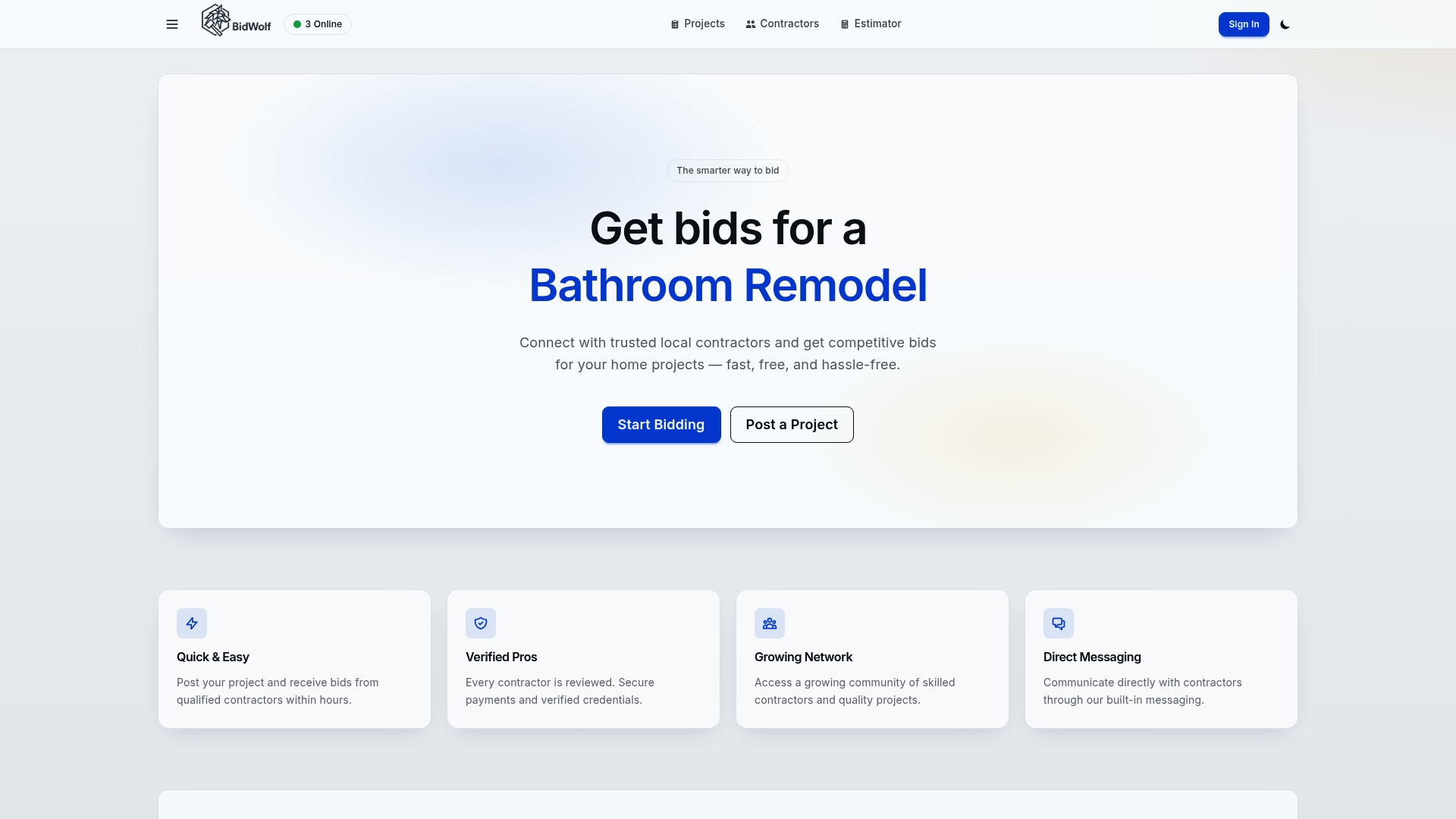
BidWolf gives Texas homeowners a structured way to post renovation projects with clear, consistent project descriptions that go to every contractor in the bid pool simultaneously. You get side-by-side bid comparisons from vetted, verified local contractors, all in one place. The platform’s built-in messaging keeps every conversation documented, so nothing important gets lost in a text thread or a verbal conversation. You can find local contractors across Texas who understand transparent bidding standards, request detailed scopes, and compare responses without chasing anyone down. Whether you are managing a bathroom remodel, a roofing replacement, or a full kitchen renovation, BidWolf helps you apply the compare contractor bids principles covered in this guide from your first project post to your final hiring decision.
Frequently asked questions
What does a transparent bidding process mean in home renovations?
It means all contractors receive the same detailed scope of work and submit comparable bids, making clear what is included, excluded, and assumed, so you can reduce surprises later. Transparent bidding requires that identical information go to every bidder to enable a true apples-to-apples comparison.
How does an open-book contract benefit homeowners?
It allows you to see actual invoices and costs during the project, promoting trust and enabling cost verification. Open-book contracts disclose line-item estimates monthly, which can capture material price savings of 5 to 15% over the course of a project.
Why is it important to have a written change order policy?
A written change order policy ensures any project change is documented, priced, and approved before work begins, protecting you from unexpected costs. Texas contracts require written change order procedures with owner approval timelines, which help reduce 20 to 40% of renovation budget overruns.
How many bids should I compare for a Texas home renovation?
You should compare at least three bids using a detailed checklist. Experts recommend at least 3 bids evaluated across scope completeness, allowances, contingency buffers, and change order policies.
What are common pitfalls homeowners face without transparent bidding?
The most common issues are scope creep, unexpected change orders, unrealistic allowances, upfront overpayments, and unpaid subcontractor liens. Low allowances and vague scopes typically drive 40% cost overruns through change orders, and without proof of sub payments, your property is at risk of a lien even after you have paid in full.
Recommended
- Top benefits of contractor bidding platforms for Texas homeowners | BidWolf Blog
- How Texas homeowners get the best landscaping bids | BidWolf Blog
- Contractor marketplaces: a complete guide for Texas homeowners | BidWolf Blog
- Streamline Project Bidding for Better Texas Home Renovations | BidWolf Blog