

Quick Response in Contracting: a Texas Homeowner's Guide

TL;DR:
- Quick response in contracting is essential because it determines which contractors win jobs and project timelines stay on schedule. Responding swiftly signals organization and capability, giving homeowners a competitive advantage and reducing delays. For optimal results, response times should match project complexity, with simple repairs receiving same-day replies and complex projects up to five days.
Quick response in contracting is the practice of promptly acknowledging and addressing Requests for Quotes (RFQs) or project proposals to secure work and keep renovations on schedule. In the industry, this concept is often called RFQ response time management, and it directly determines who wins the job. The first responder wins 78% of deals, according to 2026 data. That single fact defines the role of quick response in contracting better than any theory. For Texas homeowners and property managers, understanding this dynamic means the difference between a renovation that starts on time and one that drags on for weeks while you wait for a contractor to call back.
What is the role of quick response in contracting?
Response time in contracting is not just a courtesy. It is a measurable competitive signal that tells buyers whether a contractor is organized, capable, and serious about the work. Speed is both a revenue metric and a professionalism indicator, requiring what industry professionals call “smart speed,” which pairs automated workflows with clear accountability. For homeowners posting a bathroom remodel or roofing project, a contractor who responds within hours signals they have the capacity and systems to deliver.

The average business takes 47 hours to respond to a lead. That is nearly two full business days. In a Texas summer where a failed HVAC system or a leaking roof demands urgent attention, two days is not a delay. It is a lost opportunity for both the homeowner and the contractor. The contractor who responds in one hour captures the job. The one who responds on day two gets a voicemail saying the project is already awarded.
This is why timely response in agreements has become a core performance standard, not an afterthought. Contractors who treat response time as a priority build reputations that generate repeat business and referrals. Homeowners who understand this dynamic can use it to their advantage by actively favoring fast responders when evaluating bids.
What is the ideal response time, and how does project complexity affect it?
Response time targets are not one-size-fits-all. Contract manufacturing benchmarks response times by complexity: simple projects under two days, medium-complexity projects two to three days, and complex projects up to five days. These benchmarks translate directly to home renovation and maintenance contracting, where a simple fence repair differs significantly from a full kitchen remodel.
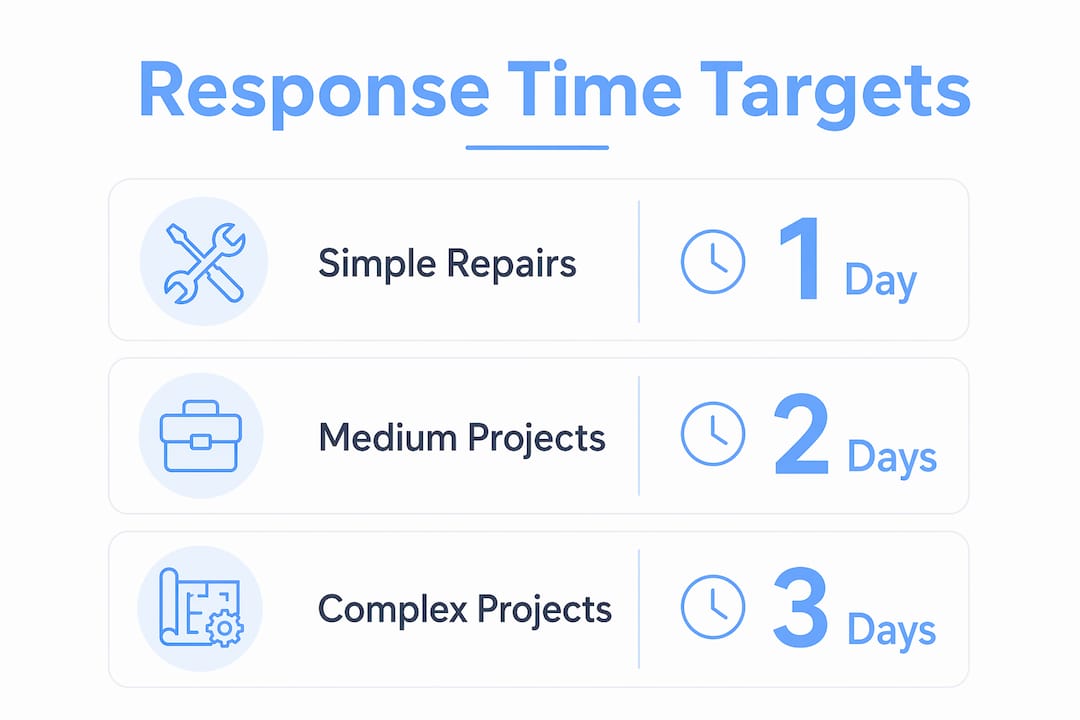
The table below shows how project type maps to realistic response time targets for Texas homeowners:
| Project type | Complexity level | Target response time |
|---|---|---|
| Minor repairs (faucet, drywall patch) | Simple | Under 24 hours |
| Bathroom remodel, flooring replacement | Medium | 2–3 days |
| Full kitchen renovation, roof replacement | Complex | 3–5 days |
| New addition, structural work | High complexity | Up to 5 days |
Efficient contractors maintain a sub-two-day average response by using automation. Tools like automated RFQ routing, pre-built estimate templates, and digital messaging platforms remove the manual delays that slow most contractors down. When a contractor uses these systems, they can acknowledge your project within minutes and follow up with a detailed quote within hours.
The speed advantage is dramatic. Companies responding within one hour are nearly 7 times more likely to qualify the opportunity than those who respond later. For homeowners, this means a contractor who calls back within the hour is not just eager. They are statistically more likely to be organized enough to complete your project on schedule.
Pro Tip: When posting a project, categorize it clearly by scope and urgency. A well-labeled project description helps contractors triage their queue and respond faster with accurate initial estimates.
How does quick response influence contracting success and buyer confidence?
Speed shapes perception before a single nail is driven. When a contractor responds to your RFQ within hours, you immediately form an impression: this person is on top of their business. That impression is not superficial. It reflects real operational capacity. A contractor who cannot manage their inbox is unlikely to manage your project timeline effectively.
The psychological effect of being first matters in active comparison scenarios. When you post a project and receive three bids, the contractor who responded first has already established a mental anchor. You evaluate the other bids against that first impression. This is why quick response time in contracting is a competitive advantage that compounds over time. Contractors who respond fast win more jobs, build stronger reputations, and attract better clients.
Here are the direct benefits of rapid response for Texas homeowners and property managers:
- Faster project starts. A contractor who responds quickly moves to scheduling faster, reducing the gap between your decision and the first day of work.
- Better pricing accuracy. Early engagement allows contractors to ask clarifying questions before submitting a bid, resulting in more accurate quotes and fewer change orders.
- Stronger trust. Responsiveness signals reliability. A contractor who is hard to reach before the job is awarded is likely harder to reach during the job.
- Reduced downtime. For property managers overseeing multiple units, a slow contractor response means longer vacancy periods and lost rental income.
- More competitive bids. When contractors know they are competing in a fast-moving marketplace, they sharpen their pricing to win quickly.
Slow responses carry real costs. A contractor who takes 48 hours to acknowledge your project may lose the bid entirely. Over time, that pattern means fewer jobs, weaker cash flow, and a reputation for being unresponsive. For homeowners, slow contractors create scheduling gaps that push renovation timelines out by weeks. Understanding how quick response affects contracting outcomes helps you filter your contractor list before you even read the bids.
What are the challenges of maintaining quick response without sacrificing quality?
Speed without quality is a liability. Rushing a contract review can introduce errors in scope, pricing, or legal terms that cost far more to fix than the time saved. Rushing without quality checks can lead to legal or financial liabilities, a risk that applies equally to contractors submitting bids and homeowners accepting them.
The biggest internal bottleneck in contracting speed is not the response itself. It is the routing delay between stakeholders. Internal contract routing causes 4–8 hours of downtime per handoff, making it the largest single drag on turnaround time. For a contractor with multiple team members reviewing bids, sequential routing means each person waits for the previous one to finish before they can start. Shifting to parallel reviews, where multiple stakeholders review simultaneously, cuts this delay significantly.
The table below compares common bottlenecks with practical solutions:
| Bottleneck | Impact | Solution |
|---|---|---|
| Sequential stakeholder routing | 4–8 hours lost per handoff | Parallel review processes |
| Missing project details from homeowner | Delays accurate quoting | Standardized project intake forms |
| Manual pricing calculations | Slows bid preparation | Pre-built estimate templates |
| Unclear approval authority | Bids stall waiting for sign-off | Predefined negotiation playbooks |
| Changing project requirements | Forces bid revisions | Scope lock before RFQ release |
Legal standards also shape what “quick” means in practice. Legal precedents emphasize reasonable response times, and procurement officers must allow sufficient logistical time for compliant responses. Demanding a full bid within one hour, especially when project requirements are still changing, is often deemed unreasonable. For Texas homeowners, this means setting realistic deadlines when you post a project. Giving contractors 24–48 hours to respond to a medium-complexity project is both fair and effective.
One proven tactic for maintaining momentum without sacrificing accuracy is the indicative estimate. Marked tentative quotes are a common practice in high-volume contracting. A contractor sends a rough range quickly to keep the buyer engaged, then follows up with a final detailed bid. This approach keeps the conversation alive without locking anyone into premature numbers.
Pro Tip: If a contractor sends you a preliminary estimate labeled “indicative” or “subject to site visit,” treat it as a positive sign. It means they are responsive and organized enough to manage the quoting process in stages.
Proactive contract design also reduces the need for emergency renegotiations. Contracts that anticipate disruptions, with clear risk allocation and flexible pricing terms, hold up better when conditions change. For property managers handling multiple renovation projects, building these terms into your standard agreements from the start saves significant time and money downstream.
How can Texas homeowners apply quick response principles to renovation projects?
Texas property owners face specific pressures that make response time especially critical. The state’s climate creates urgent repair needs, from storm damage to HVAC failures in extreme heat. The Texas construction market is active and competitive, meaning good contractors fill their schedules fast. If you are slow to respond to a bid or slow to post your project, you lose access to the best tradespeople.
Here are seven steps to apply quick response principles to your renovation and maintenance contracting:
- Post your project with complete details. Include scope, timeline, budget range, and any specific materials or permits required. Complete information gets faster, more accurate bids.
- Set a clear response deadline. Tell contractors when you expect bids. A 48-hour window for medium projects is reasonable and filters out contractors who are too busy to respond.
- Use a platform with built-in messaging. Direct communication with contractors through a single platform eliminates phone tag and keeps all project details in one place. Direct messaging with contractors has been shown to accelerate renovation timelines significantly.
- Review bids within 24 hours of receipt. Contractors who submitted quickly deserve a fast decision. Delayed decisions push your project start date back and signal to contractors that you are not a priority client.
- Ask clarifying questions immediately. If a bid is unclear, message the contractor the same day. Waiting a week to ask a question adds a week to your timeline.
- Narrow to two or three finalists quickly. Do not let the comparison phase drag on. Use price, response time, and verified credentials to make a fast shortlist.
- Confirm your selection in writing. A written confirmation, even a brief message, starts the contractor’s scheduling process immediately.
For property managers overseeing multiple units or commercial properties, coordinating bids across several projects at once requires a system. Platforms that allow you to manage multiple renovation bids in a single dashboard reduce the administrative load and help you track which contractors are responsive across projects.
Pro Tip: When hiring exterior contractors, check resources like exterior contractor hiring tips to understand what to look for beyond price, including licensing, insurance, and warranty terms specific to Texas weather conditions.
Texas also has specific licensing requirements for contractors in trades like electrical, plumbing, and HVAC. Verifying credentials before you respond to a bid is a non-negotiable step. A fast response from an unlicensed contractor is worse than a slow response from a licensed one. Use platforms that pre-verify contractor credentials so you can focus on speed and fit rather than background checks.
Key takeaways
Quick response in contracting is the single most reliable predictor of who wins the job and how smoothly the project runs from start to finish.
| Point | Details |
|---|---|
| First responder advantage | The contractor who responds first wins 78% of deals, making speed a direct revenue driver. |
| Complexity sets the benchmark | Simple repairs warrant same-day responses; complex renovations allow up to five days for accurate bids. |
| Internal routing is the biggest delay | Parallel review processes cut the 4–8 hour per-handoff bottleneck that slows most contractors down. |
| Indicative estimates maintain momentum | Sending a preliminary range quickly keeps buyers engaged while final pricing is completed. |
| Texas homeowners must respond fast too | Reviewing and confirming bids within 24 hours keeps good contractors available and projects on schedule. |
Why I think most homeowners underestimate their own role in response speed
Most articles about quick response in contracting focus entirely on the contractor. That framing misses half the equation. In my experience watching Texas homeowners navigate renovation projects, the biggest delays often come from the homeowner side, not the contractor.
You post a project, receive three bids within 48 hours, and then spend two weeks comparing them. By the time you make a decision, the contractor you wanted has filled their schedule with other jobs. The irony is that you selected for responsiveness in your contractors but did not apply the same standard to yourself.
The mindset shift I recommend is simple: treat your own response time as part of the project timeline. Every day you delay a decision is a day added to your renovation start date. The best contractors in Texas are busy. They do not wait. If you want access to them, you need to move at their pace.
Technology helps here more than most homeowners realize. Platforms that centralize bids, messaging, and project tracking remove the friction that causes decision delays. When everything is in one place, you spend less time hunting for information and more time making decisions. That is not a minor convenience. It is a structural advantage that directly affects your project outcome.
The other thing I have learned is that speed and quality are not opposites in contracting. The contractors who respond fastest are usually the most organized, and organized contractors deliver better work. Slow responders are often juggling too many projects, dealing with administrative chaos, or simply not prioritizing your job. Response time is a filter, not just a convenience metric. Use it as one.
— Devin
Get faster contractor responses with Bidwolf
Bidwolf connects Texas homeowners and property managers with vetted, local contractors who are ready to respond quickly to your renovation and maintenance projects.
When you post a project on Bidwolf, you receive competitive bids from license-verified contractors, communicate directly through built-in messaging, and track every bid in one place. The platform is built around the principle that fast, transparent communication produces better project outcomes. Whether you are managing a single bathroom remodel or coordinating repairs across multiple properties, Bidwolf gives you the tools to move quickly and confidently. Find local contractors in your area today, or post your project and start receiving bids from qualified Texas tradespeople.
FAQ
What is a quick response time in contracting?
A quick response time in contracting is typically under 24 hours for simple projects and two to three days for medium-complexity work. Companies that respond within one hour are nearly seven times more likely to win the opportunity than slower competitors.
Why does response speed matter when hiring a contractor?
Response speed signals a contractor’s organizational capacity and reliability. The first contractor to respond wins 78% of deals, which means fast responders are not just eager but statistically more likely to deliver on schedule.
How can homeowners speed up the contracting process?
Homeowners can accelerate contracting by posting complete project details, setting clear bid deadlines, and reviewing bids within 24 hours of receipt. Using a platform with built-in messaging and contractor selection guidance also reduces back-and-forth delays.
Is it risky to accept a fast bid without a full review?
Speed and quality are not mutually exclusive. Contractors often send indicative estimates quickly to maintain momentum, followed by a detailed final bid. Review the scope, licensing, and warranty terms carefully before accepting any bid, regardless of how fast it arrived.
What causes the most delays in contractor response times?
The largest bottleneck is internal routing, where bids or approvals pass sequentially between stakeholders, causing 4–8 hours of downtime per handoff. Contractors who use parallel review processes and pre-built templates respond significantly faster without sacrificing accuracy.