

Smart questions to ask Texas contractors before hiring

TL;DR:
- Hiring a licensed and insured contractor familiar with Texas-specific codes is crucial to protect your home investment.
- Asking detailed questions about project timelines, change order processes, permits, and technical expertise helps identify trustworthy professionals and avoid costly disputes.
Hiring a contractor in Texas is one of the most consequential decisions you can make as a homeowner. A poorly vetted contractor can turn a straightforward bathroom remodel into a months-long dispute, or worse, leave your home out of code with a lien on it. Texas has its own licensing rules, windstorm compliance requirements, and contract standards that make asking the right questions more important here than almost anywhere else in the country. This article gives you a practical, evidence-backed list of questions to ask before signing anything, so you can protect your investment and hire with confidence.
Table of Contents
- Key criteria before you start: Texas-specific musts
- Top questions to ask every contractor
- Technical and diagnostic questions for specialized trades
- Comparing answers: red flags, green lights, and Texas legal edge cases
- Why most homeowners underestimate the risk of contractor interviews
- Next steps: Secure your Texas home renovation with BidWolf
- Frequently asked questions
Key Takeaways
| Point | Details |
|---|---|
| Verify credentials | Always request licensing and insurance certificates before any project discussion. |
| Document all changes | Require written agreements for change orders to ensure clarity and legal compliance. |
| Assess diagnostics | Ask technical trades about their troubleshooting and verification processes. |
| Spot warning signs | Use comparison tables and checklists to recognize red flags in contractor responses. |
| Tap trusted platforms | Platforms like BidWolf streamline contractor vetting and project management for Texas homeowners. |
Key criteria before you start: Texas-specific musts
Before you sit down with a contractor and start asking about timelines or materials, there are a few non-negotiable boxes to check first. Texas does not require a general contractor’s license at the state level for all trades, but many trades do require specific licenses. Electricians, plumbers, HVAC technicians, and certain other specialists must carry state-issued licenses. Skipping this verification step is one of the most common and costly mistakes Texas homeowners make.
Start by confirming that your contractor holds the appropriate license for the specific work your project involves. A roofing company, for example, does not need a state contractor license, but an electrician absolutely does. If you are hiring for a project that mixes trades, you need to verify each trade separately. This can feel like a lot, but the Texas Department of Licensing and Regulation (TDLR) has a public license lookup tool that makes it straightforward.
Insurance verification is equally critical. Ask for current certificates of insurance, not just a verbal confirmation. Licensed and insured proof is one of the first things any reputable contractor will be ready to provide on request. You want to see two specific documents: a general liability certificate and a workers’ compensation certificate. General liability covers property damage if the contractor causes an accident. Workers’ compensation covers their crew if someone is injured on your property. Without both, you could be legally liable.
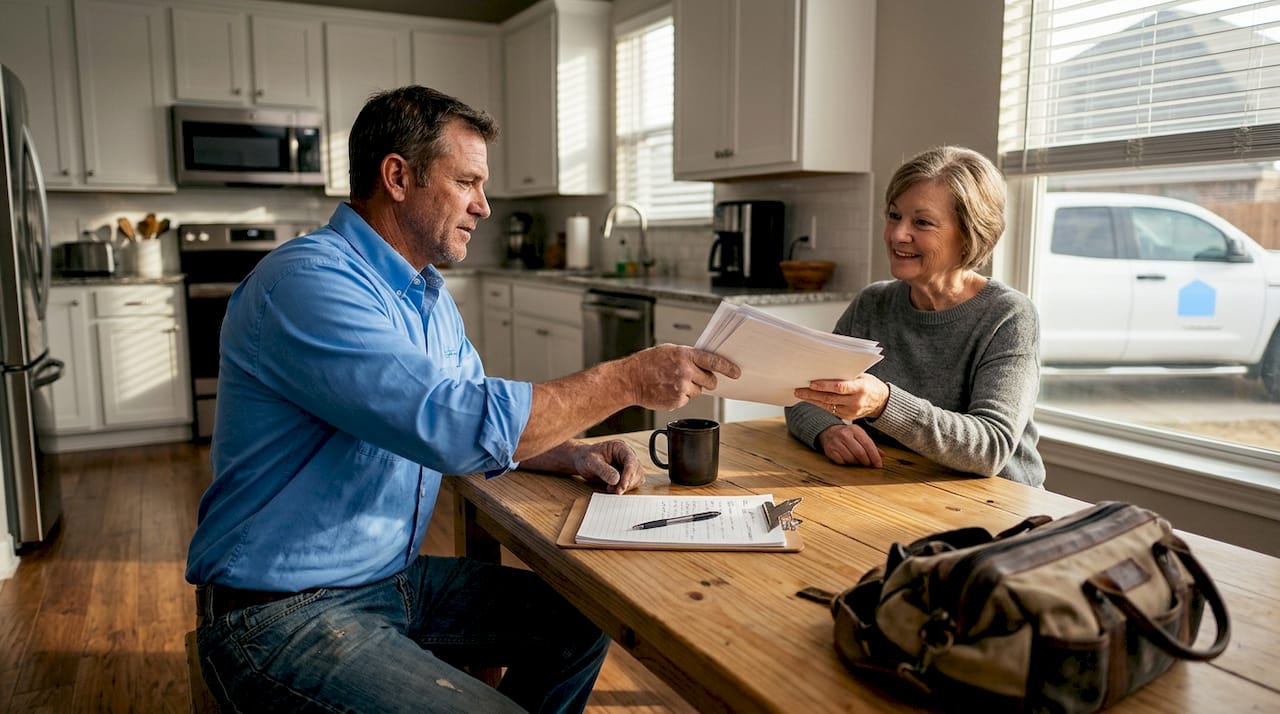
For coastal Texas homeowners, windstorm code compliance adds another layer. The Texas Department of Insurance (TDI) enforces windstorm building codes in designated areas, primarily along the Gulf Coast. If your project involves roofing, exterior walls, or structural work in a windstorm zone, your contractor must use TDI-approved products and follow specific installation protocols. Ask your contractor upfront whether they understand windstorm requirements for your county. Request documentation of compliance, including anything related to the WPI-8 form, which is the certificate of compliance required to maintain windstorm insurance eligibility.
Use this checklist as your starting point before any project discussion moves forward:
- Current general liability certificate with valid dates
- Current workers’ compensation certificate
- State trade license (plumbing, electrical, HVAC, etc.) if applicable
- Proof of windstorm code compliance knowledge for coastal projects
- Confirmation that the WPI-8 process is understood and managed
Pro Tip: Collect all certificates and licenses before your first full project conversation. If a contractor hesitates or cannot produce documents quickly, that tells you something important about how they run their business overall.
Using a Texas homeowner checklist can help you stay organized through this step. Knowing how to approach hiring contractors securely is also a smart foundation before you ever make your first call.
Top questions to ask every contractor
Once basic compliance is assured, dig deeper with core interview questions. These questions apply regardless of trade or project type. They are designed to reveal how a contractor manages their work, their clients, and unexpected problems. The answers will tell you far more than a glossy website or a stack of five-star reviews ever could.
Here are the essential questions to ask, in order of priority:
-
Are you licensed and insured for this specific type of work? This seems obvious after the previous section, but ask it again directly in conversation. You want to hear a confident, specific answer, not a vague “yes, of course.” Ask them to name the license type and issuing authority.
-
Can you walk me through your project timeline and what could affect it? A contractor who has done this kind of work before will give you a realistic breakdown. They will mention material lead times, permit wait times, and weather-related delays. A contractor who gives you a suspiciously tight or overly vague timeline is worth questioning further.
-
How do you handle change orders? This is one of the most important questions you can ask. Change orders and unexpected issues need to be documented and priced clearly before work continues. A change order is any modification to the original project scope, from a different tile selection to discovering rotted framing behind a wall. You need to know whether change orders are always written, how pricing is determined, and who authorizes the change before labor or materials cost you extra.
-
What is your payment schedule? A fair payment schedule typically involves an upfront deposit of no more than 10 to 30 percent, followed by milestone-based payments, with a final payment held until the project is complete. Any contractor who asks for more than 50 percent upfront before work begins is a warning sign worth taking seriously.
-
Who will actually be doing the work? Some contractors operate as project managers and subcontract all the physical labor. That is not always a problem, but you deserve to know who will be in your home and whether those subcontractors are also licensed and insured.
-
Can you provide three recent references from similar projects? Recent means within the last twelve months. Similar means the same type and scale of work. Always follow up with those references. Ask them specifically whether the project finished on time, on budget, and whether the contractor communicated well throughout.
-
What permits will this project require, and who pulls them? Your contractor should always pull required permits in their name, not yours. If a contractor suggests skipping permits to save time or money, walk away. Unpermitted work creates problems when you sell your home and can void your homeowner’s insurance.
“Asking how a contractor handles unexpected discoveries, like finding water damage or outdated wiring mid-project, tells you more about their professionalism than almost any other question. Their process for communication and pricing at that moment defines whether you can trust them with your home.”
Pro Tip: Always ask how change order documentation is handled in writing, not just verbally. A contractor who says “we handle it as we go” has no system. A contractor who explains a written change order process with client approval before work proceeds has a system worth trusting.
Knowing how to compare contractor bids across multiple respondents is a skill that will save you money and frustration. Learning to communicate with contractors effectively throughout the project is just as important as choosing the right one.
Technical and diagnostic questions for specialized trades
For projects involving specialized trades, it is even more important to probe technical capabilities. General questions about timeline and references are a starting point, but if you are hiring an HVAC technician, a plumber, or an electrical contractor, you need to go deeper. The technical quality of their work is harder to evaluate after the fact, which means asking the right questions upfront is your primary protection.
For HVAC work, the key issue is diagnostic approach. Any technician can replace a broken part. But a skilled technician diagnoses the root cause first, then verifies that the fix actually resolved the problem. For HVAC diagnostic approach, contractors should explain not just what they will repair, but how they will confirm the repair worked. Ask these specific questions:
- How do you diagnose a problem before recommending a repair?
- What tools or measurements do you use to verify the system is working correctly after the repair?
- Can you give me an example of a time you found a different root cause than what was initially suspected?
That last question is particularly revealing. A contractor with genuine diagnostic experience will have a ready example. One who just swaps parts until something works will struggle to answer it clearly.
For plumbing projects, ask about their process for locating leaks or clogs before tearing into walls. Modern plumbers use camera inspection tools that can identify problems precisely, reducing unnecessary damage to your home. Ask whether they use camera inspection, and if so, whether you can see the footage.
For electrical work, ask how they verify circuit integrity after completing a job. A licensed electrician should be testing circuits, checking load calculations, and confirming that everything meets current National Electrical Code (NEC) standards. Texas follows the NEC, and any electrician who is unfamiliar with the current version should be questioned further.
“The question that separates average tradespeople from excellent ones is: how do you know the repair worked? If they cannot give you a specific, measurable answer, they are guessing.”
Use the responses to these technical questions as a quality filter. A contractor who explains their diagnostic process with confidence and specificity has done this work many times. Reviewing winning contractor bid examples can help you understand what thorough, qualified responses look like in practice.
For specialty work like HVAC or mechanical systems, ask whether the contractor performs a post-completion walkthrough with you to explain what was done and how to maintain it. This is a mark of professionalism that separates contractors who care about long-term relationships from those who are simply moving on to the next job.
Comparing answers: red flags, green lights, and Texas legal edge cases
Gathering responses is half the battle. Now you need to evaluate and compare them side by side. This is where structured comparison becomes your best tool.
| Question topic | Red flag response | Green light response |
|---|---|---|
| Licensing and insurance | “We’re covered, don’t worry about it” | Provides current certificates immediately |
| Change orders | “We handle it as we go” | Written change orders with client sign-off required |
| Payment schedule | Requests 50%+ upfront | Milestone-based, final payment on completion |
| Permits | “We can skip permits to save time” | Pulls permits in their name as standard practice |
| References | Cannot provide recent references | Gives three contacts from similar projects |
| Windstorm compliance | Unfamiliar with WPI-8 | Can explain the WPI-8 process and documentation |
| Subcontractors | Vague about who will be on site | Names subcontractors and confirms their credentials |
Beyond the table, here are the most common warning signs to watch for during your conversations:
- Pressure to sign quickly or accept a verbal agreement
- Reluctance to provide a written, itemized estimate
- No physical address or permanent business presence
- Unusually low bids that seem disconnected from realistic material costs
- Requests for payment in cash only
Green light indicators include a contractor who brings documentation to your first meeting without being asked, who asks clarifying questions about your project rather than immediately quoting a price, and who mentions the permit process without you bringing it up first.
For Texas-specific edge cases, the windstorm compliance checklist from the Texas Department of Insurance is an authoritative resource. Key items to verify with your contractor include whether windstorm-approved products are being used, how inspections will be coordinated with TDI, and who holds the WPI-8 documentation once the project is complete. In some cases, homeowners have lost windstorm insurance eligibility because their contractor used non-approved materials or skipped required inspections. The financial consequences of that mistake can be severe.
Direct, fast messaging with contractors throughout the evaluation process helps you document responses and keep a clear record of what each contractor committed to before the contract was signed.
Why most homeowners underestimate the risk of contractor interviews
Here is something that does not get said enough: most homeowners treat the contractor interview as a formality. They have already made a gut decision based on a recommendation or a review site rating, and the questions feel like a checkbox exercise. This is one of the most expensive mistakes you can make.
The interview is not a formality. It is the moment where project success or failure is actually determined. A missed question about change order documentation, for example, can turn a $15,000 kitchen remodel into a $22,000 legal dispute. This happens more often than most homeowners realize, and it happens to careful, educated people who simply did not know what to ask.
We have seen this play out in real Texas projects. A Houston homeowner hired a well-reviewed contractor for a roof replacement after a storm. The contract was clear about the base scope. But when the crew discovered damaged decking underneath, the contractor replaced it without a signed change order and added $4,200 to the final invoice. The homeowner had no documented agreement to point to and ultimately paid the full amount rather than risk a lien on the property.
The fix was simple. One question asked upfront, “How do you handle change orders in writing?” combined with a contract requirement for client sign-off before any additional work, would have prevented the entire situation. As contract change order provisions make clear, requiring that all changes follow documented amendment processes is essential to reducing ambiguity and protecting both parties.
Pro Tip: Document every change to your project, even minor ones. A quick written confirmation via text or email creates a paper trail that protects you without requiring a formal signed amendment for every small decision.
The right questions do more than protect you legally. They signal to contractors that you are an informed client. Contractors know that informed clients lead to cleaner projects. When you ask specific, structured questions, you attract contractors who prefer that kind of clarity and filter out those who rely on ambiguity to increase their margins.
Learning to use online platforms for renovation projects adds another layer of protection, because documented communication and verified credentials become part of the process by default.
Next steps: Secure your Texas home renovation with BidWolf
With the right questions in mind, the next move is finding the best contractors and organizing your project for success.
BidWolf makes that process straightforward for Texas homeowners. When you post your project on the platform, you receive competitive bids from license-verified local contractors who understand Texas compliance requirements, including windstorm codes, trade licensing, and permit processes. You do not have to cold-call businesses or wonder whether a contractor is legitimate.
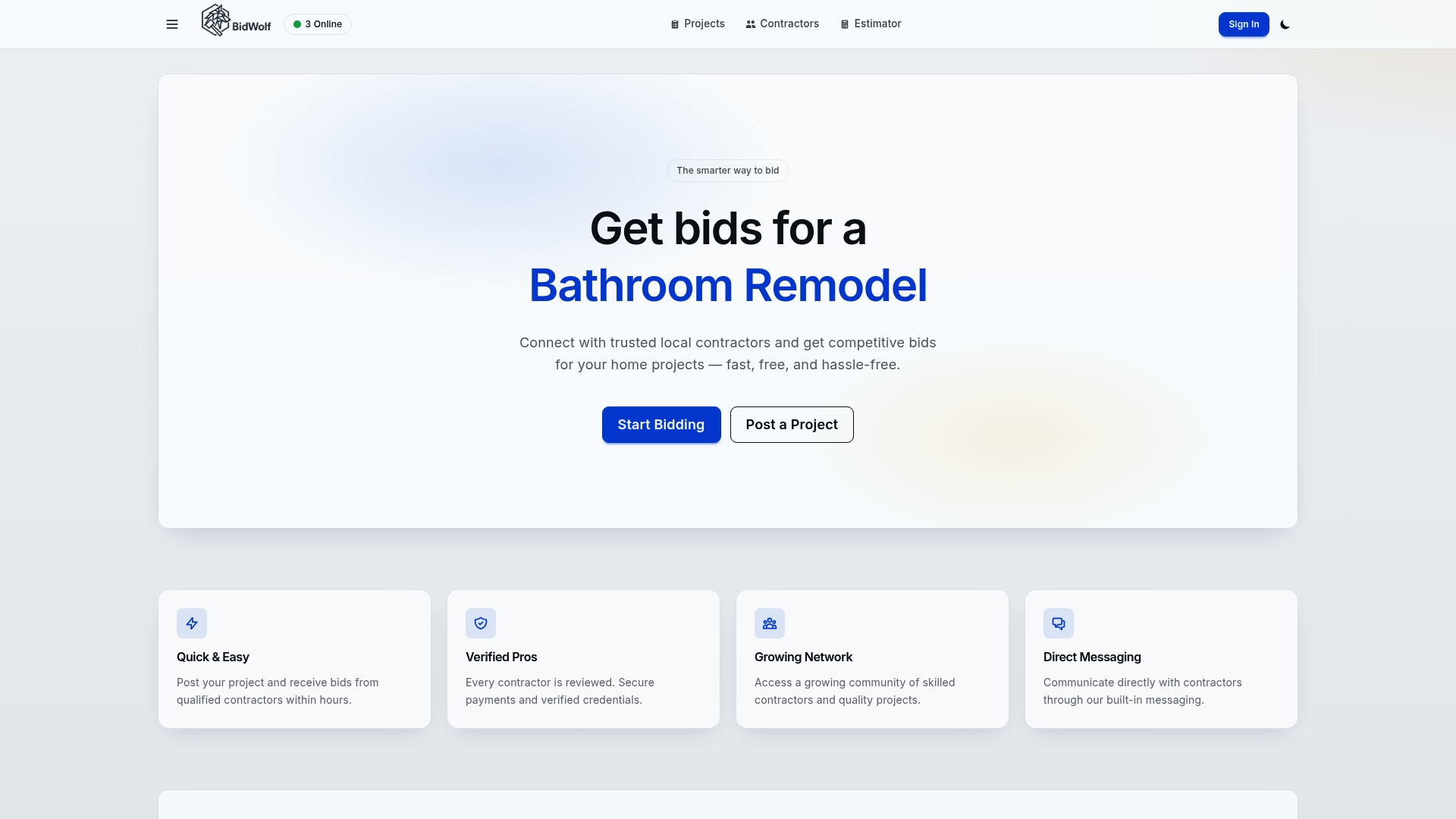
The BidWolf platform includes built-in messaging so every conversation with a contractor is documented in one place, making it easy to compare answers to your key interview questions side by side. Payments are handled securely, and the bid comparison tools let you evaluate not just price but scope, timeline, and contractor credentials all at once. Browse local contractors in your area today and start collecting bids from professionals who are ready to earn your business.
Frequently asked questions
Do I need to verify windstorm compliance for my home project in Texas?
Yes, for coastal areas or roofing projects, you must confirm windstorm compliance and secure related documents with your contractor. The WPI-8 compliance process is required to maintain windstorm insurance eligibility, and using non-approved materials can void your coverage.
What proof of insurance should a Texas contractor provide?
Texas contractors should show current certificates for general liability and workers’ compensation insurance before starting your project. Licensed and insured proof is a baseline expectation for any reputable professional, and both documents need to show valid, current dates.
How should change orders be handled according to Texas contract law?
All change orders must be recorded in writing and follow the contract’s amendment provisions to avoid ambiguity. Documented change order agreements protect both homeowners and contractors by creating a clear record of what was agreed before additional work begins.
Should I ask technical questions if my project involves HVAC or mechanical work?
Yes, ask contractors to explain their diagnostic approach and how they verify solutions to ensure quality repairs. For HVAC diagnostic verification, a qualified technician should be able to describe the specific tools and measurements they use to confirm the repair was successful.