

Efficient workflow for managing multiple renovation bids

TL;DR:
- Managing multiple renovation bids in Texas requires clear scopes, organized tracking, and verifying contractor credentials to prevent costly mistakes. Using consistent documents, normalization of bids, and structured comparison tools ensures informed decisions and successful projects. Leveraging dedicated platforms like BidWolf streamlines bid collection, communication, and project management across multiple renovations.
Juggling three, four, or even five renovation projects at the same time is genuinely stressful. Contractors quote different formats, materials, and payment terms, and it quickly becomes difficult to know whether you’re comparing fair numbers or getting misled by a suspiciously low price. Texas homeowners face an extra layer of complexity because licensing rules, permit requirements, and local regulations vary by city and county. This article walks you through a proven, step-by-step workflow for collecting, organizing, and comparing contractor bids so that every renovation decision you make is informed, documented, and protected. As a best practice, detailed written bids should come from at least three to five licensed, insured contractors using an identical written scope of work.
Table of Contents
- What you need before collecting bids
- Step-by-step workflow for collecting and organizing bids
- How to compare contractor bids effectively
- Beware of pitfalls: Common bid mistakes and how to avoid them
- Tips for tracking bids across multiple renovation projects
- Common myths and what actually works with bid management
- Streamline your bidding workflow with BidWolf
- Frequently asked questions
Key Takeaways
| Point | Details |
|---|---|
| Prepare detailed scopes | Always start with a written scope of work and gather all documents before requesting bids. |
| Normalize all bids | Use spreadsheets or comparison matrices to ensure apples-to-apples evaluation of every contractor proposal. |
| Avoid low-ball offers | Be wary of bids that are much lower than the rest—they often hide extra costs or risks. |
| Track every detail | Centralize your bid documentation and communications in one place to avoid confusion across projects. |
| Prioritize documentation over price | A mid-range bid with clear details generally offers better value and fewer headaches than the lowest quote. |
What you need before collecting bids
Good bid management starts before any contractor ever sees your project. The single biggest mistake homeowners make is reaching out to contractors without a clear, written scope of work (SOW). When each contractor interprets the project differently, the bids they return are impossible to compare fairly. You end up selecting a number rather than selecting the right professional.
Build your scope of work template
A scope of work is a written document that describes exactly what you need done. It should cover the specific areas involved, the materials you expect, design specifications, a target timeline, permit responsibilities, and any exclusions or work you are handling yourself. When every contractor receives the same document, their bids reflect the same set of expectations. That is the foundation of an honest comparison.
For multiple projects, create a separate SOW for each one. Label them clearly, version-control them (SOW v1, SOW v2), and keep them in a shared folder you can access from your phone or laptop. This discipline pays off enormously when you are tracking five projects with fifteen total bids.
Understand Texas-specific contractor requirements
Texas does not have a single statewide contractor license that covers all trades. Instead, licensing and registration requirements vary by trade and locality. Texas contractor requirements include verifying TDLR (Texas Department of Licensing and Regulation) licenses or registrations for applicable trades, confirming current insurance coverage, and checking whether permits are required for your specific renovation. In Dallas, Houston, Austin, and San Antonio, permit requirements for structural, electrical, and plumbing work are strictly enforced. Skipping this verification step can expose you to fines, failed inspections, and liability if a worker is injured on your property.
Use our Texas contractor checklist to confirm credentials before you invite anyone to bid. It is also worth reviewing guidance on how to hire contractors securely in Texas to avoid common fraud risks.
Documents to prepare before you collect bids
Here is a summary of what to have ready:
- Written scope of work for each project, using consistent formatting
- Material specifications listing preferred brands, grades, or finishes where relevant
- Site access information including parking, entry points, and working hours
- Insurance and license verification forms requesting current certificates from each contractor
- A bid submission deadline so all quotes arrive in the same window for fair comparison
| Document | Why it matters | Format |
|---|---|---|
| Scope of work | Ensures apples-to-apples bids | PDF or printed document |
| Material specs | Prevents substitutions | Attached list or schedule |
| Insurance request form | Confirms coverage before work starts | Signed certificate |
| Permit responsibility note | Clarifies who pulls permits | Included in SOW |
| Bid deadline notice | Keeps the process organized | Email or project portal |
Pro Tip: Add a line to your SOW stating that any bid that does not address every item in the document will not be considered. This filters out contractors who skim and quote low to win the job, then charge extra later.
Step-by-step workflow for collecting and organizing bids
Once your preparation is complete, you are ready to run a structured bidding process. The goal is to collect enough bids to see a realistic price range and identify outliers, then organize that information so you can make a confident decision.
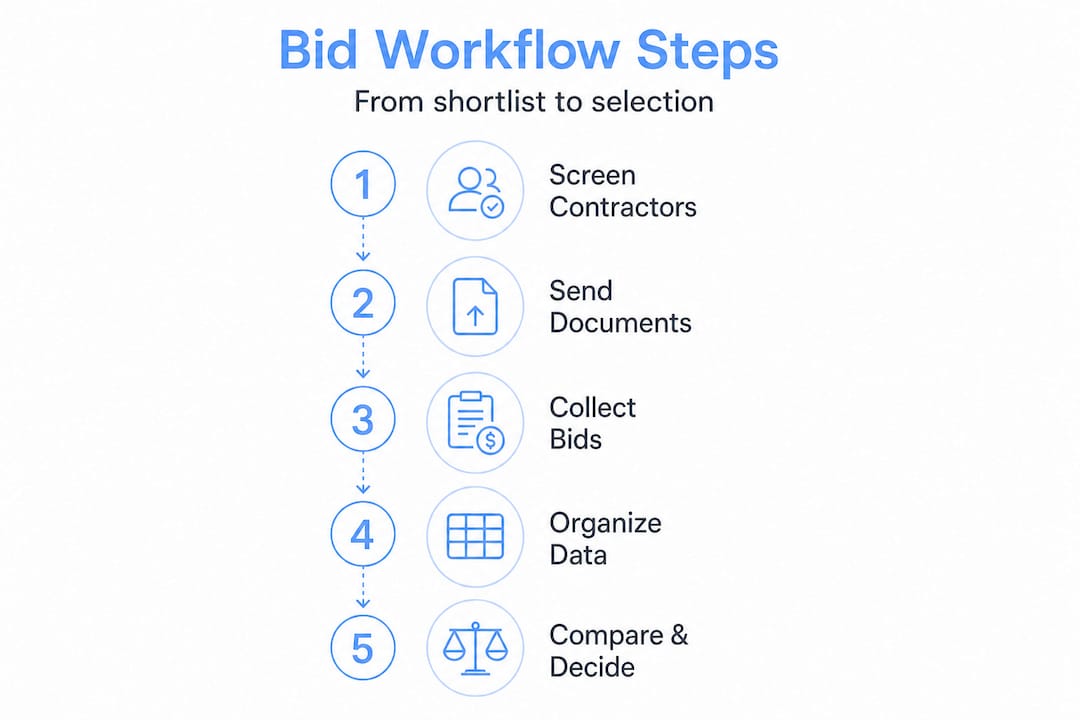
The recommended process
-
Identify and vet at least three contractors per project. Check TDLR registration, request certificates of insurance, and review verified reviews. For Texas projects, collecting 3-5 written bids from licensed, insured contractors is the industry-standard starting point.
-
Send the identical SOW to every contractor on your list. Deliver it by email or through a project platform so you have a timestamped record. Include a firm bid submission deadline, typically 5 to 10 business days out.
-
Request line-item written bids. Ask each contractor to break down their quote into labor, materials, permits, and any subcontracted work. Bids that arrive as a single lump sum are very difficult to evaluate and often hide omissions.
-
Log all incoming bids in a centralized tracking sheet. Create a tab for each project. Each row should represent a line item from the SOW. Each column represents a different contractor. Fill in the numbers as bids arrive.
-
Normalize the bids for comparison. This is the critical step most homeowners skip. Normalizing means adjusting figures so that all bids reflect the same scope. If Contractor A included permits and Contractor B did not, add the estimated permit cost to Contractor B’s total before comparing. If Contractor C used a lower-grade material, note the upgrade cost needed. A side-by-side spreadsheet listing all line items, allowances, and exclusions is the most effective tool for this step.
-
Follow up with clarifying questions. Use your spreadsheet gaps to guide conversations. Ask contractors to explain any line items that are vague or missing. Document their answers in writing.
-
Schedule brief interviews or site visits. For larger projects, meet each finalist in person or via video call. This helps you assess communication style, which matters when you are managing a long project remotely.
To see examples of what strong contractor bids look like, review some winning bid examples as a reference before you start collecting.
| Step | Action | Output |
|---|---|---|
| Step 1 | Vet at least three contractors | Verified contractor shortlist |
| Step 2 | Send identical SOW to all | Timestamped delivery records |
| Step 3 | Collect line-item bids | Written, detailed quotes |
| Step 4 | Enter bids into tracking sheet | Centralized data file |
| Step 5 | Normalize bids | Adjusted, comparable totals |
| Step 6 | Follow up on gaps | Written clarifications |
| Step 7 | Interview finalists | Notes on professionalism and fit |
Pro Tip: Set a shared deadline for all bids on a given project, then resist extending it unless there is a clear reason. Contractors who miss your deadline without communication are showing you something important about how they will handle your project timeline.
How to compare contractor bids effectively
With bids neatly organized, the next challenge is to make an informed, fair comparison among your options. Organized bids are only useful if you know what to look for when analyzing them. A number on its own tells you very little. The details around that number tell you almost everything.

What to look at in every bid
When you compare contractor bids for your Texas projects, check each of the following items carefully:
- Scope coverage: Does the bid address every item in your SOW? Any missing item is a potential future change order, which is an additional charge added after work begins.
- Material specifications: Did the contractor specify the brand, grade, and quantity of materials? Vague language like “standard tile” or “quality lumber” opens the door for substitutions.
- Labor type: Is the work being done by the contractor’s own employees, or will it be subcontracted? Subcontracted work is not automatically bad, but you should know about it and verify that subcontractors are also licensed and insured.
- Permit responsibility: Who is pulling the permits? The permit holder is legally responsible for ensuring the work meets code, so this matters.
- Payment schedule: How and when is money changing hands? Milestone-based schedules tied to project phases protect you far better than large upfront lump-sum demands.
- Warranty terms: What does the contractor guarantee, for how long, and in writing?
The most effective way to visualize all of this is a comparison matrix. A matrix lists all evaluation criteria on one axis and all bidding contractors on the other, so you can see gaps and strengths across all options at once.
According to benchmarking data, collecting 3-4 bids saves homeowners 12 to 18 percent compared to going with a single contractor. That is a meaningful saving on a $40,000 bathroom remodel or a $90,000 kitchen renovation. The same data shows that bids priced more than 30 percent below competitors lead to disputes in about 40 percent of cases.
“Normalize bids by scope of work, line-item breakdowns, allowances, exclusions, timelines, payment schedules, warranties, and licensing and insurance verification before making any final comparison.” National Home Repair Authority
For teams managing commercial or larger residential portfolios, home services software tools can automate parts of the normalization and tracking process, reducing manual data entry across multiple concurrent bids.
Beware of pitfalls: Common bid mistakes and how to avoid them
While comparison tools help, Texas homeowners need to stay vigilant for frequent pitfalls during the selection process. These mistakes are common, costly, and largely preventable.
Choosing based on price alone
The lowest bid is often the most dangerous choice. Low bids frequently omit scope items, use below-standard materials, or rely on unlicensed labor. A contractor who wins your business with a suspiciously low number often recoups the difference through change orders once work has started and you are committed. By that point, stopping the project is even more expensive than paying the extras.
A mid-range bid that addresses every line in your SOW and comes with full documentation is almost always a better value than the cheapest number you receive.
Accepting vague contract language
Before you sign anything, read the full contract carefully. Every material, timeline commitment, and warranty should be written in plain language. If the contract says “work will be completed in a reasonable time,” that is not an enforceable deadline. Push for specific calendar dates tied to project milestones.
Watch out for these common contract problems:
- Ambiguous scope descriptions that allow broad interpretation
- No specified material brands or grades, allowing substitutions
- Missing exclusions list, which leaves it unclear what is not covered
- No change-order process, meaning cost overruns are handled informally
- Vague warranty language that does not specify duration or what is covered
Paying too much upfront
“Sound payment practice means no more than 10 to 15 percent upfront, milestone-based disbursements tied to completed work phases, and a final holdback of 10 to 15 percent until all punch-list items are resolved.” Build-Folio contractor guide
Any contractor demanding 40 to 50 percent upfront before a single tool hits your property is raising a serious warning sign. Upfront payments give contractors leverage and remove your ability to withhold funds if work falls short. Stick to milestone-based payment schedules tied to documented progress.
Skipping license and insurance verification
In Texas, unlicensed and underinsured contractors create real legal and financial exposure for homeowners. If a worker is injured on your property and the contractor carries no workers’ compensation insurance, you could be liable. Always request current certificates of insurance and verify TDLR credentials before signing any agreement.
Tips for tracking bids across multiple renovation projects
After understanding pitfalls, focus on streamlining the workflow for multiple, overlapping renovation projects. Managing bids for a single project is manageable with a simple spreadsheet. Managing bids for three, four, or five simultaneous renovations requires a more structured system. Here is how to stay in control.
Build a centralized bid tracking system
-
Create a master project folder with subfolders for each renovation. Label them clearly: “Kitchen Remodel,” “Roof Replacement,” “Bathroom Addition.” Inside each folder, store the SOW, all received bids, contractor credentials, and communication records.
-
Use a bid tracking spreadsheet with one tab per project. Tracking spreadsheets for multiple projects should include the contractor name, bid amount, bid submission date, key inclusions and exclusions, status (pending, under review, selected, rejected), and follow-up action items.
-
Assign a bid status label to every quote. Categories like “received,” “under review,” “awaiting clarification,” “finalist,” and “declined” let you see the state of each project at a glance without digging through files.
-
Log every communication. Every phone call, email, or message exchange with a contractor should be summarized in your tracking sheet. If a contractor verbally agrees to a change in scope, follow up in writing immediately. Verbal agreements are nearly impossible to enforce.
-
Set calendar reminders for key dates. Bid submission deadlines, permit application windows, and contract signing dates all need calendar entries. Missing a deadline on one project can create a domino effect across other projects you are managing in parallel.
-
Share your comparison sheets with co-decision-makers. If your partner, property manager, or HOA board needs to weigh in, give them direct access to the organized comparison files rather than forwarding long email threads. Shared access reduces back-and-forth and speeds up decisions.
-
Leverage digital platforms built for contractor management. Contractor bidding platforms designed for Texas homeowners consolidate bid collection, contractor communication, and comparison tools in one place, eliminating the need to build and maintain complex spreadsheets from scratch.
Pro Tip: Do a weekly five-minute review of your master tracker. Check bid statuses, flag overdue responses, and confirm that no project has stalled while you were focused on another. This habit prevents small delays from becoming expensive project gaps.
Common myths and what actually works with bid management
To wrap up, let us challenge a few pervasive bidding myths with a dose of real-world experience in the Texas renovation market.
Myth 1: The lowest bid saves the most money. This is the most dangerous misconception in contractor selection. The lowest number rarely reflects the full cost of completing your project correctly. What it usually reflects is missing scope, cheaper materials, or labor that cuts corners under budget pressure. The actual savings from choosing the lowest bid often disappear in the first round of change orders. The homeowners we see come out ahead financially are the ones who selected a mid-range bid with full documentation, covering every item in the written SOW, rather than the number that looked best at first glance.
Myth 2: More bids always mean better outcomes. Collecting ten bids sounds thorough, but it actually creates noise. Beyond five bids, the additional data rarely changes your decision, and managing the communications burden adds real time cost to the process. Three to five bids from vetted, licensed contractors is the right range. Quality of bids matters more than quantity.
Myth 3: You can negotiate the same deal without a written SOW. Verbal agreements and loosely scoped bids are how renovation disputes begin. The written SOW is not just a formality. It is your primary legal and practical protection. Homeowners who invest time in a thorough, consistent SOW template find that their streamlined bidding process produces bids that are genuinely comparable, negotiations that are shorter, and projects that finish closer to the quoted price.
Myth 4: Price is the most objective measure. In reality, documentation quality is a better predictor of project success. A contractor who submits a detailed, line-item bid with clear material specs, a realistic timeline, permit notes, and a milestone payment schedule is demonstrating the same level of organization they will bring to your project. A contractor who sends a one-paragraph quote with a single number is showing you how they plan to communicate when problems arise.
Smart homeowners treat the entire bid workflow as a risk management process, not just a price comparison. The upfront investment in preparation, documentation, and structured evaluation consistently reduces costly surprises on the back end.
Streamline your bidding workflow with BidWolf
Ready to put these strategies into action? Managing multiple renovation bids across Texas does not have to mean juggling spreadsheets, chasing contractors for clarifications, and verifying credentials one by one. BidWolf brings the entire process into a single, organized workspace designed specifically for homeowners like you.
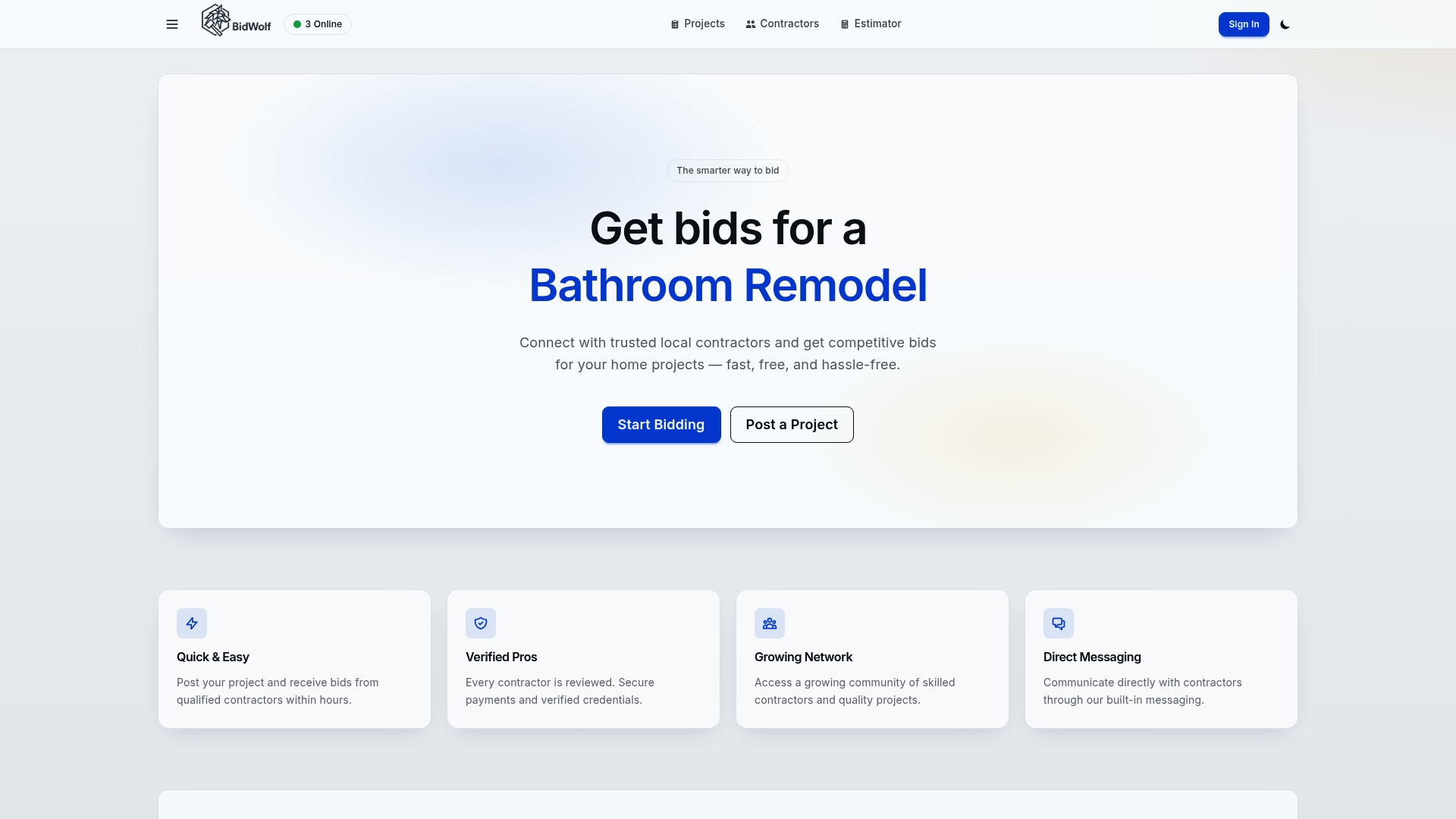
When you manage projects through BidWolf, you post your scope of work once and receive competitive bids from our network of vetted, license-verified local contractors. You can find local contractors across multiple Texas cities, compare bids side by side using built-in tools, and communicate directly with every bidder through our secure messaging system. Not sure what your project should cost before bids come in? Use our project cost estimator to set a realistic baseline. From bathroom remodels to roofing and electrical work, BidWolf gives you the structure and confidence to make the right hire every time.
Frequently asked questions
How many contractor bids should I collect for a Texas remodel?
Aim for at least three to five detailed, written bids from licensed contractors to get a reliable price range. Three to five written bids using an identical scope of work is the industry-recommended standard.
What is the safest payment schedule when hiring a contractor?
Never pay more than 10 to 15 percent upfront, and structure the rest as milestone-based payments tied to completed project phases, with a final holdback until all work is finished and inspected.
How can I be sure contractor bids are comparable?
Send every contractor the same written scope of work, then use a side-by-side spreadsheet listing all line items, allowances, and exclusions to normalize the figures before comparing totals.
Why should I avoid the lowest contractor bid?
Bids priced more than 30 percent below the others frequently lead to disputes in roughly 40 percent of cases, often due to missing scope, substandard materials, or unlicensed labor.
What is the best way to keep track of bids across multiple renovations?
Use bid tracking spreadsheets or software to organize contractor names, bid amounts, statuses, and deadlines for every active project in one centralized location.