

Winning contractor bid examples: secure quality projects in Texas

TL;DR:
- A winning contractor bid is detailed, transparent, and includes licensing and insurance proof.
- Low bids often exclude scope items, permits, or contingencies, leading to hidden costs.
- Homeowners should prioritize documentation, clear scope, and reliability over the lowest price.
Sorting through a stack of contractor bids for your Texas home project can feel overwhelming. Prices vary wildly, proposals look nothing alike, and one wrong choice can cost you thousands in rework, delays, or unfinished work. The temptation to simply pick the lowest number is real, but experienced Texas homeowners know that the cheapest bid rarely delivers the best outcome. A truly winning bid tells a complete story: it shows exactly what you are paying for, proves the contractor is licensed and insured, and accounts for the unexpected. This guide walks you through the specific criteria and real-world examples that separate quality contractor bids from the rest, so you can make a confident, informed decision on your next project.
Table of Contents
- Key criteria that define winning contractor bids
- Example 1: Transparent line-item bid for a kitchen remodel
- Example 2: Winning bid through insurance and compliance
- Example 3: Edge cases—bid strategies for older homes and complex projects
- Head-to-head comparison: What separates winning bids from the rest
- Why most homeowners overlook the real signs of a winning bid
- Find winning contractors for your Texas home project
- Frequently asked questions
Key Takeaways
| Point | Details |
|---|---|
| Transparency is essential | Clear line-item bids help you compare offers and prevent costly surprises. |
| Value outweighs lowest price | Winning bids balance cost with experience, compliance, and reliability. |
| Insurance boosts trust | Fully insured contractors win more jobs and protect your home investment. |
| Account for contingencies | Older or complex projects should always build in a contingency fund. |
Key criteria that define winning contractor bids
Before you can evaluate any bid, you need a clear framework. Many Texas homeowners make the mistake of treating a bid like a price tag on a store shelf, picking the lowest number and moving on. That approach ignores everything that actually determines whether a project succeeds.
The myth of the lowest bid
The idea that the lowest bid automatically wins is one of the most persistent misconceptions in home improvement. In practice, lowest bid does not always win; best value is selected based on experience, reliability, and compliance, even on public projects that bypass low bids for better qualifications. The same principle applies to your home. A contractor bidding $8,000 for a bathroom remodel may have excluded tile work, permits, and debris removal, while a $10,500 bid covers all of it. You are not comparing the same thing.
What actually defines a winning bid
A winning bid consistently demonstrates these qualities:
- Detailed cost breakdown: Every line item is listed separately, including materials, labor, permits, and cleanup.
- Clear scope of work: The bid specifies exactly what is and is not included, with no ambiguous language.
- Insurance and licensing documentation: Proof of general liability insurance and Texas contractor licensing is attached or readily available.
- Timeline and milestones: Start and end dates are stated, along with key project milestones.
- Contingency allowance: A realistic buffer (typically 5 to 10%) is included for unexpected conditions.
- References and past performance: The contractor provides verifiable references from similar Texas projects.
- Payment schedule: Payments are tied to completed milestones, not arbitrary dates.
“A bid without a detailed breakdown is just a guess with a dollar sign on it. You deserve to know exactly where every dollar goes before you sign anything.”
Transparency and detail build trust
When a contractor takes the time to list every cost separately, it signals professionalism and accountability. It also makes comparison much easier. You can see at a glance whether one contractor is using higher-grade materials or charging more for labor. Vague lump-sum bids make it impossible to hold a contractor accountable if something goes wrong mid-project.
Insurance and licensing as non-negotiables
In Texas, contractors working on residential projects are expected to carry general liability insurance and, depending on the trade, specific licenses. Electrical and plumbing contractors must be licensed by the state. Roofing contractors are not required to hold a state license, but many reputable ones carry additional certifications. Always ask for a certificate of insurance before signing any contract.
Pro Tip: Always request line-item bids and verify that any amendments or scope changes are documented in writing before work begins. A verbal agreement about adding a window or changing tile mid-project can become a costly dispute without written confirmation.
Example 1: Transparent line-item bid for a kitchen remodel
Now that you know what to look for, let’s see how these criteria play out in a real-life Texas kitchen remodel bid.
A homeowner in the Dallas area received three bids for a full kitchen remodel: new cabinets, countertops, appliances, flooring, and electrical updates. Two bids came in as lump sums with minimal description. The third bid was a fully itemized proposal. The homeowner chose the third contractor, even though the price was $2,000 higher than the middle bid.
Why line-item detail matters
The itemized bid made it immediately clear what materials were being used, which brand of cabinets was specified, and how many hours of labor were allocated to each phase. The homeowner could see that the two lump-sum bids had excluded appliance installation and permit fees, which would have added roughly $1,800 to the final cost. Once those items were factored in, the itemized bid was actually the most competitive.

Sample comparison: itemized vs. lump sum
| Cost category | Lump sum bid | Itemized bid |
|---|---|---|
| Cabinet supply and install | Not specified | $4,200 |
| Countertop supply and install | Not specified | $2,800 |
| Flooring supply and install | Not specified | $1,950 |
| Electrical updates | Not specified | $1,100 |
| Appliance installation | Excluded | $650 |
| Permit fees | Excluded | $420 |
| Debris removal and cleanup | Excluded | $300 |
| Contingency (8%) | None listed | $920 |
| Total | $11,000 | $12,340 |
At first glance, the lump sum looks cheaper. But once you add the excluded items, the real cost of the lump-sum bid climbs to approximately $13,200. The itemized bid was actually $860 less when comparing apples to apples.
How this approach eased comparison
The homeowner used the itemized bid as a template to go back to the other contractors and ask them to clarify their scope. One contractor could not provide the detail and withdrew. The other revised their bid upward once exclusions were addressed. This is exactly why transparent line-item bids win trust over lump sums when Texas homeowners compare bids on a normalized scope, aligning materials, allowances, exclusions, and contingencies.
Key elements that built homeowner trust in this example
- Specific material brands and grades were listed
- Labor hours were broken out by trade
- Permit responsibility was clearly assigned to the contractor
- A written timeline showed a six-week completion window
- A 5% contingency was included for any unforeseen structural issues behind the walls
Pro Tip: Before comparing bids, normalize the scope across all proposals. Use a project cost estimator to establish a baseline, then confirm that each bid includes the same materials, permits, and cleanup. This prevents you from comparing a fully loaded bid against a stripped-down one.
Example 2: Winning bid through insurance and compliance
Transparent pricing is not the only success factor. Compliance and insurance also turn losing bids into winners.
A San Antonio homeowner was planning a significant bathroom addition, including new plumbing, electrical work, and tile. She received four bids ranging from $14,000 to $19,500. Two contractors provided certificates of insurance, Texas plumbing and electrical licenses, and a written compliance checklist. Two did not. She chose one of the compliant contractors, even though they were the third-lowest price.
What compliance documents look like in a Texas bid
A fully compliant Texas contractor bid should include or reference the following:
- Certificate of general liability insurance (minimum $1 million per occurrence is standard)
- Workers’ compensation insurance documentation
- Texas plumbing license number (verified through the Texas State Board of Plumbing Examiners)
- Texas electrical license number (verified through the Texas Department of Licensing and Regulation)
- Proof of any manufacturer certifications relevant to the project
- A signed statement acknowledging local building code compliance
Side-by-side comparison: compliant vs. non-compliant bid
| Feature | Non-compliant bid | Compliant bid |
|---|---|---|
| Price | $14,500 | $17,200 |
| Insurance certificate provided | No | Yes |
| License numbers listed | No | Yes |
| Permit responsibility stated | Unclear | Contractor’s responsibility |
| References provided | None | Three local references |
| Written warranty | None | One-year labor warranty |
| Contingency included | No | 7% |
The non-compliant bid looks attractive at $14,500. But if an unlicensed plumber causes water damage, the homeowner’s insurance policy may not cover it. The liability exposure on a $14,500 bid can quickly turn into a $40,000 problem.
The 25% win-rate advantage
The numbers back this up. A Texas remodeling contractor increased bid win rate by 25% through refined cost breakdowns and insurance compliance. Homeowners respond to documentation because it reduces their perceived risk. When a contractor can hand over a compliance packet on the first meeting, it signals that they run a professional operation.
How to verify compliance before signing
You do not have to take a contractor’s word for it. Here are practical steps to verify:
- Check the Texas Department of Licensing and Regulation website for electrical and HVAC license status
- Verify plumbing licenses through the Texas State Board of Plumbing Examiners
- Call the insurance company listed on the certificate to confirm the policy is active
- Search the contractor’s business name on the Better Business Bureau or the Texas Attorney General’s consumer protection portal
Browsing local contractor listings on a vetted platform can also save you significant time, since credentials are pre-screened before contractors are allowed to submit bids.
Example 3: Edge cases—bid strategies for older homes and complex projects
Some Texas projects, especially in older homes or those with changing scopes, call for extra care and specific bid strategies.
A homeowner in Austin purchased a 1960s bungalow and wanted to renovate the kitchen, update the electrical panel, and add a half bath. Three contractors submitted bids. The winning contractor was the only one who acknowledged the unknowns directly in their proposal and structured the contract to handle them properly.
Why older homes require a different bidding approach
Older Texas homes frequently hide problems behind walls and under floors. Outdated wiring, galvanized pipes, asbestos insulation, and foundation irregularities are common in homes built before 1980. A contractor who bids a fixed price without acknowledging these risks is either inexperienced or hoping you will not notice when change orders start piling up.
The winning contractor in this Austin example used a hybrid contract structure:
- Fixed-price scope for all planned work (kitchen cabinets, countertops, half bath rough-in)
- Time-and-materials scope for any discovered conditions (electrical rewiring, pipe replacement, structural repairs)
- A 10% contingency fund held in escrow, released only upon homeowner approval
- A written amendment process requiring both signatures before any additional work began
When fixed-price vs. time-and-materials contracts win
Fixed-price contracts work best for clear scope, while time-and-materials contracts are better suited to repairs and projects where unknowns are likely. Older homes need higher contingencies for unknowns, and acknowledging all amendments is critical to avoid disputes or, in formal contract settings, outright disqualification.
“The contractor who tells you exactly what they do not know is often more trustworthy than the one who claims to have all the answers before they have opened a single wall.”
The importance of acknowledging amendments
Contract amendments are changes to the original scope that arise during a project. In the Austin example, the contractor discovered outdated knob-and-tube wiring behind the kitchen walls. Because the contract included a written amendment process, the homeowner received a clear cost estimate for the additional electrical work before it began. There were no surprises on the final invoice.
For more on contractor bids and how to structure contracts for complex projects, it helps to understand the amendment process before you start, not after a problem surfaces.
Pro Tip: Ask every contractor how they handle unexpected discoveries during a project. A specific, documented answer tells you far more about their professionalism than their price does. Request that contingency funds and amendment procedures be written into the contract before you sign.
Head-to-head comparison: What separates winning bids from the rest
With the specific examples in mind, let’s see what consistently differentiates winning contractor bids from the rest.
Across all three examples, a clear pattern emerges. Winning bids share specific structural and documentation features that losing bids consistently lack. This is not about one contractor being better than another at the trade itself. It is about how they communicate, document, and protect the homeowner’s investment.
Losing bids vs. winning bids: a direct comparison
| Feature | Losing bid | Winning bid |
|---|---|---|
| Pricing format | Lump sum, vague | Fully itemized by category |
| Scope definition | Minimal or unclear | Detailed, with exclusions listed |
| Insurance documentation | Missing or verbal only | Certificate attached |
| License verification | Not provided | License numbers listed and verifiable |
| Contingency | None | 5 to 10% included |
| Amendment process | Not addressed | Written process defined |
| References | None or unverifiable | Multiple local references |
| Payment schedule | Upfront or arbitrary | Tied to project milestones |
| Warranty | None stated | Written labor warranty included |
| Timeline | Vague or absent | Start and end dates with milestones |
What the pattern tells you
The same principle that applies to public infrastructure projects applies to your home. Best value is selected based on experience, reliability, and compliance, not just the lowest number. Winning bids reflect a contractor who has thought through the entire project before submitting a proposal.
Your final bid evaluation checklist
Use this checklist when reviewing any contractor bid for your Texas home:
- Is every cost category listed separately with a dollar amount?
- Does the bid clearly state what is excluded?
- Is a certificate of insurance attached?
- Are license numbers listed and verifiable?
- Is a contingency allowance included?
- Does the bid define a written amendment process?
- Are payment milestones tied to completed work?
- Are references provided and verifiable?
- Is a written warranty included for labor?
- Are start and end dates clearly stated?
If a bid answers yes to all ten questions, you are looking at a strong proposal. If it answers no to more than three, ask the contractor to revise before you proceed. A contractor who refuses to provide this level of detail is telling you something important about how they will manage your project.
Why most homeowners overlook the real signs of a winning bid
Here is an uncomfortable truth: most Texas homeowners already know that the lowest bid is not always the best choice. They have heard it before. But they still choose based on price far more often than they should, and the reason is almost never ignorance. It is pressure.
When you have three bids in hand and the lowest one is $3,000 cheaper, it takes real confidence to pass it up. That pressure is exactly where mistakes happen. The rush to get started, the desire to stay under budget, and the discomfort of asking a contractor to revise their proposal all push homeowners toward the path of least resistance.
What we have seen consistently is that the homeowners who get the best outcomes are the ones who slow down at the bid stage. They treat the bid document as a preview of the contractor’s entire working style. A contractor who submits a vague, lump-sum proposal is showing you exactly how they will communicate when problems arise during the project. A contractor who provides transparent cost estimates, documentation, and a clear amendment process is showing you how they handle accountability.
The fine print matters more than most homeowners realize. Payment schedules buried in the last paragraph, warranty limitations hidden in footnotes, and exclusions listed in small type at the bottom of a proposal have derailed more Texas home projects than bad craftsmanship ever has. Read every word. Ask questions about anything unclear. A professional contractor will welcome the scrutiny. One who gets defensive about detailed questions is another warning sign worth taking seriously.
The real skill is not just knowing what a winning bid looks like. It is being willing to hold out for one, even when the calendar and the budget are pushing you to decide quickly.
Find winning contractors for your Texas home project
After learning what defines a winning bid, here is how to easily put that knowledge to work for your next Texas project.
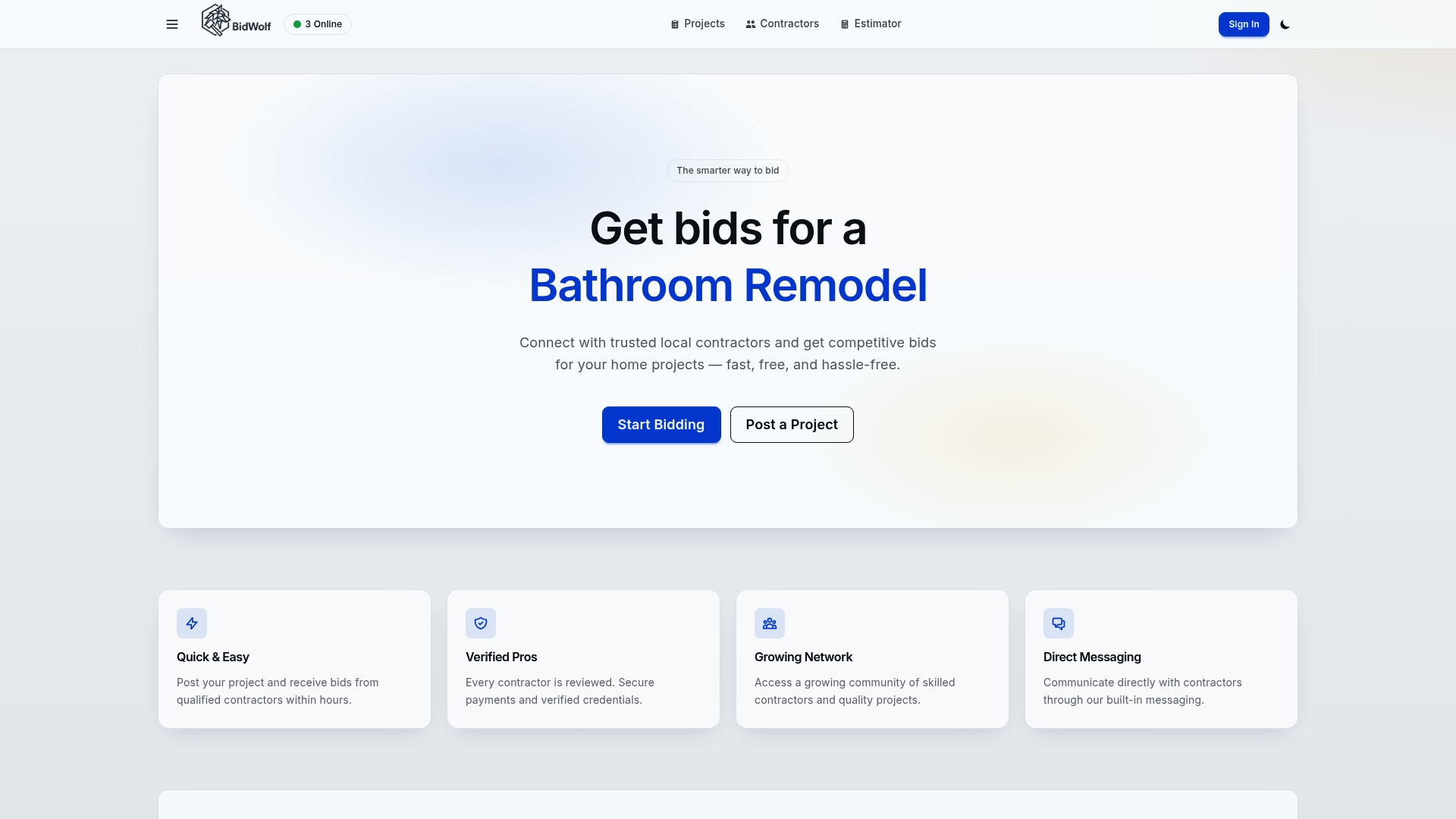
BidWolf connects Texas homeowners with vetted, verified local contractors who submit detailed, competitive bids for projects of every size. Whether you are planning a kitchen remodel, bathroom addition, roofing replacement, or electrical upgrade, you can find local contractors who meet the compliance and documentation standards covered in this guide. Post your project, receive multiple itemized bids, and compare them side by side using BidWolf’s built-in tools. You can also browse Texas project examples to understand realistic scopes and costs before you even receive your first bid. Start with a get a quick estimate to set your budget baseline and go into the bidding process fully prepared.
Frequently asked questions
What should I prioritize in a contractor bid for my Texas home project?
Prioritize clarity, transparent cost breakdowns, full insurance and licensing documentation, and contingencies in the 5 to 10% range. The lowest price is rarely the best value when all costs are accounted for.
How does a contractor demonstrate reliability in a bid?
Reliability shows in complete documentation, verifiable references, insurance certificates, and a track record with similar Texas projects. Contractors who refine their compliance documentation and cost breakdowns consistently win more bids because homeowners trust the transparency.
Should I always choose the lowest contractor bid?
No. Lowest bids can miss crucial details like permits, insurance, and cleanup costs. Best value means a qualified, transparent, and properly insured contractor whose total scope matches what you actually need.
How are bids for old homes or complex projects different?
They include higher contingency allowances of 5 to 10% for unknowns and may use flexible time-and-materials contracts alongside fixed-price scopes to address changes discovered during construction.