

How to communicate effectively with Texas contractors

TL;DR:
- Clear, written communication including contracts and change orders is essential to prevent disputes.
- Organized documentation and routine updates help manage scope, timeline, and budget effectively.
- Following formal processes and proactive record-keeping aid in dispute resolution and legal protection.
Hiring a contractor in Texas is one of the biggest decisions you’ll make as a homeowner. Whether you’re planning a bathroom remodel in Austin or re-roofing a home in Houston, miscommunication can turn a straightforward project into a costly nightmare. Scope creep, payment disputes, and unexpected delays are rarely caused by bad contractors alone. Most stem from unclear expectations and untracked agreements. This guide gives you practical, proven strategies for communicating with contractors at every stage, so you stay in control, protect your investment, and get results you can be proud of.
Table of Contents
- Why clear communication matters in Texas renovation projects
- Essential tools and documents for effective contractor communication
- Step-by-step guide to communicating with your contractor
- How to handle changes, disputes, and unexpected issues
- A contractor’s perspective: What homeowners miss (and how to stand out)
- BidWolf: Get matched with vetted Texas contractors and manage communication with ease
- Frequently asked questions
Key Takeaways
| Point | Details |
|---|---|
| Document every agreement | Always follow up verbal discussions with written recaps to avoid misunderstandings. |
| Handle changes formally | Insist on written change orders with updated costs and schedule before extra work starts. |
| Know your rights | Written notice and mediation are required steps when handling disputes in Texas. |
| Use clear tools | Leverage templates, recap emails, and formal contracts for all major decisions. |
Why clear communication matters in Texas renovation projects
Renovation projects in Texas are booming. With the state’s rapid population growth and surge in housing demand, contractors are busier than ever. That’s great news for the industry, but it also means homeowners need to be more organized and proactive than ever before. When communication breaks down on a job site, the consequences can be expensive and frustrating.
The construction industry consistently identifies miscommunication as one of the leading drivers of project disputes. Poor communication leads to budget overruns, timeline delays, and disagreements about what was promised versus what was delivered. In Texas, where communicating with home services providers clearly is especially important given the volume of active projects, the stakes are even higher.
Understanding what’s at risk will help you take communication seriously from day one. Here are the most common risks Texas homeowners face when communication is unclear:
- Disputes over scope: When expectations aren’t written down, contractors and homeowners often disagree about what work was included in the original price.
- Timeline delays: Without clear milestones documented in writing, projects drift with no accountability for completion dates.
- Budget overruns: Verbal approvals for extra work are almost impossible to track. Costs can spiral quickly without documented approvals.
- Lost lien rights: In Texas, mechanics liens (legal claims a contractor can file if unpaid) are time-sensitive. If you don’t have clear records, disputes about payment become much harder to resolve.
- Material substitutions: If the specific brands or grades of materials aren’t documented, a contractor may substitute cheaper options without your knowledge.
The most reliable safeguard against all of these risks is written documentation. As House Beautiful notes, you should “use writing as the source of truth: document scope decisions, materials/finishes, timeline milestones, and any changes; follow verbal discussions with an email/text recap.”
This approach protects both parties. It gives your contractor clarity on exactly what’s expected, and it gives you a record to reference if anything goes sideways. Before you even think about finding reliable contractors, you need to understand that your communication practices will be just as important as who you hire.
| Risk area | Consequence of poor communication | Prevention strategy |
|---|---|---|
| Project scope | Disputes about included work | Written contract with detailed scope |
| Timeline | Missed milestones, delays | Documented schedule with key dates |
| Budget | Unexpected charges | Written change orders before extra work |
| Materials | Substituted products | Specifications listed in contract |
| Legal rights | Lost lien or dispute protections | Written notices and documented records |
Texas law takes construction documentation seriously. Courts and mediators rely heavily on written records when resolving contractor disputes. If you never put anything in writing, you’re at a serious disadvantage if something goes wrong.
Essential tools and documents for effective contractor communication
Understanding the risks leads naturally to the practical tools every Texas homeowner should have on hand. Good communication isn’t just about having the right conversations. It’s about having the right systems in place before a single nail is driven.
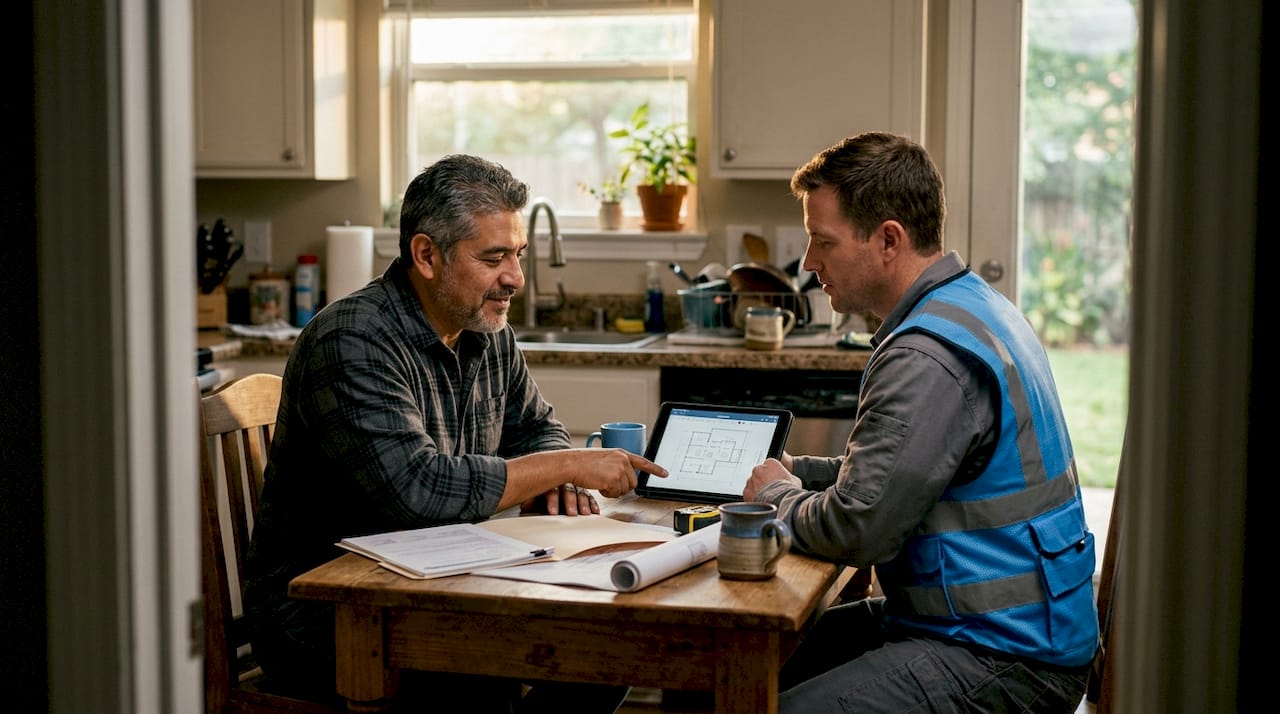
Here’s an overview of the key tools that support effective contractor communication:
| Tool | Purpose | Format |
|---|---|---|
| Written contract | Defines scope, timeline, cost, and responsibilities | Signed document |
| Project schedule | Tracks milestones and completion dates | Calendar or Gantt chart |
| Change order form | Documents approved changes in scope or cost | Written, signed form |
| Recap emails/texts | Confirms verbal conversations in writing | Email or SMS thread |
| Lien waiver | Confirms contractor/subcontractor payment | Signed legal form |
| Material specification list | Records brands, grades, and colors of materials | Attached to contract |
Before work begins, make sure you have every one of these documents in place. Many Texas homeowners skip this step because they trust the contractor or feel it’s overly formal. That’s a mistake. The paperwork isn’t about distrust. It’s about shared clarity.
Checklist of documents to prepare before your project starts:
- Signed written contract with full scope of work
- Payment schedule tied to project milestones
- Itemized materials list with brands and specifications
- Project timeline with start date, key milestones, and completion date
- Contact list with contractor, subcontractors, and your own point of contact
- Blank change order forms, ready for any additions or modifications
- A folder (digital or paper) to store all communications and receipts
One of the most important processes you can establish is a formal change order system. As FT Worth Construction Lawyer notes, you should “handle changes through a formal change-order process with written cost and schedule impact, and get approval before extra work begins.” This single habit prevents more disputes than almost anything else.
Setting up your communication toolkit in four steps:
- Create a dedicated project folder. Use a shared cloud folder (Google Drive, Dropbox, or similar) that both you and your contractor can access. Store all contracts, change orders, receipts, and emails here.
- Establish your primary communication channel. Decide early whether you’ll use email, text, or a project management platform. Stick to one channel for major decisions.
- Schedule regular check-in times. Don’t wait for problems to arise before reaching out. Set a weekly update call or site visit to review progress.
- Prepare your change order template. Create a simple one-page form that includes a description of the change, the added cost, the schedule impact, and a signature line. Use it every single time the scope shifts.
When choosing the right contractor for your Texas renovation, ask upfront how they prefer to communicate and whether they’re willing to confirm decisions in writing. A professional contractor will have no issue with this. In fact, good contractors often appreciate homeowners who are organized because it protects them too.
Pro Tip: After every in-person conversation or phone call with your contractor, send a follow-up email summarizing what was discussed and agreed upon. Something as simple as “Per our call today, we agreed to use granite countertops from Brand X at the quoted price of $4,200” creates a trackable record that protects everyone.
Step-by-step guide to communicating with your contractor
Once you have your documents, it’s important to know exactly how to put them to use with your contractor. Having the right tools is only half the job. The other half is knowing how to use them at each stage of the project.
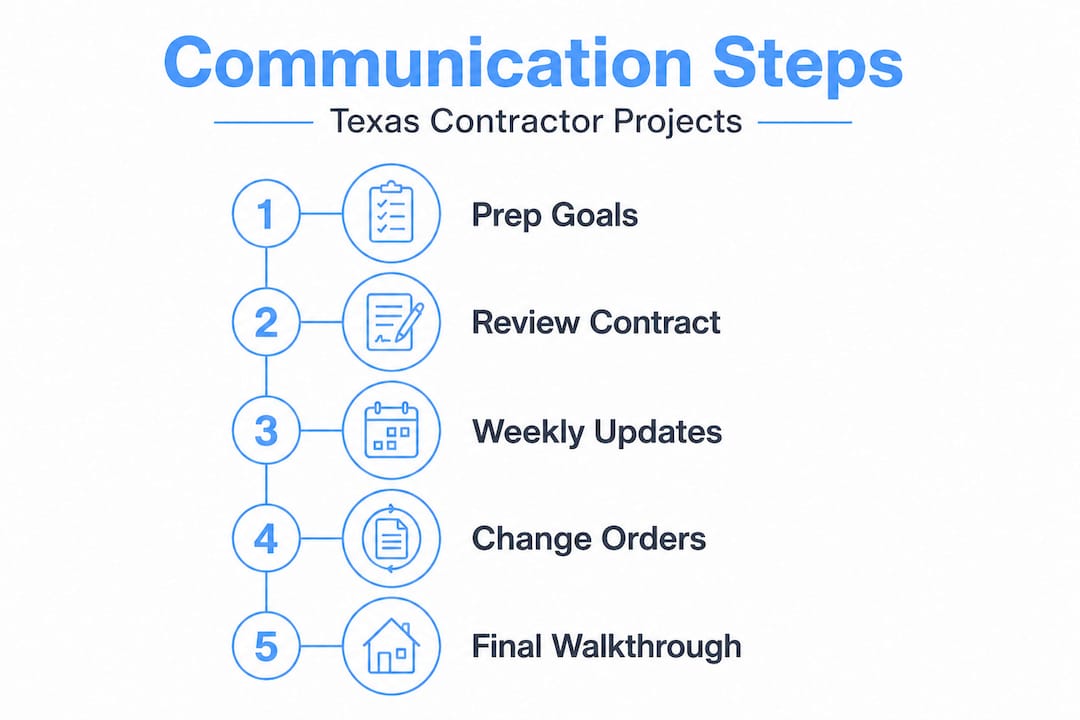
Step 1: Prepare thoroughly for your initial meeting
Before you sit down with any contractor, write out your project goals in plain language. Describe what you want the finished result to look like, not just what work needs to be done. Include your budget range, your timeline, and any non-negotiables (specific materials, brands, or features). The clearer your vision going in, the more accurate your quotes will be.
Step 2: Set written guidelines before work begins
Once you’ve selected your contractor, review the contract line by line together. Confirm the scope, the payment milestones, the start date, and the timeline. Make sure every item you discussed verbally is in the written contract before you sign. Do not assume that anything discussed verbally is automatically included.
Step 3: Establish a progress update routine
Ask your contractor to provide weekly written updates, even just a short email or text summary. This keeps you informed without requiring you to be on-site constantly. It also creates a running record of what was completed each week, which is useful if a dispute arises later.
Step 4: Handle all changes through your formal process
When anything changes, no matter how small, use your change order form. This includes material upgrades, added fixtures, layout changes, or work removed from the original scope. Per project communication best practices, all cost and schedule impacts should be documented before the new work begins, not after.
Step 5: Conduct a detailed final walkthrough
Before you release the final payment, walk through the completed project with your contractor and compare it to the original scope. Create a written punch list (a list of items that still need to be completed or corrected) and agree on a timeline for finishing those items. Do not pay in full until the punch list is resolved.
Key questions to ask your contractor before work starts:
- Who is my main point of contact on your team?
- How will you notify me of delays or unexpected problems?
- What is your process for handling change orders?
- Are all subcontractors licensed and insured?
- How do you handle disputes if they arise?
- What does your payment schedule look like and what triggers each payment?
Here’s a sample recap message you can model after a verbal conversation:
“Hi [Contractor Name], following up on our conversation today. We agreed to move forward with the tile upgrade in the master bath using 12x24 porcelain from [Brand], which adds $650 to the project total and two additional days to the timeline. Please confirm this is correct so I can update the change order. Thanks.”
This kind of message takes two minutes to write and provides documentation that can save you thousands in a dispute. As House Beautiful recommends, following every verbal discussion with a written recap is one of the most effective communication habits you can build.
Pro Tip: Use email for any discussion involving price, scope, or timeline changes. Text messages can be hard to search and organize later. Email creates a cleaner, date-stamped record that’s much easier to reference if you need to revisit an agreement.
How to handle changes, disputes, and unexpected issues
Even with great communication, issues can pop up. Here’s how to stay protected and proactive when things don’t go as planned.
The most important thing to understand about construction disputes in Texas is that written notice is not just best practice. It is often legally required. As Texas Commercial Authority explains, Texas contract frameworks commonly require written notice and encourage alternative dispute resolution (mediation) before litigation or arbitration.
“Texas contract frameworks commonly require written notice and encourage alternative dispute resolution (mediation) before litigation/arbitration.” — Texas Commercial Authority
This means that if you have a problem with your contractor, your first step should always be a written notice describing the issue in detail. Do not skip straight to phone calls or threats. Put it in writing first.
Here’s how common scenarios are best handled in Texas:
| Scenario | Recommended Texas step | Documentation needed |
|---|---|---|
| Scope change dispute | Submit written change order; request written acknowledgment | Signed change order form |
| Defective work | Provide written notice describing defect and expected remedy | Photos, written notice, contract copy |
| Payment dispute | Send written demand referencing contract terms | Payment schedule, invoices, receipts |
| Project delay | Request written explanation and revised timeline | Original schedule, written update |
| Subcontractor issues | Notify general contractor in writing | Written complaint, photos if applicable |
When issues escalate beyond simple written communication, here is a clear path forward:
- Step 1: Written notice. Send a formal written notice (email or certified mail) describing the issue and your expected resolution. Give a reasonable deadline for a response.
- Step 2: Mediation. If the contractor does not respond or disagrees, request mediation. This is a structured conversation facilitated by a neutral third party. It’s faster and cheaper than a lawsuit.
- Step 3: Legal action. If mediation fails, you may need to pursue arbitration (a binding private resolution process) or file a claim in court. At this stage, having thorough written records is critical.
It’s worth emphasizing again how important the change order process is during the project itself. According to FT Worth Construction Lawyer, getting written approval before extra work begins is essential to preventing disputes. Verbal approvals for extra work are one of the most common causes of payment disagreements. Your contractor says you approved an upgrade; you say you never agreed to the price. Without a signed change order, that dispute is extremely difficult to resolve.
Reviewing your mediation and arbitration resources before disputes escalate is time well spent. Knowing your options in advance helps you respond calmly and effectively when problems arise instead of reacting emotionally.
A contractor’s perspective: What homeowners miss (and how to stand out)
We’ve covered your action steps. Now here’s an inside look from the other side of the table. After working with thousands of projects across Texas, we’ve noticed a clear pattern: the homeowners who get the best results from contractors are almost never the ones who micromanage every hour. They’re the ones who communicate clearly, document consistently, and treat the relationship like a professional partnership.
Most contractors want to do great work. But they work with many clients at once, and their attention naturally flows toward the jobs where expectations are clearest. When you show up prepared, with a signed contract, clear specifications, and a habit of confirming things in writing, you signal to your contractor that you’re organized and serious. That changes the dynamic immediately.
Here’s something that surprises most homeowners: many contractors actually appreciate written change orders, even when homeowners think they’re being overly formal. Why? Because it protects them too. When a homeowner asks for an upgrade verbally and later disputes the cost, the contractor is left trying to prove something that isn’t documented. A signed change order removes that ambiguity for both sides.
Timeline expectations are another major blind spot. Texas homeowners often underestimate how many factors outside a contractor’s control can affect a schedule. Material delivery delays, permitting timelines, subcontractor availability, and weather all play a role. The homeowners who handle delays best are those who built a buffer into their timeline from the start and who have regular check-in conversations rather than only reaching out when something goes wrong.
Earning contractor trust is a genuine asset on a renovation project. Contractors talk to each other. When you’re known as a fair, organized homeowner who pays on time and communicates professionally, you’ll find that top-quality contractors are more willing to take your calls, prioritize your project, and go the extra mile when something unexpected comes up.
Pro Tip: Set up a brief weekly check-in with your contractor. Even five minutes by phone on a consistent schedule builds rapport and keeps you informed. Contractors are much more communicative with homeowners who make it easy to communicate. Regular, low-pressure check-ins prevent the communication gaps that turn into major disputes.
The bigger lesson here is this: communication isn’t just a legal protection strategy. It’s a relationship strategy. The homeowners who treat their contractors as skilled professionals and communicate with clarity and respect consistently report better outcomes than those who either go completely hands-off or try to control every detail. That balance is worth intentionally building into your project plan from day one.
BidWolf: Get matched with vetted Texas contractors and manage communication with ease
Ready to put these strategies into action? BidWolf makes it straightforward to find qualified Texas contractors and manage every phase of your project from one platform.
When you start a renovation project on BidWolf, you can post your project details and receive competitive bids from vetted, verified local professionals across Texas. Every contractor in our network is credential-checked, so you spend less time worrying about who you’re hiring and more time planning your renovation. Our built-in messaging system keeps all of your contractor communications in one organized place, making it easy to document decisions, track updates, and maintain a clear record throughout the project. You can also use our get a project estimate tool to set realistic budget expectations before bids come in, and find a Texas contractor in your city quickly. Whether you’re remodeling a kitchen in Dallas or adding a deck in San Antonio, BidWolf connects you with professionals who are ready to work.
Frequently asked questions
What should I do if my contractor isn’t responding to messages?
Start by following up in writing and keep a detailed record of your attempts to reach them. If there’s still no response, review your contract for notice requirements, then consider sending a formal written notice or pursuing mediation as required under Texas contract standards.
Is it necessary to have all communications with contractors in writing in Texas?
Not every casual note needs to be formal, but all critical changes, cost agreements, and dispute notices must be in writing. As House Beautiful recommends, always follow verbal discussions with a written recap to protect your interests.
What documents should I prepare before starting a project with a Texas contractor?
You should have a signed written contract, a project schedule, a detailed materials list, and a formal process for documenting any changes. Following a formal change-order process with written cost and schedule impacts is considered Texas best practice.
How should I handle disputes or unexpected problems with my contractor in Texas?
Provide a written notice describing the issue clearly and request a response within a reasonable timeframe. If that doesn’t resolve the problem, pursue mediation before litigation, as Texas contract frameworks strongly encourage alternative dispute resolution first.