

Streamline Project Bidding for Better Texas Home Renovations

TL;DR:
- Traditional bidding processes in Texas are inconsistent, making fair contractor comparison difficult.
- Streamlined bidding offers better prices, clearer scope, and verified contractors, reducing costs.
- Structured, digital platforms save time and help homeowners manage bids effectively for successful projects.
Many Texas homeowners end up overpaying for renovations not because they chose the wrong contractor, but because the bidding process itself was broken from the start. Fragmented, unclear bids make it nearly impossible to compare contractors fairly, leaving you guessing at true costs and quality. The good news is that competitive bidding from vetted contractors gives Texas homeowners better prices and quality through apples-to-apples comparisons. Streamlining how you collect and evaluate bids is the single most effective step you can take before any renovation project begins. This guide walks you through exactly how to do it.
Table of Contents
- Why the traditional project bidding process falls short
- The benefits of streamlining project bidding
- How to streamline your home renovation bidding process
- Common mistakes to avoid when seeking project bids
- Our take: What most homeowners miss about project bidding
- Make project bidding easier with BidWolf
- Frequently asked questions
Key Takeaways
| Point | Details |
|---|---|
| Level the playing field | Streamlining project bidding ensures you compare true apples-to-apples offers from local Texas pros. |
| Save time and money | An organized approach avoids costly mistakes and hidden fees in your renovation project. |
| Choose with confidence | Side-by-side bids and vetting tools help you select the best contractor for quality results. |
Why the traditional project bidding process falls short
Most Texas homeowners approach a renovation the same way: they ask a neighbor for a referral, call two or three contractors, wait days for callbacks, and then try to make sense of bids that look nothing alike. One contractor quotes materials separately. Another bundles everything. A third gives you a one-line total with no breakdown at all. By the time you have three bids in hand, you are not comparing contractors. You are comparing documents that were written in entirely different languages.
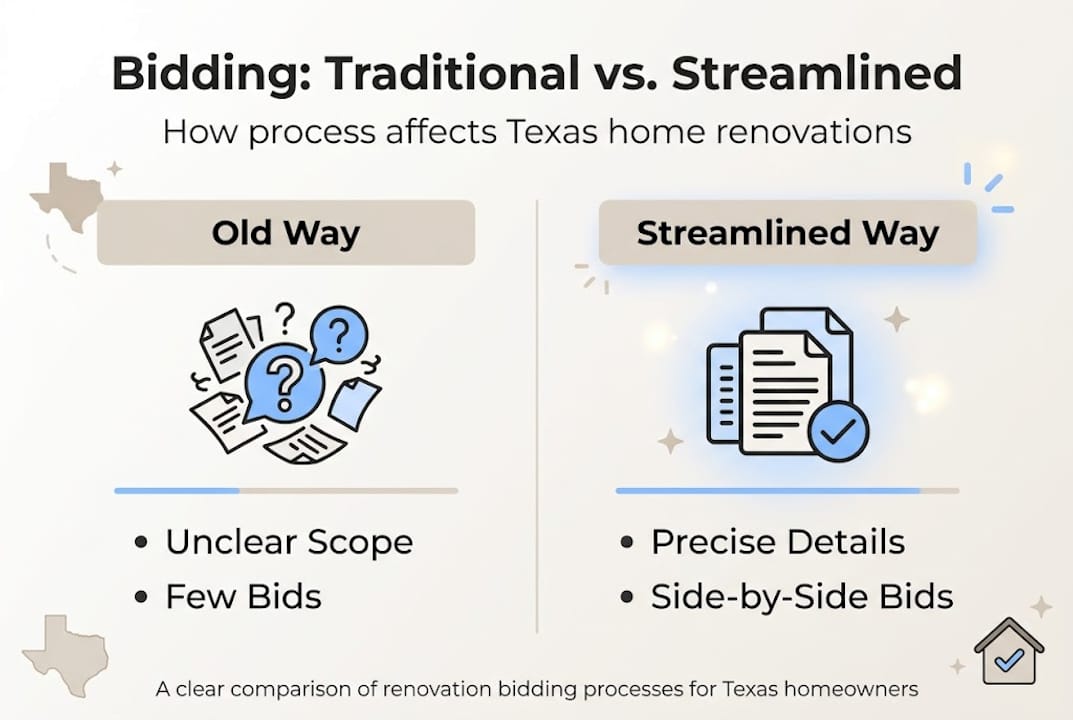
This is the core problem with the traditional bidding process. It is unstructured, inconsistent, and heavily dependent on each contractor’s personal style of communication. Some contractors are excellent at their trade but poor at paperwork. Others produce polished proposals that look professional but hide vague language that leaves room for costly add-ons later. Without a standardized format, you have no reliable way to tell the difference.
The financial consequences are real. When scopes of work are vague, contractors can interpret your project differently, and those differences show up as change orders once work has already begun. A homeowner in the Dallas area, for example, might receive a roofing bid that does not specify whether the price includes removing the old shingles, adding underlayment, or replacing damaged decking. When those items surface mid-project, the final bill can be thousands of dollars higher than the original quote.
Here are some of the most common ways the traditional bidding process fails Texas homeowners:
- Inconsistent scope definitions: Each contractor defines the project differently, making direct price comparison impossible.
- Missing line items: Labor, permits, material disposal, and cleanup costs are frequently omitted from initial bids.
- No timeline commitments: Traditional bids rarely specify start dates, milestones, or completion deadlines.
- Unverified credentials: Homeowners often have no easy way to confirm licensing, insurance, or past work quality before inviting a contractor to bid.
- Slow response times: Phone-based outreach can take days or weeks to generate even a single bid, delaying your project before it starts.
- No competitive pressure: When contractors know they are the only one bidding, there is little incentive to sharpen their pricing.
“The biggest risk in an unstructured bidding process is not that you will pick a bad contractor. It is that you will never know you did until the project is already underway.”
The result is a process that feels stressful and opaque, where homeowners make major financial decisions with incomplete information. You can find streamlined bidding tips that show exactly how a more organized approach changes the outcome. The traditional method is not just inconvenient. It actively works against your ability to get fair pricing and reliable service. Recognizing these gaps is the first step toward fixing them.
The benefits of streamlining project bidding
When you organize the bidding process from the start, the advantages show up quickly and clearly. Streamlining does not just save time. It changes the quality of information you receive, the competitiveness of the pricing you are offered, and your confidence in the contractor you ultimately choose.
The most immediate benefit is price competitiveness. When multiple contractors know they are bidding against each other on an identical scope of work, they have a strong incentive to sharpen their numbers. A contractor who might otherwise quote a comfortable margin will tighten that margin when they know a competitor is in the running. This competitive dynamic routinely saves Texas homeowners between 10 and 20 percent on project costs, simply by creating the right conditions for fair competition.
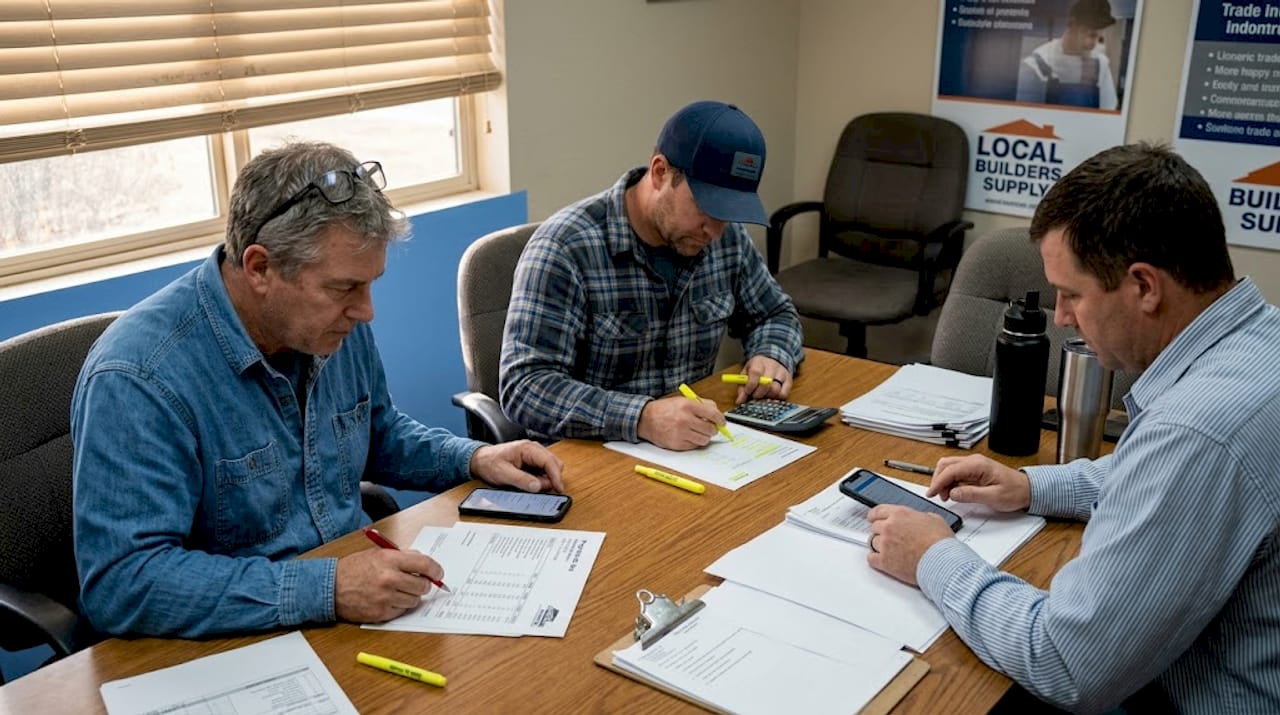
The second benefit is clarity. When every contractor receives the same detailed project description, their bids become genuinely comparable. You can look at two bids side by side and see exactly where the differences lie. Is one contractor using a higher-grade material? Is another offering a longer warranty on labor? Is the pricing gap explained by a difference in approach, or is one contractor simply cutting corners? A standardized scope makes these questions answerable.
Here is a simple comparison of what a disorganized versus a streamlined bidding process typically looks like:
| Factor | Traditional process | Streamlined process |
|---|---|---|
| Scope of work | Varies by contractor | Identical for all bidders |
| Bid format | Inconsistent | Standardized |
| Contractor verification | Homeowner’s responsibility | Pre-screened and verified |
| Response time | Days to weeks | Hours to days |
| Price comparison | Difficult and unreliable | Direct and accurate |
| Hidden cost risk | High | Low |
| Contractor accountability | Informal | Documented |
The benefits of multiple bids extend beyond just price. When you collect three or more bids on the same scope, you also gather valuable information about how contractors communicate, how quickly they respond, and how thoroughly they read your project description. A contractor who submits a vague bid after receiving a detailed scope is telling you something important about how they will manage your project.
Streamlining also helps you avoid hidden costs. When your project description is thorough and specific, contractors cannot leave out inconvenient line items and add them back later as change orders. You set the terms of the conversation, and that protects your budget from the start.
Pro Tip: Before sending your project out for bids, write a one-page scope document that lists every task, material specification, and quality standard you expect. This single step eliminates most of the confusion that leads to lopsided bids and costly surprises.
Connecting with a reliable local contractor network also means you are not starting from scratch every time. Verified contractors who work regularly through a platform have a track record you can review, which removes much of the guesswork from the selection process. The combination of standardized scopes and verified professionals is what makes streamlined bidding genuinely effective, not just faster.
How to streamline your home renovation bidding process
Knowing that streamlining works is one thing. Knowing exactly how to do it is another. The following steps give you a practical framework you can apply to any renovation project, whether you are remodeling a bathroom in Austin or replacing a roof in Houston.
-
Define your project scope in writing before contacting anyone. Include every task that needs to be completed, the materials you prefer or require, any brand specifications, and the quality standards you expect. The more specific you are, the more accurate and comparable your bids will be.
-
Request at least three bids, all based on the same written scope. Competitive bidding from vetted contractors consistently produces better pricing and quality outcomes. Three bids give you a meaningful range. Fewer than three limits your ability to identify outliers, whether a bid that is suspiciously low or one that is unjustifiably high.
-
Use a digital platform to distribute your scope and collect responses. Posting your project online through a vetted platform means your scope goes out to multiple qualified contractors simultaneously. You receive structured responses in a consistent format, which makes comparison straightforward. This eliminates the phone tag and scheduling delays that slow down the traditional process.
-
Verify contractor credentials before reviewing their bids. Check that each bidder holds a valid Texas contractor license, carries general liability insurance, and has workers’ compensation coverage. Ask for proof of these documents. A contractor who hesitates to provide them is a red flag worth taking seriously.
-
Check references and past project reviews. Ask each contractor for two or three references from recent projects similar to yours. Contact those references directly and ask specific questions: Was the project completed on time? Did the final cost match the bid? Were there any issues, and how were they handled?
-
Compare bids line by line, not just by total. Look at how each contractor has broken down labor, materials, permits, and contingencies. A lower total bid that excludes permit fees or material disposal can easily end up costing more than a higher bid that includes everything.
-
Clarify payment terms and project timelines in writing. Before you sign anything, confirm the payment schedule, the expected start date, and the projected completion date. Reputable contractors will put these details in a formal contract.
Pro Tip: Use a spreadsheet to compare bids side by side. List every line item from your scope down the left column and enter each contractor’s pricing across the top. This format makes gaps and discrepancies immediately visible and helps you ask the right follow-up questions.
You can start finding trusted contractors in your area right now, and use a free cost estimator to establish a realistic budget range before bids even come in. Knowing your baseline number helps you recognize when a bid is genuinely competitive versus when it is simply low for the wrong reasons.
Common mistakes to avoid when seeking project bids
Even homeowners who understand the value of competitive bidding can undermine their own process by making avoidable mistakes. These errors are common, and they can cost you significantly in both money and project quality.
The most frequent mistakes Texas homeowners make when seeking bids include:
- Writing a vague or incomplete scope of work. If your project description is unclear, contractors will fill in the blanks differently. One might assume you want standard builder-grade materials while another quotes premium options. The resulting bids look incomparable because they actually are.
- Contacting only one or two contractors. A single bid gives you no frame of reference. Two bids give you a comparison but no tiebreaker. Three or more bids give you a genuine market picture.
- Skipping credential verification. Hiring an unlicensed contractor in Texas can void your homeowner’s insurance coverage and leave you liable for accidents on your property. Always verify before you invite anyone to bid.
- Choosing based solely on the lowest price. The lowest bid is not always the best value. A contractor who bids significantly lower than competitors may be cutting corners on materials, planning to add change orders, or simply underestimating the job.
- Failing to ask about warranties. Both material warranties and labor warranties matter. A contractor who stands behind their work will offer a written warranty on labor. If they do not, ask why.
- Ignoring red flags in communication. A contractor who is slow to respond, vague in their answers, or reluctant to provide references during the bidding phase will likely behave the same way once the project starts.
Here is a quick reference table showing the most common bidding mistakes and their likely consequences:
| Mistake | Likely consequence |
|---|---|
| Vague project scope | Incomparable bids, change orders mid-project |
| Fewer than three bids | No competitive pricing, limited options |
| No credential check | Liability risk, insurance complications |
| Choosing lowest price only | Poor quality work, incomplete project |
| No written timeline | Delays with no accountability |
| Skipping reference checks | Unknown track record, higher risk |
| No warranty discussion | No recourse for defective work |
The data is consistent: vetted contractors produce better outcomes for Texas homeowners in both price and quality. Yet many homeowners still skip the verification step because it feels time-consuming. Digital platforms that pre-screen contractors solve this problem by doing the credential work before you ever see a bid.
Another common oversight is forgetting to address payment terms before work begins. Reputable contractors typically request a reasonable deposit, often 10 to 30 percent, with milestone payments tied to project progress. Be cautious of any contractor who demands more than 50 percent upfront or who wants full payment before the project is complete. These are recognized warning signs in the Texas contracting industry.
You can review contractor selection mistakes in more detail and learn how a structured platform helps you avoid them before they become expensive problems. The goal is not to distrust contractors. It is to create a process that protects both parties and sets clear expectations from day one.
Our take: What most homeowners miss about project bidding
Here is the part that most renovation guides skip. Homeowners focus heavily on getting multiple bids, and that is a good instinct. But collecting three bids from three contractors who each interpreted your project differently is not competitive bidding. It is organized confusion. The real value of a streamlined process comes from the standardization, not just the volume.
We have seen homeowners go through the motions of getting multiple bids and still end up with a costly outcome because they never established a common baseline. The bids looked different because the contractors were quoting different things. Without a standardized scope, you cannot compare pricing, you cannot evaluate quality differences, and you cannot negotiate from a position of knowledge.
The other thing most homeowners underestimate is the cost of a slow, disorganized process. Every week spent chasing callbacks and deciphering inconsistent bids is a week your project is not moving forward. In Texas, where contractor availability can be tight during peak seasons, delays in the bidding phase can push your project start date back by months.
Technology is changing this significantly. Platforms that connect homeowners with trusted renovation contractors do more than save time. They create a structured environment where bids are generated against a common scope, credentials are already verified, and communication is centralized. The result is a process that is faster, more transparent, and more likely to produce a successful project outcome.
Our honest take is this: the homeowners who get the best results from renovation projects are not the ones who spend the most money or hire the most experienced contractor. They are the ones who manage the bidding process well. That means defining the scope clearly, collecting comparable bids, verifying credentials, and using the right tools to organize the information. Get that process right, and everything else becomes easier.
Make project bidding easier with BidWolf
You now have a clear picture of what a well-run bidding process looks like and why it matters. The next step is putting it into practice without spending hours on phone calls and spreadsheets.
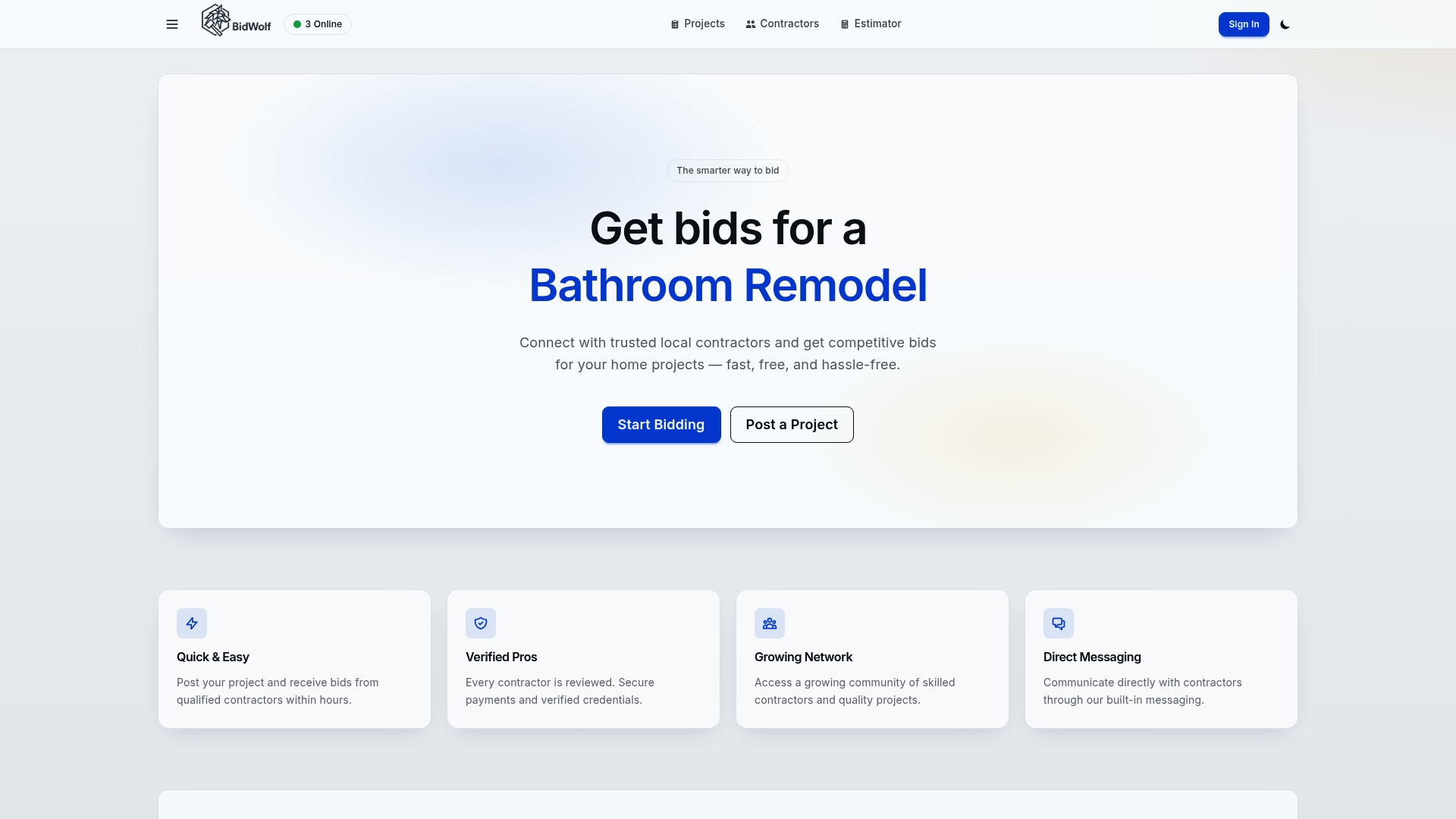
BidWolf was built specifically for Texas homeowners who want a faster, more transparent way to connect with qualified local contractors. When you post a project, your scope goes directly to vetted professionals in your area. You receive clear, structured bids you can compare side by side, all in one place. There is no chasing contractors down or waiting days for a response. Built-in messaging keeps all communication organized, so nothing gets lost. Whether you are planning a kitchen remodel, a roofing replacement, or a landscaping overhaul, stress-free project bidding starts the moment you post your project. Connect with local renovation experts who are license-verified and ready to compete for your business, and get a free estimate to set your budget before bids arrive.
Frequently asked questions
Why should Texas homeowners get multiple bids for a renovation project?
Getting three or more bids with an identical scope lets you compare pricing and quality directly, so you can choose the contractor who offers the best overall value rather than just the lowest number.
How does streamlining the bidding process save time?
A streamlined process delivers side-by-side competitive bids from multiple vetted contractors at once, cutting out the back-and-forth communication that slows traditional bidding and helping you make a confident decision faster.
What are the most common mistakes when getting contractor bids?
Choosing based only on the lowest price, skipping credential checks, and failing to compare identical project scopes are the three errors that most often lead to budget overruns and disappointing results.
How do digital bidding platforms help Texas homeowners?
They connect you quickly with vetted local professionals and organize bids in a consistent format, making it straightforward to compare options and choose the right contractor without the usual delays and confusion.