

Bid Comparison Process Guide for Homeowners

TL;DR:
- A structured bid comparison evaluates multiple contractor proposals against a common scope to find the best value. Homeowners who compare three or more bids save an average of 12-18% and reduce project disputes by ensuring scope, exclusions, and credentials are thoroughly examined. Normalizing bids through referencing scope gaps and adding plug numbers is essential to make fair, confident choices based on total project cost and contractor reliability.
A bid comparison is defined as the structured method of evaluating multiple contractor proposals against a common scope baseline to identify the best value, not just the lowest price. For homeowners and property managers tackling renovation or repair projects, following a solid bid comparison process guide is the difference between a smooth project and a costly dispute. Homeowners who collect 3 or more bids save 12–18% on average compared to accepting the first offer. On a $75,000 bathroom remodel or roofing job, that gap translates to $9,000–$13,500 in real savings. The process involves more than price. Scope, exclusions, payment terms, and contractor credentials all factor into a defensible decision.
What is the bid comparison process guide?
The bid comparison process, also called bid leveling or bid analysis in professional construction management, is a step-by-step framework for evaluating contractor proposals on equal terms. Most homeowners skip the leveling step entirely. They look at the bottom-line number and pick the cheapest option. That approach explains why more than 35% of contractor disputes stem from scope disagreements rooted in unclear bid inclusions and exclusions. The number is striking. It means more than one in three projects ends in conflict, not because contractors are dishonest, but because the bids were never truly comparable to begin with.
A complete bid evaluation checklist covers six areas: scope of work, material specifications, exclusions, payment schedule, warranty terms, and contractor credentials. Bid assessment strategies used by professional general contractors weight non-price factors at 20–40% of the total evaluation, depending on project complexity. That weighting reflects a core truth: the cheapest bid is rarely the least expensive project.
What do you need before starting a bid comparison?
Preparation determines whether your bid comparison produces a clear winner or a confusing pile of numbers. Contractors who receive vague project descriptions return vague bids. The solution is a detailed bid package sent to every contractor before they quote.
Your bid package should include:
- Scope summary: A written description of every task you expect completed, from demolition to final cleanup.
- Drawings or photos: Floor plans, site photos, and any architectural drawings that clarify dimensions and conditions.
- Material specifications: Brand names, grades, or product lines you expect. “Standard tile” means different things to different contractors.
- Site access details: Hours of access, parking restrictions, and any occupied-space considerations.
- Bid deadline and format: Specify that you want line-item pricing, not a lump sum total.
Collecting 3 to 4 bids is the optimal range for comparison. Fewer than three gives you no competitive baseline. More than four creates diminishing returns and significant time investment. Once bids arrive, schedule a walkthrough with each contractor. Walkthroughs surface assumptions that never appear in writing. A contractor who walks the site will price more accurately than one who bids from a phone call.
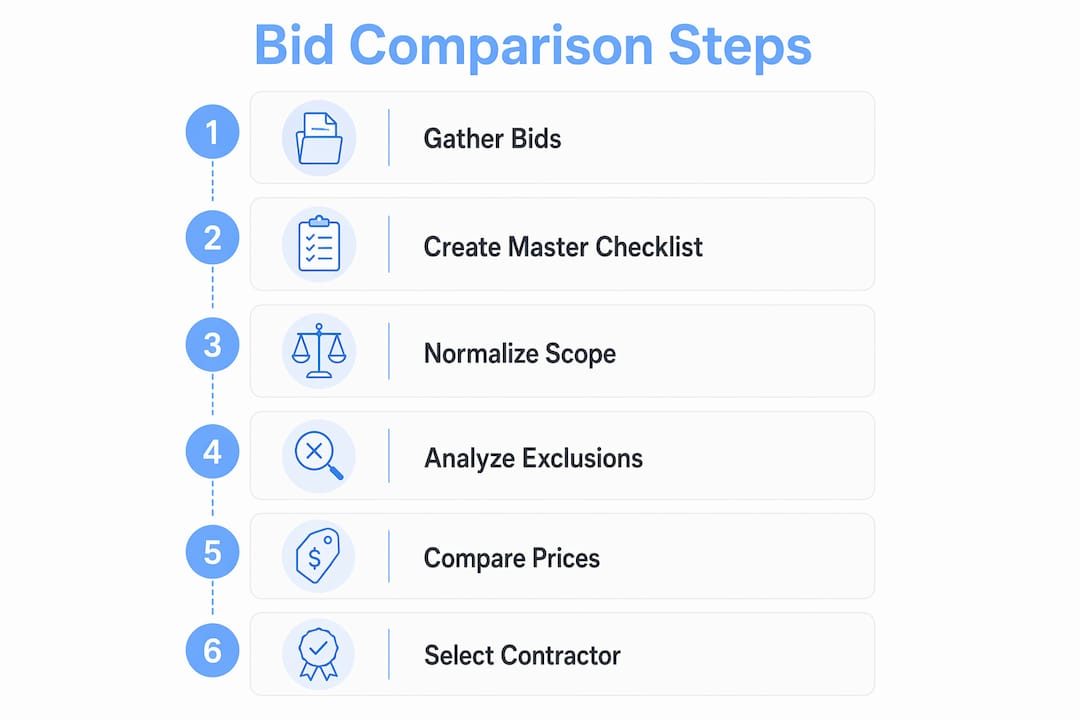
Build a master checklist before bids arrive. List every task, material, and service you expect. When bids come in, you check each item off. Missing items are not automatically excluded from the project. They become change orders after work starts, and change orders cost more than original scope.

Pro Tip: Ask each contractor to confirm in writing what is NOT included in their bid. Exclusion lists reveal more about a contractor’s pricing strategy than the total price itself.
How do you normalize and level bids to compare them fairly?
Bid leveling is the process of adjusting each proposal to reflect the same scope so that price differences reflect actual cost differences, not missing line items. This process takes roughly 2–4 hours per trade package for an experienced estimator. For a homeowner doing it for the first time, budget a full afternoon.
Follow these steps to level bids accurately:
- Build a comparison matrix. Create a spreadsheet with every expected scope item as a row and each contractor as a column. Enter each contractor’s price for that line item. Leave cells blank where a contractor did not include the item.
- Identify scope gaps. Any blank cell is a scope gap. That item is either excluded or simply not priced. Contact the contractor and ask for clarification before assuming it is included.
- Issue clarification requests. Send a written request to each contractor asking them to confirm or price the missing items. Give a 48-hour deadline. Contractors who do not respond are telling you something about how they will communicate during the project.
- Add plug numbers for unresolved gaps. A plug number is an estimated cost you add to a bid that excludes a scope item, so you can compare normalized totals. Plug numbers compensate for excluded scope and give you a true apples-to-apples comparison. Get a rough market rate from a supplier or a third-party estimator if you are unsure of the cost.
- Convert lump sums to unit rates. Divide total prices by square footage, linear feet, or hours to create comparable unit rates. A roofing bid of $18,000 for 2,000 square feet is $9 per square foot. A competing bid of $16,500 for the same area is $8.25 per square foot. Unit rates expose pricing differences that total numbers obscure.
- Calculate normalized bid totals. Add plug numbers to each bid’s subtotal. The resulting figure is the normalized bid total. Use this number, not the original quote, for your final price comparison.
Here is an example of a simple bid comparison matrix for a bathroom remodel:
| Scope Item | Contractor A | Contractor B | Contractor C |
|---|---|---|---|
| Tile installation (80 sq ft) | $1,200 | $1,050 | $1,400 |
| Plumbing rough-in | $2,400 | $2,200 | Excluded |
| Dumpster removal | Excluded | $350 | $300 |
| Final cleaning | $150 | Excluded | $200 |
| Normalized Total | $8,950 | $9,100 | $8,700 |
Contractor C looked cheapest at first glance. After adding plug numbers for the excluded plumbing rough-in, the normalized totals tell a different story.
Pro Tip: Save your comparison matrix as a permanent project document. If a dispute arises mid-project, your matrix shows exactly what each contractor included and at what price.
What are the common red flags when evaluating renovation bids?
Bid comparison is a risk management exercise, not a price-hunting exercise. Recognizing warning signs early protects you from expensive surprises after work begins.
Watch for these red flags in every bid you receive:
- Lump sum totals with no line items. Transparent bids contain at least 15 detailed line items. A single total number with no breakdown makes scope verification impossible and signals either inexperience or intentional vagueness.
- Excessive allowances. An allowance is a placeholder cost for an item not yet specified, such as tile or fixtures. Allowances under 20% of the total bid are acceptable. Higher than that, and the contractor is pricing a project they have not fully thought through.
- Missing exclusion lists. Every professional bid should list what is NOT included. A bid with no exclusions is not a complete bid. It is a starting point for change orders.
- Standard hidden cost items. Dumpster removal, final cleaning, touch-up paint, and unforeseen conditions clauses are the most common exclusions that inflate final project costs. If these are not explicitly included, assume they are not covered.
- Front-loaded payment schedules. A contractor requesting 50% or more upfront has limited financial stability or plans to fund another job with your deposit. Standard payment schedules tie payments to completed milestones.
- No warranty terms. Reputable contractors specify warranty coverage in writing. One year on labor is a common minimum. No warranty language is a red flag.
“Bids that are 30% below the average price from comparable contractors carry significant risk of scope omissions, material substitutions, or planned change orders after work begins.” — How to Compare Contractor Bids
Lowest bids win about 60% of the time but cause disputes 40% of the time because they frequently cover less scope or use cheaper materials. A bid within 10% of the average reflects competitive pricing. A bid 30% below average reflects something missing.
Beyond price: what non-price factors should influence your decision?
Price normalization tells you what each contractor will charge for the same work. Non-price evaluation tells you which contractor will actually deliver it. Professional bid evaluations weight non-price factors at 20–40% of the total score depending on project complexity. For a $10,000 deck repair, price dominates. For a $150,000 kitchen addition, reputation and schedule reliability matter just as much.
Evaluate each contractor on these non-price criteria:
- Verified credentials. Confirm license status, insurance coverage, and bond status through your state’s contractor licensing board. In Texas, the Texas Department of Licensing and Regulation maintains a public database. Unverified credentials are a liability you absorb.
- Reputation and references. Request three references from projects completed in the past 12 months. Call them. Ask specifically about schedule adherence, communication, and how the contractor handled unexpected problems.
- Safety record. Ask for the contractor’s Experience Modification Rate (EMR), a workers’ compensation insurance metric. An EMR below 1.0 indicates a better-than-average safety record. Higher rates suggest more frequent workplace incidents.
- Schedule commitments. A bid should include a projected start date, duration, and key milestones. Contractors who cannot commit to a schedule in writing often cannot commit to one in practice. Review how they plan to staff the project and whether they rely heavily on subcontractors.
- Financial stability. For larger projects, ask whether the contractor can provide a payment and performance bond. Bonding requires financial vetting by a surety company. A bondable contractor is a financially stable contractor.
- Post-completion service. Ask how warranty claims are handled. A contractor who responds to warranty calls within 48 hours is worth more than one who disappears after final payment.
Reviewing how to select service providers based on both price and qualitative factors gives you a complete picture before you sign anything.
Which tools and techniques simplify the bid comparison process?
The right tools reduce the time you spend organizing data and increase the accuracy of your comparisons. Your choice of tool depends on project size and how many bids you are managing.
| Tool Type | Best For | Key Benefit | Limitation |
|---|---|---|---|
| Excel or Google Sheets | Projects with 3–5 bids | Free, flexible, fully customizable | Manual data entry, no automation |
| Bid tabulation templates | First-time homeowners | Structured format, easy to follow | Still requires manual input |
| Construction estimating software | Large or complex projects | Automated extraction, scope flagging | Cost and learning curve |
| Platform-based comparison tools | Online bid marketplaces | Side-by-side display, built-in messaging | Limited to platform contractors |
Bid tabulation organizes proposals into line-item spreadsheets with columns for exclusions, alternates, and unit pricing. This structure is the foundation of any leveling analysis. Digital tools can automate data extraction from PDF bids, but manual review remains necessary for scope normalization. No software yet reliably identifies when a contractor has simply not priced a scope item versus priced it at zero.
For most homeowners managing a single renovation project, a well-structured Google Sheets template covers 90% of the work. Build one tab for the comparison matrix, one for contractor credentials, and one for your normalized totals. Keep all bid documents in a shared folder linked to the sheet. That documentation protects you if a dispute arises later.
Platforms like Bidwolf simplify the collection side of the process by delivering structured bids from verified contractors directly to one place. That reduces the time spent chasing quotes and gives you a consistent format to work from. For Texas homeowners, the transparent bidding process Bidwolf provides means contractors know their bids will be compared side by side, which encourages more complete and competitive submissions.
Key takeaways
A fair bid comparison requires scope normalization first. Price alone never tells the full story of what a contractor will actually deliver.
| Point | Details |
|---|---|
| Collect 3–4 bids minimum | Homeowners save 12–18% on average by comparing at least three contractor proposals. |
| Normalize before comparing | Add plug numbers for excluded scope items to calculate true, comparable project costs. |
| Watch for lump sum bids | Bids without at least 15 line items mask scope and make fair comparison impossible. |
| Weight non-price factors | Reputation, schedule reliability, and warranty terms should account for 20–40% of your decision. |
| Document everything | A comparison matrix and saved bid documents protect you if disputes arise after work begins. |
Why most homeowners get the bid process wrong
I have reviewed hundreds of renovation projects over the years, and the same mistake shows up repeatedly. Homeowners receive three bids, sort them by total price, and pick the middle one. They feel like they did their due diligence. They did not.
Many homeowners compare total prices without normalizing scope, which produces misleading conclusions. The middle bid is not automatically the safest choice. It might simply be the bid that excluded the most expensive items without making that obvious. I have seen $8,000 price differences between two bids that, after leveling, turned out to be within $400 of each other once missing scope was accounted for.
The other pattern I see constantly is homeowners skipping the exclusion review entirely. They read the price, skim the scope summary, and sign. Then dumpster removal shows up as a $600 change order. Final cleaning is another $400. Touch-up paint is $250. Those three items alone add $1,250 to a project that looked like a great deal on paper.
My honest recommendation: treat the bid comparison process the way a licensed general contractor would. Build the matrix. Issue clarification requests. Add plug numbers. Calculate normalized totals. It takes a few hours. It saves thousands of dollars and weeks of frustration. If the project is large enough, consider hiring a construction consultant or project manager to run the leveling process for you. Their fee is almost always recovered in better pricing and fewer change orders.
The contractors who submit complete, detailed bids with clear exclusion lists are telling you something about how they run their business. Reward that transparency. It predicts how they will behave when something unexpected happens on site.
— Devin
How Bidwolf makes bid collection and comparison easier
Collecting comparable bids from verified contractors is the hardest part of the process for most homeowners. Bidwolf removes that friction.
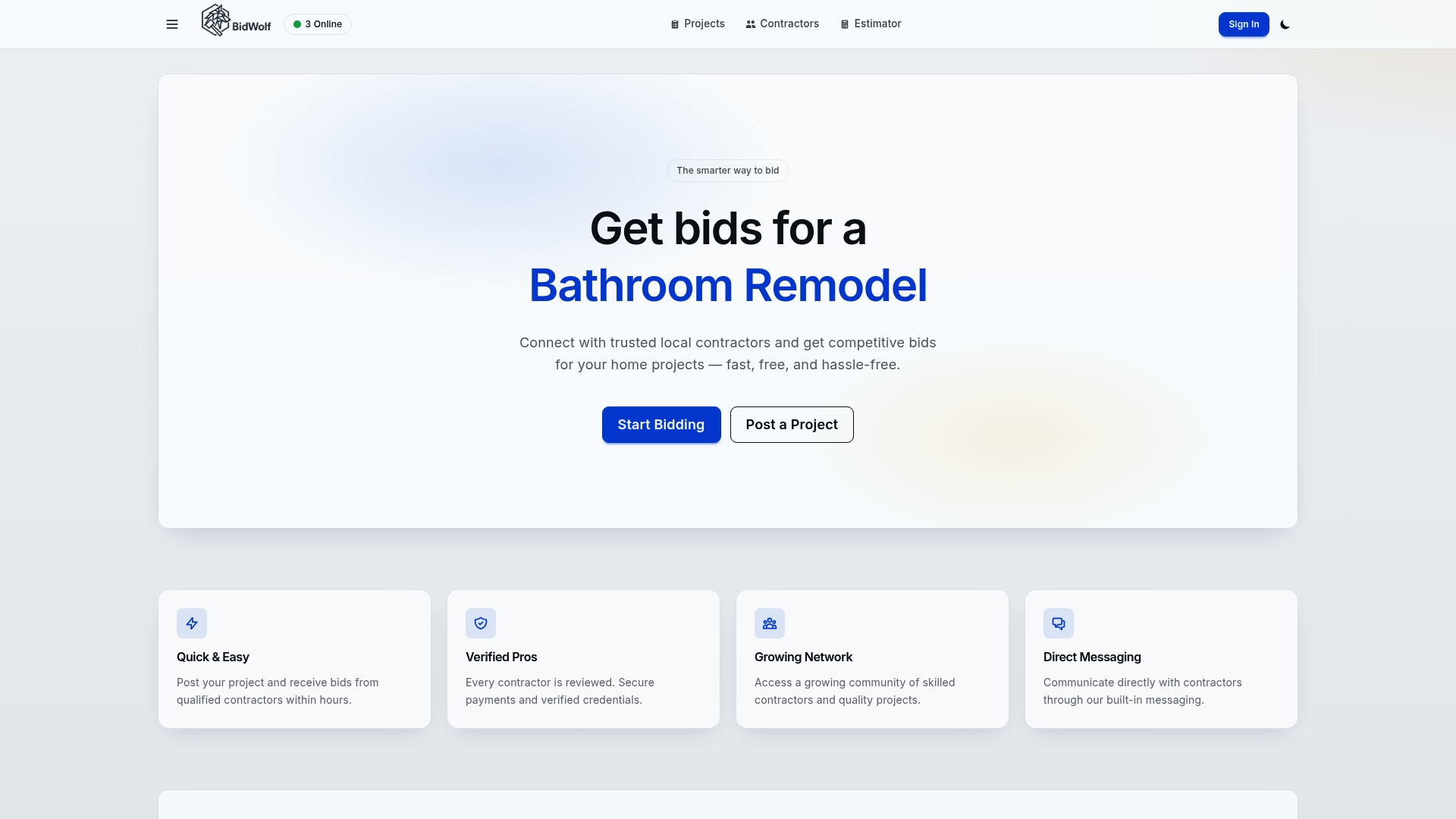
With Bidwolf, you post your renovation project once and receive structured bids from vetted local contractors across Texas. The platform requires contractors to submit detailed proposals, which means you spend less time chasing line-item breakdowns and more time evaluating real options. Built-in messaging lets you send clarification requests directly to each bidder without juggling phone calls and emails. Side-by-side bid display gives you a clear starting point for your comparison matrix. Whether you are managing a bathroom remodel, a roofing replacement, or an electrical upgrade, Bidwolf connects you with qualified local contractors who compete for your project on scope and price. Start your project today and see what competitive bidding actually looks like.
FAQ
What is a bid comparison in home renovation?
A bid comparison is the process of evaluating multiple contractor proposals against the same scope of work to identify the best combination of price, quality, and reliability. It goes beyond comparing totals and includes reviewing exclusions, materials, payment terms, and credentials.
How many bids should i get for a home project?
Collect 3 to 4 bids for any significant renovation or repair project. Fewer than three provides no competitive baseline, and bids within 15% of each other typically indicate normalized scope and competitive market pricing.
What is bid leveling and why does it matter?
Bid leveling is the process of adding estimated costs for scope items that some contractors excluded, so all bids reflect the same total project cost. Without leveling, price comparisons are misleading because you are comparing different scopes of work.
Should i always choose the lowest bid?
No. Lowest bids cause disputes 40% of the time because they often exclude scope or use lower-grade materials. Choose the bid with the best normalized total after accounting for scope, contractor credentials, and non-price factors.
What should a complete contractor bid include?
A complete bid should include a detailed line-item breakdown with at least 15 items, a clear exclusions list, material specifications, a payment schedule tied to milestones, warranty terms, and a projected project timeline.