

How to Select Service Providers for Home Projects

TL;DR:
- Verifying licensing, insurance, and project experience is essential before contacting contractors for home repairs. Collecting three consistent, detailed bids and signing a comprehensive, milestone-based contract prevents disputes and hidden costs. Clear communication, proper documentation, and cautious payment practices protect homeowners from common renovation pitfalls.
Selecting service providers for home renovation and repair is a structured, criteria-driven process built on verifying licensing, insurance, written contracts, and competitive bids. Knowing how to select service providers correctly protects your investment and prevents costly disputes before a single nail is driven. The National Association of REALTORS® confirms that structured vetting steps including licensing checks, detailed contracts, and multiple bids are the baseline for any responsible hiring decision. Skip those steps and you expose yourself to vague scopes, inflated costs, and contractors who disappear mid-project. This guide gives you a practical, evidence-based framework to vet, compare, and hire with confidence.
How to select service providers: the core criteria
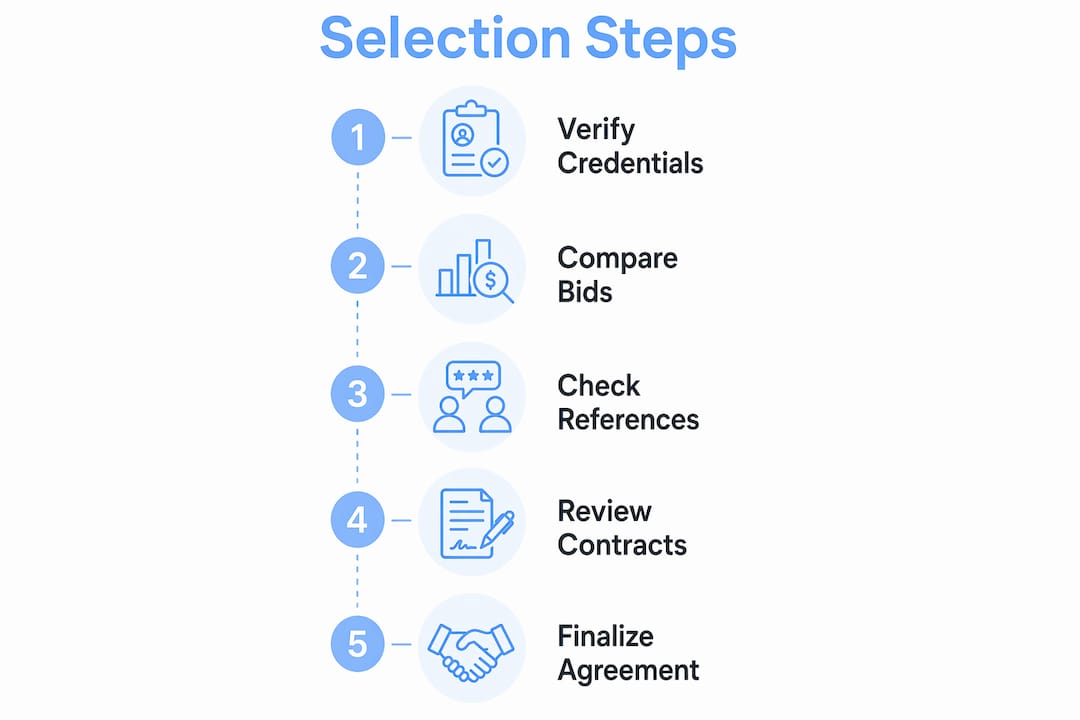
Choosing service providers starts with a non-negotiable checklist. Before you discuss price or timelines with anyone, you need to confirm that the contractor is legally authorized to work in your state, carries the right insurance, and has a track record you can verify independently. These are not optional courtesies. They are the minimum standards that separate reliable professionals from high-risk hires.
Here is what to verify before any conversation goes further:
- Active contractor license. Confirm the license is current and covers the type of work you need. Most states maintain an online lookup tool. In Texas, for example, the Texas Department of Licensing and Regulation (TDLR) lets you search any licensed contractor by name or license number in seconds.
- General liability and workers’ compensation insurance. Ask for a certificate of insurance and call the insurer directly to confirm it is active. If a worker is injured on your property and the contractor carries no workers’ comp, you may be liable.
- Disciplinary and complaint history. The Massachusetts Office of Consumer Affairs recommends checking registration status and disciplinary history through state tools, not just taking a contractor’s word for it. The Better Business Bureau (BBB) is a useful secondary source for complaint patterns.
- Relevant project experience. A contractor who excels at kitchen remodels may not be the right fit for a full roof replacement. Ask for examples of completed projects that match your scope, and request contact information for past clients.
- References you actually call. Most homeowners request references and never follow through. Call at least two. Ask specifically about whether the project finished on time, whether the final cost matched the estimate, and how the contractor handled problems.
Pro Tip: Vet registrations and disciplinary history independently rather than relying on contractor claims. A quick search through your state licensing board takes five minutes and can save you thousands.
The Bidwolf blog’s guide on choosing a reliable contractor in Texas walks through each of these verification steps in detail, which is worth reading if your project is in the Lone Star State. The principle applies everywhere: verify first, then negotiate.

How do you gather and compare bids fairly?
Once you have a shortlist of qualified candidates, the next step is collecting bids in a way that makes honest comparison possible. The most common mistake homeowners make is asking three contractors for a price without giving them the same project description. You end up comparing a full-scope proposal against a stripped-down estimate, and the lowest number wins for the wrong reason.
Follow these steps to run a fair bid process:
- Write a consistent scope of work. Before you contact anyone, document exactly what you want done. Include materials, dimensions, finishes, and any access constraints. Every contractor should receive the same written description.
- Request detailed written estimates. A verbal quote is not a bid. Ask each contractor to break down labor, materials, permits, and any contingency costs in writing. Vague line items like “miscellaneous work” are a warning sign.
- Interview at least three contractors. The NAR consumer guide recommends interviewing a minimum of three remodeling contractors before making any hiring decision. More options give you a realistic sense of market pricing and scope expectations.
- Score proposals on consistent criteria. Ivalua’s vendor selection research recommends using a scoring rubric to evaluate proposals on scope clarity, price, timeline, and provider reliability. Apply the same rubric to every bid so your comparison is objective, not gut-driven.
- Evaluate payment terms carefully. Note when each contractor expects payment and what triggers each installment. Milestone-based payments tied to completed work stages are the standard for responsible contractors.
Pro Tip: Build a simple spreadsheet with columns for scope completeness, total price, timeline, payment structure, and license status. Score each bid 1 to 5 in every column. The contractor with the highest total score is usually the right choice, even if they are not the cheapest.
The table below shows how a basic bid comparison might look for a bathroom remodel:
| Criteria | Contractor A | Contractor B | Contractor C |
|---|---|---|---|
| Scope completeness | Detailed, itemized | Partial, vague | Detailed, itemized |
| Total price | $14,200 | $11,800 | $15,500 |
| Timeline | 3 weeks | 2 weeks | 4 weeks |
| Payment structure | Milestone-based | 50% upfront | Milestone-based |
| License verified | Yes | Pending | Yes |
Contractor B looks attractive on price, but the vague scope, unverified license, and 50% upfront payment demand are three separate red flags in one proposal. Structured bid comparison, as Ivalua’s proposal scoring guidance confirms, prevents scope creep and hidden costs by forcing every proposal through the same filter. Understanding fair bidding practices before you start collecting quotes will sharpen your ability to spot the difference between a competitive price and a dangerously low one.
What should a contract include before you sign?
A signed contract is your primary legal protection once work begins. Many homeowners treat it as a formality. That is a costly assumption. The contract defines what you are paying for, when you pay, and what happens if something goes wrong. Without specific language on each of those points, disputes become expensive and difficult to resolve.
Every service agreement for home renovation or repair should include:
- Detailed scope of work. Every task, material specification, and finish standard should be written out. “Install new flooring” is not a scope. “Install 450 square feet of 5-inch white oak hardwood, sanded and finished with two coats of water-based polyurethane” is a scope.
- Cost breakdown and payment milestones. The total price should be divided into installments tied to specific completed stages. The Massachusetts anti-scam guidance stresses that deposits must be linked to completed work stages, not arbitrary dates.
- Project timeline with start and completion dates. Vague language like “approximately six weeks” invites delays. Specify a start date and a target completion date, with a clause addressing what happens if the contractor misses the deadline.
- Warranty terms. Know what is covered, for how long, and what process you follow to make a warranty claim. A reputable contractor will offer at least a one-year workmanship warranty on most renovation projects.
- Insurance and license confirmation. The contract should reference the contractor’s license number and confirm that general liability and workers’ compensation coverage are active for the duration of the project.
- Change order process. Any deviation from the original scope should require a signed written change order before additional work begins. This single clause prevents the majority of cost overrun disputes.
Watch for these red flags before you sign:
- Large upfront payment demands. Paying more than 10 to 15 percent before work starts is a recognized warning sign. The NAR’s consumer hiring guide explicitly warns against vague contracts and excessive upfront payments.
- Excessive “allowances” without specified materials. An allowance is a placeholder for a cost not yet determined. Too many allowances mean the contractor has not fully scoped the project, and your final bill will be higher than the estimate.
- No written warranty language. If a contractor resists putting warranty terms in writing, that resistance tells you something important about their confidence in their own work.
Pro Tip: Before signing any contract over $5,000, have a real estate attorney or a trusted industry advisor review it. The cost of a one-hour legal consultation is a fraction of what a poorly written contract can cost you in disputes.
Tips for tenant projects and compliance-driven selections
Tenants and landlords managing rental properties face a layer of complexity that owner-occupied homeowners do not. When repairs affect habitability or involve subsidized housing programs, the criteria for evaluating service providers expand beyond licensing and price. Documentation, response time, and regulatory knowledge become equally important.
Key factors to prioritize in tenant or compliance-driven contexts:
- Documentation practices. Ask prospective providers whether they photograph work before, during, and after completion. For properties subject to HUD oversight or NSPIRE inspections, the Inspection Group’s guidance confirms that documentation quality is as vital as technical repair quality. Repair logs and timestamped photos protect both the landlord and the tenant in any dispute or audit.
- Response time commitments. Urgent repairs like plumbing failures or HVAC outages in occupied units require a provider who can respond within hours, not days. Ask for a written service level agreement that specifies response windows for emergency versus routine work.
- Regulatory familiarity. If your property participates in a HUD program or receives housing subsidies, your service provider must understand REAC or NSPIRE inspection standards. A contractor unfamiliar with those standards can inadvertently create deficiencies that trigger failed inspections and financial penalties. Master Service Pro’s maintenance and repair services are one example of providers who specialize in compliance-aware property maintenance.
- Trial engagements before long-term contracts. For ongoing maintenance relationships, consider awarding a single project or a short-term contract before committing to a multi-year agreement. Performance on a small job tells you more than any reference check.
- Periodic performance reviews. Set a calendar reminder to evaluate your service provider every six months. Review documentation quality, response times, and whether completed work has held up. Providers who know they are being evaluated consistently tend to maintain higher standards.
The Inspection Group’s vendor selection framework for HUD properties reinforces that compliance-driven selections require ongoing evaluation, not just a one-time vetting process. Build that review cycle into your property management routine from the start.
Key takeaways
Selecting a reliable service provider requires verifying licensing and insurance, comparing at least three detailed bids on consistent criteria, and signing a contract that specifies scope, payment milestones, and warranty terms before any work begins.
| Point | Details |
|---|---|
| Verify credentials first | Confirm active license, insurance, and complaint history before discussing price. |
| Compare at least three bids | Use a consistent scope and a scoring rubric to evaluate proposals objectively. |
| Demand a detailed contract | Scope, payment milestones, timeline, and warranty terms must all be in writing. |
| Avoid large upfront payments | Deposits should be tied to completed work stages, not paid in full before work starts. |
| Add documentation for tenant projects | Require before/after photos and response time commitments for compliance-driven repairs. |
What I have learned from watching homeowners get this wrong
I have reviewed hundreds of contractor disputes, and the pattern is almost always the same. The homeowner skipped one step early in the process, and that single gap created every problem that followed. The most common skip is the contract review. People feel awkward asking a contractor to revise their standard agreement, so they sign it without reading the scope carefully. Three weeks later, they are arguing about whether crown molding was included.
The second most common mistake is paying too much upfront. A contractor who demands 40 or 50 percent before breaking ground is either cash-strapped or betting that you will not push back once the money is transferred. Both scenarios put you at a disadvantage. Milestone-based payments keep the contractor accountable because their next check depends on completing the previous phase to your satisfaction.
What I find underrated in most guides is the role of communication quality during the selection process itself. Transparent communication during contractor interviews is a reliable signal of how a provider will behave once the project starts. If a contractor is slow to return calls, vague about their process, or defensive when you ask about their license, those behaviors do not improve after you sign. They get worse. Pay attention to how a contractor communicates before you hire them. It is one of the most honest previews you will get.
The homeowners who consistently get good outcomes are not the ones who found the cheapest contractor. They are the ones who defined their scope clearly, verified credentials independently, compared bids on equal terms, and read the contract before signing it. That process takes more time upfront. It saves an enormous amount of time, money, and frustration later.
— Devin
Find vetted contractors faster with Bidwolf
Bidwolf takes the most time-consuming parts of provider selection and handles them for you. When you post your project on the platform, you receive competitive bids from vetted, license-verified local contractors who have already been screened for credentials and reviews. You can compare bids side by side, message contractors directly through the built-in tool, and review verified ratings before making a decision.
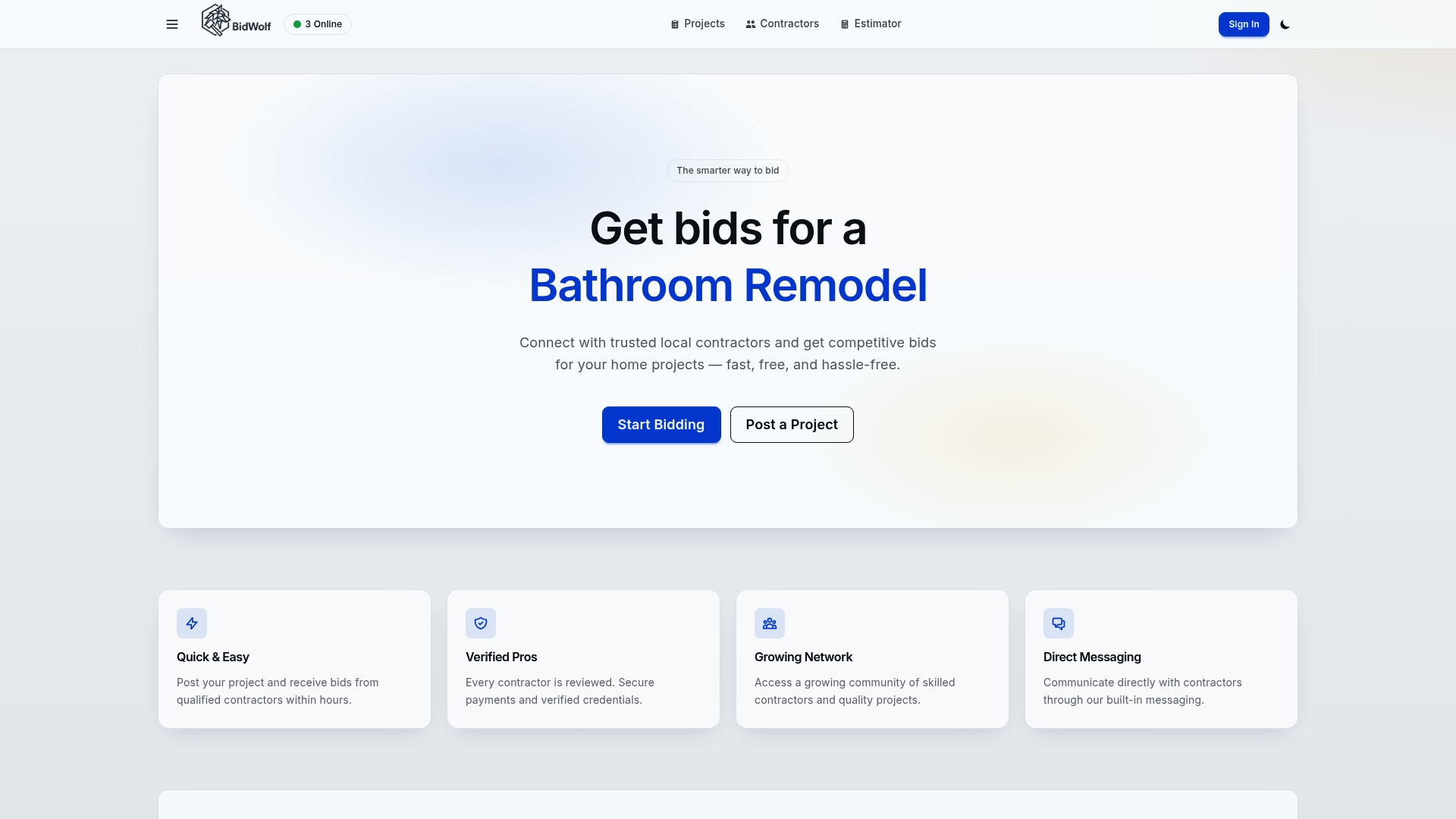
Bidwolf operates across multiple cities in Texas and continues to grow its contractor network. Whether you are planning a bathroom remodel, a roofing repair, or a landscaping overhaul, the platform gives you the structure and transparency that makes choosing service providers straightforward. You can also find local contractors by trade and location to build your shortlist before bids even come in. No cold calls, no guesswork, and no pressure to accept the first number you see.
FAQ
What are the most important criteria for selecting a contractor?
Licensing, insurance, relevant experience, and a detailed written contract are the four non-negotiable criteria. The NAR’s consumer guide confirms that verifying these factors before signing protects homeowners from the most common renovation disputes.
How many bids should I get for a home renovation project?
Get at least three written bids from qualified contractors. Interviewing a minimum of three providers gives you a realistic sense of market pricing and helps you identify outliers on both the high and low end.
What should I never pay upfront to a contractor?
Avoid paying more than 10 to 15 percent of the total project cost before work begins. The Massachusetts Office of Consumer Affairs warns that large upfront deposits not tied to completed work stages are one of the most common signals of contractor fraud.
How do I verify a contractor’s license in Texas?
Search the Texas Department of Licensing and Regulation (TDLR) online database using the contractor’s name or license number. The search is free and confirms whether the license is active and whether any disciplinary actions have been filed.
What documentation should I require for tenant repair projects?
Require before and after photographs, dated repair logs, and written confirmation of response time commitments. For HUD or subsidized properties, the Inspection Group recommends verifying that vendors understand NSPIRE inspection standards to avoid compliance failures.