

Texas Contractor Regulation: What Homeowners Must Know

TL;DR:
- Texas contractors are regulated through a layered system where specialty trades like electricians, plumbers, and HVAC must hold state licenses, but general contractors do not require a statewide license. Local city and county rules, which vary significantly, add additional permitting and registration requirements that homeowners must navigate carefully. Verifying contractor credentials involves multiple steps, including license checks, business registrations, insurance confirmation, and permit verifications, to ensure legal compliance and project protection.
Texas contractor regulation is defined as a layered system of trade-specific state licensing and locally enforced permitting rules, with no statewide general contractor license required for general construction work. This structure surprises most homeowners planning a renovation. You are not dealing with one central authority. Instead, you are navigating the Texas Department of Licensing and Regulation (TDLR), the Texas State Board of Plumbing Examiners (TSBPE), and your city or county’s own permitting office, all at once. Understanding how these layers interact is the difference between a protected project and a costly dispute.
What is Texas contractor regulation and how does it work at the state level?
The most important fact about contractor regulations in Texas is also the most misunderstood: Texas does not require a statewide license for general contractors. A person can legally manage your kitchen remodel or room addition without holding any state-issued general contractor credential. That does not mean anyone can do anything. The state draws a firm line around specialty trades, and those rules are strict.

How TDLR and TSBPE regulate specialty trades
The Texas Department of Licensing and Regulation governs electricians and HVAC contractors. The Texas State Board of Plumbing Examiners governs plumbers. These are separate agencies with separate databases, and verifying the correct license type with the correct agency is a step many homeowners skip entirely. Hiring an unlicensed electrician, for example, can void your homeowner’s insurance coverage if a fire results from faulty wiring.
Here is what state-level Texas contractor licensing covers:
- Electricians: Licensed through TDLR. Search the TDLR license lookup tool at tdlr.texas.gov to confirm active status before any work begins.
- HVAC contractors: Also licensed through TDLR. Technicians must hold an Air Conditioning and Refrigeration Contractor license for commercial work or a Technician license for residential systems.
- Plumbers: Licensed through TSBPE. Texas law requires a licensed plumber to be on-site or directly supervising all plumbing work. Verify at tsbpe.texas.gov.
- General contractors: No state license required. Regulation falls to local jurisdictions for permitting and registration.
The consequences of hiring unlicensed specialty contractors go beyond safety. If unpermitted or unlicensed work is discovered during a home sale inspection, you may be required to tear out and redo the work at your own expense. That is a real scenario that plays out in Texas real estate transactions every year.
Pro Tip: Always ask for the license number before signing any contract for electrical, plumbing, or HVAC work. Then look it up yourself. Do not rely on a contractor’s verbal assurance or a photocopy of a card.
How do local city and county rules affect contractor registration?
Local jurisdictions are where contractor regulations in Texas get genuinely complex. The state sets the floor for trade licensing, but cities and counties build their own requirements on top of it. What applies in Austin does not necessarily apply in Dallas or Houston, and that geographic variation catches homeowners off guard.
Here is how three major Texas cities handle contractor registration and permitting:
- Austin: The Building Technical and Code Services (BTCS) division requires permits for most construction, electrical, plumbing, and mechanical work. Contractors must register with the city and maintain current insurance. Austin’s permit portal allows homeowners to check permit status online by address.
- Dallas: Contractors must complete annual registration with the city and pay associated fees. Dallas also requires proof of general liability insurance and, for some trades, a surety bond. Registration must be renewed each year, so a contractor who was compliant last year may not be compliant today.
- Houston: Houston operates on a job-by-job permit system rather than annual contractor registration. Each project requires its own permit pulled before work starts. Houston’s local permitting rules mean a contractor’s compliance status must be verified project by project, not just once.
| City | Registration type | Permit model | Bond required |
|---|---|---|---|
| Austin | City registration + insurance | Project-based permits | Varies by trade |
| Dallas | Annual registration + fees | Project-based permits | Yes, for some trades |
| Houston | No annual registration | Job-by-job permits | Not universally required |
Beyond registration, most Texas cities require permits for electrical, plumbing, structural, and major remodeling work. Permits trigger inspections that confirm the work meets safety and building codes. Skipping permits to save time or money is a serious red flag, and the homeowner, not the contractor, typically bears the legal liability for unpermitted work on their property.
Pro Tip: Before hiring any contractor, call your city’s permitting office or check their website to confirm what permits your specific project requires. Do not assume the contractor will handle this automatically.
What legal protections should Texas homeowners know before signing a contract?
Texas construction law gives homeowners more protection than most people realize, but those protections only work if you know they exist and document your project correctly. Two areas matter most: payment rules and contract terms.
Prompt payment rules on public projects
Texas’s Payment for Goods and Services Act establishes prompt payment rules for public construction projects. A prime contractor must pay subcontractors within 10 days of receiving payment from the public owner. Late payments trigger automatic interest accrual. This matters to homeowners indirectly. If your contractor is also working on public projects and has payment disputes there, those financial pressures can affect how they prioritize your private job.
The same statute gives contractors and subcontractors the right to suspend work for nonpayment, provided they give written notice and wait 10 days. Knowing this helps you understand why a contractor might pause work and what your rights are if they do so without proper notice.
New 2025 venue rules that protect Texas homeowners
A significant change in Texas construction law took effect September 1, 2025. New legislation voids contractual provisions that designate non-Texas venues or laws for disputes involving Texas real property. Before this law, some contractor contracts included clauses requiring disputes to be arbitrated in another state or under another state’s laws. That practice is now prohibited. Any dispute about work done on your Texas home must be resolved in Texas, and unless both parties agree otherwise after the dispute arises, it must be handled in the county where the property is located.
This 2025 venue law is a genuine win for Texas homeowners. It eliminates a tactic some contractors used to make disputes too expensive or inconvenient to pursue. If a contractor’s contract still contains a foreign venue clause, that clause is now void by law, even if you signed it.
What your written contract must include
A clear written contract is your primary protection on any private renovation project. Every contract should spell out the full scope of work, payment schedule tied to project milestones, start and completion dates, and a process for handling changes. Separate disputed amounts from undisputed amounts in any payment dispute, and document every invoice, payment, and written communication. If a contractor abandons a project or performs substandard work, your documentation determines whether you can recover damages through a lawsuit or contractor bond claim.
- Scope of work: detailed description of every task, material, and finish
- Payment terms: milestone-based payments, not large upfront lump sums
- Timeline: specific start date and substantial completion date
- Change order process: written approval required before any scope changes
- Dispute resolution: now must comply with Texas venue requirements under 2025 law
How can Texas homeowners verify contractor credentials effectively?
Verification is not a single database search. It is a multi-step process that covers trade licenses, business identity, insurance, and local registration. Homeowners who rely on only one check are leaving significant risk on the table.
Step-by-step credential verification
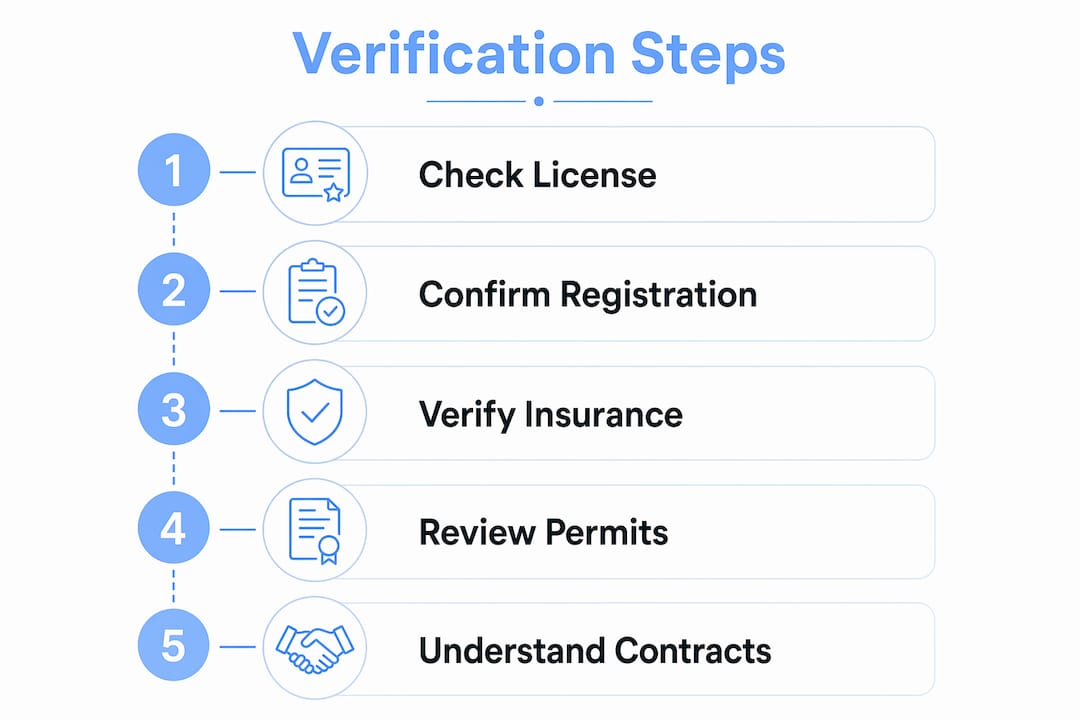
Start with trade licenses. Search TDLR’s online lookup for electricians and HVAC contractors. Search TSBPE’s database for plumbers. Confirm the license is active, not expired or suspended, and that the name on the license matches the name on your contract. This single step catches a large share of fraudulent or unqualified contractors.
Next, verify business identity. Texas contractors operating as LLCs or corporations appear in the Texas Secretary of State’s business search. However, sole proprietors may not appear in the same databases as registered entities. A contractor operating under an assumed name, sometimes called a DBA (doing business as), must file that name with the county clerk. Cross-check the business name on your contract against assumed name filings and Secretary of State records. A mismatch between the business name on a contract and the name on an insurance certificate is a red flag that warrants clarification before you pay anything.
Request a current certificate of general liability insurance and, where applicable, workers’ compensation coverage. Ask to be listed as an additional insured on the policy. Call the insurance company directly to confirm the policy is active. Do not accept a certificate that is more than 30 days old.
Here is a practical verification checklist for Texas homeowners:
- Search TDLR at tdlr.texas.gov for electricians and HVAC contractors
- Search TSBPE at tsbpe.texas.gov for plumbers
- Check Texas Secretary of State business search for LLCs and corporations
- Verify assumed name (DBA) filings with the county clerk if the contractor is a sole proprietor
- Request and verify a current certificate of general liability insurance
- Confirm workers’ compensation coverage for contractors with employees
- Check your city’s permit portal to confirm permits are pulled before work starts
- Ask for references from projects completed in your city within the last 12 months
The BidWolf homeowner’s checklist covers each of these steps in detail and is a practical companion to the verification process described here.
Pro Tip: If a contractor asks you to pull the permit yourself or suggests skipping inspections to save time, walk away. Homeowner-pulled permits can shift legal liability for the work entirely onto you, and skipped inspections mean no independent verification that the work is safe.
Common mistakes homeowners make include relying on a single database search, assuming a contractor’s business card name matches their legal entity, and skipping insurance verification because the contractor seems trustworthy. Trustworthiness is not a substitute for documentation. A Conroe restaurant owner learned this after a contractor took $200,000 and left the job unfinished. Proper credential verification before payment would have revealed the warning signs earlier.
Key takeaways
Texas contractor regulation requires homeowners to verify trade licenses, local registration, insurance, and contract terms across multiple agencies and jurisdictions before any work begins.
| Point | Details |
|---|---|
| No state general contractor license | Texas does not require a statewide license for general contractors; regulation is trade-specific and local. |
| TDLR and TSBPE govern specialty trades | Verify electricians and HVAC contractors through TDLR; verify plumbers through TSBPE before hiring. |
| Local rules vary significantly | Austin, Dallas, and Houston each have distinct registration, permit, and bond requirements for contractors. |
| 2025 venue law protects homeowners | New Texas law voids foreign venue clauses in construction contracts, keeping disputes in Texas courts. |
| Verification requires multiple steps | Check trade licenses, business identity, insurance, and local permit status separately for full protection. |
What I’ve learned from watching Texas homeowners get this wrong
The most consistent mistake I see is homeowners treating contractor verification as a one-time box to check rather than a layered process. They search one database, get a result, and assume they are covered. They are not.
The second mistake is conflating a contractor’s confidence with their compliance. A contractor who has been in business for 20 years and comes with a neighbor’s recommendation can still be operating without current local registration or with a lapsed insurance policy. Those credentials expire. Your neighbor’s experience from three years ago does not tell you what the contractor’s status is today.
What actually works is treating the verification process the way you would treat a background check for any significant financial decision. You would not wire $50,000 to someone based on a handshake. Do not authorize $50,000 in renovation work without confirming every credential is current and documented.
I also want to push back on the idea that local permitting offices are bureaucratic obstacles. In my experience, they are one of the most underused resources available to Texas homeowners. Call them before you hire. Ask what permits your project requires, what contractor registration they expect, and whether the contractor you are considering has pulled permits in their jurisdiction before. That conversation takes 15 minutes and can save you months of legal headaches.
The 2025 venue law change is genuinely significant and most homeowners do not know about it yet. If a contractor hands you a contract with an out-of-state arbitration clause, you now have the legal standing to reject it outright. Use that standing. A contractor who insists on keeping a clause that Texas law has voided is telling you something important about how they handle disputes.
For a practical framework on choosing reliable contractors in Texas, the verification steps outlined in this article are the starting point, not the finish line.
— Devin
Find verified Texas contractors through BidWolf
Navigating Texas contractor licensing requirements on your own takes time and requires checking multiple agencies and local offices. BidWolf simplifies that process by connecting Texas homeowners directly with license-verified, vetted contractors who are active in their city.

When you post a project on BidWolf, you receive competitive bids from local professionals whose credentials have already been reviewed. You can compare bids, review contractor profiles, and communicate directly through the platform before committing to anyone. BidWolf’s network spans multiple Texas cities, and the platform supports permit management guidance so your project stays compliant from start to finish. Find local contractors in your area and get bids from professionals who meet Texas’s trade licensing and local registration requirements.
FAQ
Does Texas require a general contractor license?
Texas does not require a statewide general contractor license for residential or commercial construction. Regulation applies to specialty trades like electrical, plumbing, and HVAC through TDLR and TSBPE, while local jurisdictions handle permitting and contractor registration.
How do I verify a contractor’s license in Texas?
Search the TDLR database at tdlr.texas.gov for electricians and HVAC contractors, and the TSBPE database at tsbpe.texas.gov for plumbers. Confirm the license is active and that the name matches your contract before any work begins.
What permits are required for home renovation in Texas?
Most Texas cities require permits for electrical, plumbing, structural, and major remodeling work. Requirements vary by city, so contact your local permitting office or check their online portal to confirm what your specific project needs before work starts.
What does the 2025 Texas venue law mean for homeowners?
The 2025 law voids any contract clause that requires disputes about Texas real property to be resolved outside Texas. Disputes must now be handled in Texas, and typically in the county where the property is located, giving homeowners a stronger legal position.
What are the biggest red flags when hiring a Texas contractor?
The top red flags include requests to skip permits or inspections, large upfront payments before work begins, a mismatch between the business name on a contract and the name on an insurance certificate, and any contract clause requiring out-of-state dispute resolution. Verify all credentials independently before signing anything.