

How to request project bids: Texas homeowner's guide

TL;DR:
- Requesting accurate home renovation bids requires a detailed, written scope of work to ensure fair comparisons and prevent costly scope creep.
- Preparing a comprehensive bid request packet with clear guidelines and standardized formats enables homeowners to evaluate contractor bids effectively and select qualified, licensed professionals.
Getting three bids for a home renovation sounds simple until you actually do it. One contractor quotes you a lump sum with no breakdown. Another lists 40 line items you can’t decipher. The third never mentions permits at all. Knowing how to request project bids correctly, before you ever contact a contractor, is what separates homeowners who finish renovations on budget from those who absorb thousands in unexpected change orders. This guide walks you through every step, from writing a clear scope to verifying credentials, so your bids are actually comparable and your project stays on track.
Table of Contents
- Why clear scope definition is essential before requesting bids
- Preparing your request for bid packet: key elements and format
- How to solicit and evaluate multiple bids to ensure fairness and quality
- Common pitfalls when requesting bids and how to avoid them
- What to do after receiving bids: verification and selecting the right contractor
- The overlooked power of a well-crafted bid request in Texas renovations
- Simplify your bidding process with BidWolf’s platform
- Frequently asked questions
Key Takeaways
| Point | Details |
|---|---|
| Define detailed scope | A clear and specific scope of work ensures contractors submit comparable bids with no hidden assumptions. |
| Request multiple bids | Getting at least three bids from qualified contractors helps you find competitive prices and reliable services. |
| Verify licensing | Ensure regulated trades like electrical and plumbing are properly licensed to protect safety and compliance. |
| Clarify allowances and change orders | Ask contractors how they handle allowances and change orders to avoid unexpected cost increases. |
| Use written documentation | Keep all bids and assumptions in writing to serve as your contract’s source of truth and avoid disputes. |
Why clear scope definition is essential before requesting bids
The single most costly mistake Texas homeowners make happens before a single contractor is contacted. They skip the written scope of work. As one industry resource puts it, a vague scope produces mismatched estimates and bidding responses that simply cannot be fairly compared. That’s not a minor inconvenience. It’s how a $25,000 bathroom remodel turns into a $38,000 project halfway through.
A scope of work is a written document that describes exactly what will be done, what materials will be used, and what is explicitly excluded from the project. It answers the questions every contractor will have and gives every bidder the same starting point. Without it, each contractor fills in the blanks differently, and you end up comparing bids that are fundamentally quoting different projects.
What to include in your scope of work:
- Inclusions: Every task you expect the contractor to complete, listed specifically. “Replace master bath tile” is not enough. “Remove existing 12x12 ceramic floor tile in master bath (approx. 80 sq ft), dispose of debris, install owner-supplied 12x24 porcelain tile with standard grout” is usable.
- Exclusions: Anything you are handling yourself or through another contractor. This protects you from being billed for work you never requested.
- Allowances: Budget placeholders for items not yet selected, such as fixtures or finishes. Every bidder should use the same allowance figure so pricing stays comparable.
- Assumptions: Conditions the bid is based on, such as “assumes no water damage behind existing tile.” If an assumption turns out to be false, a change order is expected, but you’ll know exactly why.
“The scope of work is the beating heart of a bid request. If it’s not detailed and unambiguous, you’ll get responses that can’t be fairly compared.” — DownToBid
Pro Tip: Write your scope in plain language, then have a knowledgeable friend read it and list every question it leaves unanswered. Those gaps are exactly where surprise costs hide.
When you hand every contractor the identical written scope, you make comparing contractor bids in Texas a straightforward exercise rather than a guessing game.
Preparing your request for bid packet: key elements and format
With your scope defined, here’s how to package it into a clear, professional bid request. A bid request packet is the full set of documents you send to every contractor. Think of it as a job posting for your project. The more complete it is, the more complete and accurate the responses will be.
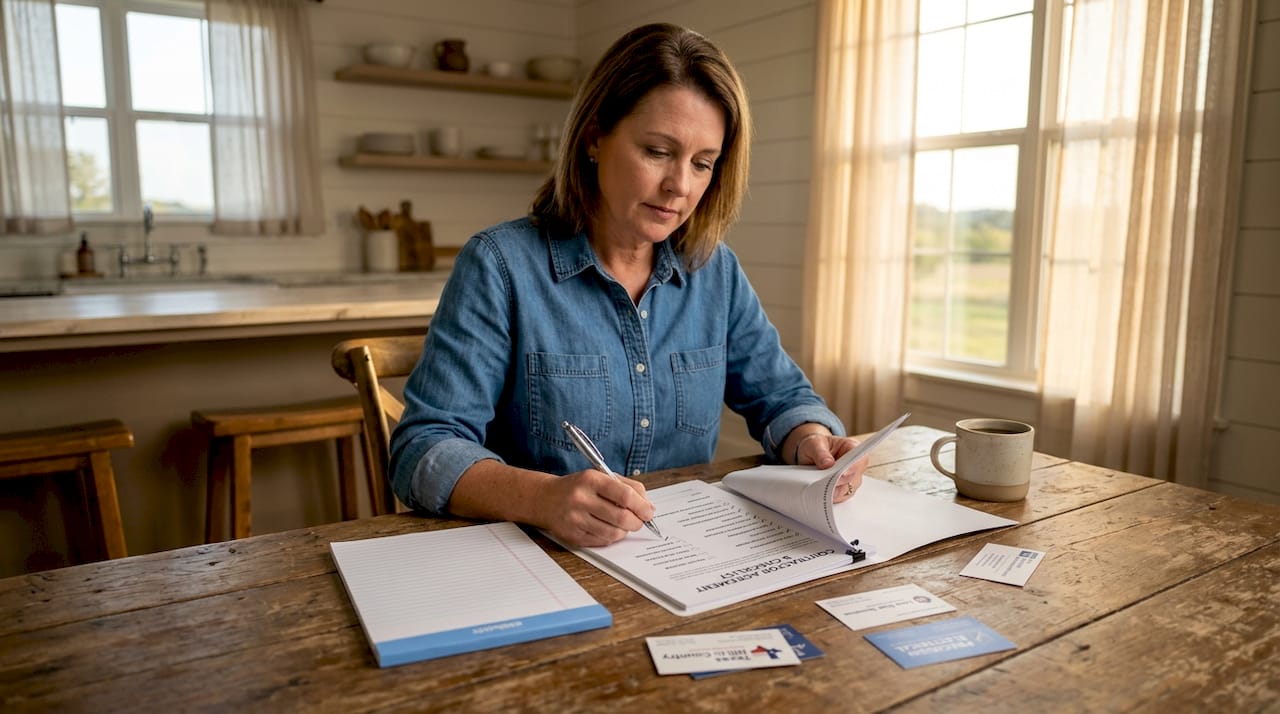
A properly assembled bid request should include at minimum project scope and specifications, timeline expectations, contract terms, and submission guidelines. Here’s how each piece works in practice.
Steps to build your bid request packet:
- Cover page. Include your name, property address, project name, bid deadline, and preferred contact method. Keep it one page.
- Scope of work document. The detailed written scope you developed, including inclusions, exclusions, allowances, and assumptions.
- Materials and specifications. List any materials you’ve already selected, including brand, model, or finish. If the contractor is sourcing materials, define the minimum quality standard.
- Timeline expectations. State your desired start date, projected completion window, and any hard deadlines, such as a lease end date or family event.
- Submission instructions. Tell contractors exactly how to submit their bid, in what format, and by what date. Specify that verbal quotes are not accepted.
- Bid format template. A simple form or table that requires each contractor to fill in total price, labor cost, material cost, allowances used, exclusions, and change order policy. This is what allows direct comparison.
Using a uniform bid format is one of the most underutilized tools in home renovation. Without it, project bidding turns into a translation exercise where you’re guessing what each number includes.
| Bid component | What to require from each contractor |
|---|---|
| Total project price | Full cost including labor, materials, and disposal |
| Line item breakdown | Labor and materials listed separately |
| Allowances | Dollar amount used for unselected items |
| Exclusions | Specific tasks or materials not included |
| Change order policy | How cost increases are documented and approved |
| Payment schedule | Milestone payments tied to project phases |
| Timeline | Estimated start and completion dates |
| Permits | Who pulls them and who pays for them |
Every field in that table matters. A bid that skips permit responsibility is hiding a potential $500 to $2,000 cost that you may be responsible for if no one addresses it.
How to solicit and evaluate multiple bids to ensure fairness and quality
After preparing your bid request, the next step is to reach out and compare bids effectively. You need more than one or two responses to make a sound decision. Sending requests to three or more independently qualified contractors gives you a realistic picture of market pricing and exposes any outliers, both unusually high and suspiciously low.
How you select those three contractors matters just as much as how many you ask. Here’s what to verify before you even send your bid packet:
- License status for regulated trades. Texas has specific licensing requirements. Contractor licensing in Texas requires electricians, plumbers, and HVAC technicians to hold state-issued specialty licenses, even if the general contractor they work for does not. Ask for license numbers and verify them with the Texas Department of Licensing and Regulation.
- Active general liability insurance. Request a certificate of insurance naming you as the certificate holder. A contractor without current liability coverage transfers all risk to you if something goes wrong.
- References from similar project types. A contractor with strong roofing references may not be your best choice for a full kitchen remodel. Match their track record to your project type.
- Current workload. A contractor who can start next week when everyone else is booked out three months is not necessarily a deal. Ask why they’re available and what projects they currently have in progress.
Pro Tip: When you send your bid request, include a specific response deadline, typically 7 to 10 business days. Contractors who miss that deadline without communicating are showing you exactly how they’ll handle communication mid-project.
Once bids come in, don’t open them and go straight to the bottom line. Use the comparison table you required as part of the submission to review each bid side by side. Tools for managing multiple renovation bids can save hours of spreadsheet work when comparing three or more responses at once. You’re looking at total price, inclusions, allowances, exclusions, payment terms, and timeline. A bid that’s $4,000 lower but excludes demolition, permits, and disposal is not cheaper. It’s just less honest.
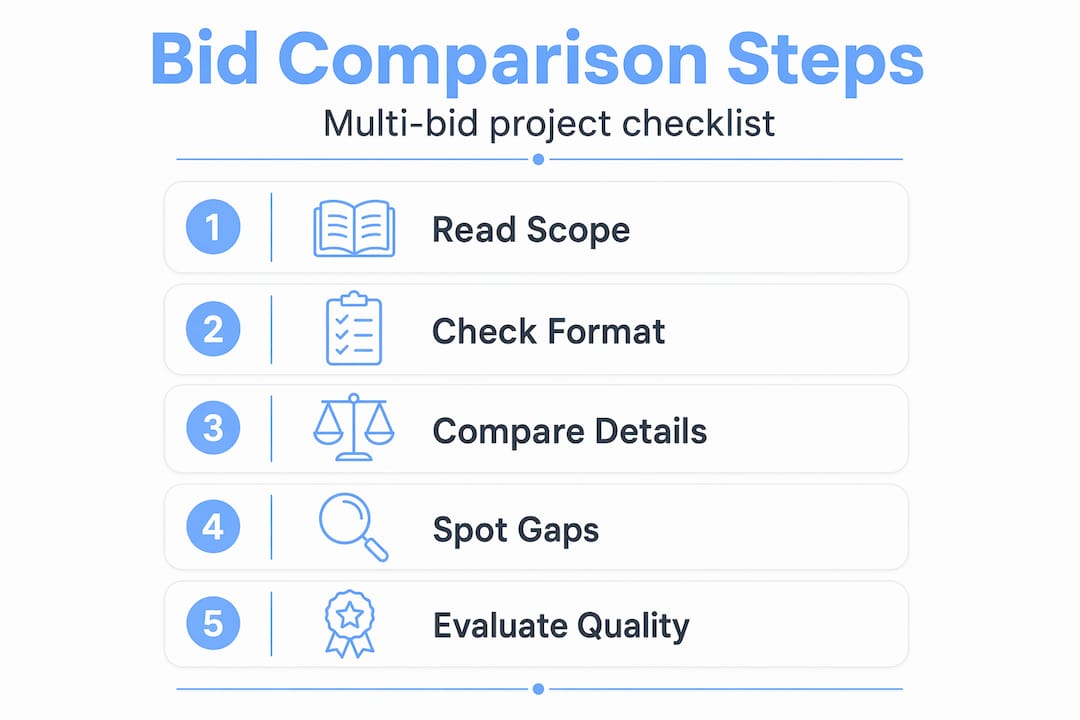
Refer to this choosing contractors checklist to make sure you’re covering every evaluation point before making a selection.
Common pitfalls when requesting bids and how to avoid them
Understanding these pitfalls helps you finalize your bid requests and interpret responses accurately. Most bid problems don’t start when contractors submit their numbers. They start before the bid is written, when the scope is unclear and each party is quietly filling in blanks with their own assumptions.
The most common mistakes Texas homeowners make:
- Accepting verbal clarifications. A contractor walks your project, says “yeah, we’ll take care of the demo,” and you assume it’s in the bid. It’s not, unless it’s in writing. Every clarification, addition, or exception must be documented in the bid itself or in a written follow-up email.
- Ignoring allowance definitions. If your scope says “owner to select tile, allowance $3 per sq ft,” a contractor bidding $2.50 per sq ft and one bidding $5 per sq ft are pricing different projects. Standardize your allowances and require every bidder to use the same number.
- Not asking about permit responsibility. In Texas, pulling permits is usually the contractor’s job, but it’s not automatic. If no one explicitly owns it in the bid, disputes happen. Make it a required field in your bid form.
- Overlooking waste disposal language. Debris removal from a demo can cost $500 to $1,500 depending on project size. If the bid says nothing, you may be paying for a dumpster you didn’t know you needed.
- Skipping the change order policy question. This is the number one source of budget overruns. Ask every bidder to state in writing how change orders are initiated, priced, and approved. A contractor who says “we’ll work it out” is not giving you a usable answer.
Pro Tip: Create a one-page checklist of every item you want explicitly addressed in each bid. If a submitted bid leaves any item blank, send it back and ask for clarification before you evaluate it.
Strong communication with Texas contractors throughout the bidding process sets a professional tone that the best contractors respect. If you treat bidding casually, expect casual responses.
What to do after receiving bids: verification and selecting the right contractor
Now that you know how to avoid bid problems, here’s how to finalize your choice after review. Receiving three well-formatted bids is progress, but selecting the right contractor requires one more layer of due diligence.
Step-by-step review process:
- Read each bid line by line. Compare it directly against your scope. Mark any line item in your scope that is missing from the bid. Those gaps are either exclusions the contractor forgot to note, or scope you’ll be asked to pay for later.
- Check allowances. Did the contractor use your standard allowance figures, or did they substitute their own? A contractor who lowers an allowance to reduce their bid total is not saving you money. They’re deferring the cost.
- Verify licensing and insurance. For any regulated trade, confirm license numbers are current. For general contractors, confirm general liability insurance and workers’ compensation coverage are active.
- Ask about subcontractors. Many general contractors subcontract electrical, plumbing, or HVAC work. Find out who those subs are and whether they are licensed. The GC’s license does not cover a subcontractor’s work in regulated trades.
- Clarify payment schedule milestones. A payment schedule tied to specific milestones protects you. Upfront payments exceeding 10 to 15 percent of the total project cost are a caution sign.
- Confirm start and completion dates in writing. A verbal promise of a six-week timeline is not enforceable. Require it in the contract.
What to look for when reviewing final bids:
- Complete scope coverage with no unexplained gaps
- Allowances that match your standardized figures
- Active license and insurance documentation provided
- Change order policy stated clearly in writing
- Payment schedule tied to measurable project milestones
- Realistic timeline with defined start and end dates
One of the most counterintuitive realities of the bidding process: the lowest bid often signals scope omissions, unlicensed labor, or substandard materials rather than genuine cost savings. Mid-range bids with complete scope and verified credentials represent lower risk. This doesn’t mean the highest bid is better. It means price alone is not a reliable signal of value.
Use the smart questions for Texas contractors to dig into any gaps before you sign anything.
The overlooked power of a well-crafted bid request in Texas renovations
Here’s an honest observation after watching thousands of renovation projects go sideways: most homeowners treat the bid request as a formality. They send a quick email describing what they want, wait for numbers to come back, then pick the lowest one. That approach produces predictable results. Cost overruns. Scope disputes. Contractors who feel entitled to bill for things you thought were included.
The bid request is not paperwork. It’s your first act of project management. A well-written scope of work, paired with a standardized bid format, does something most homeowners don’t realize: it filters out the contractors who can’t or won’t work professionally. Contractors who submit vague, incomplete bids in response to a detailed, specific request are telling you something important about how they’ll perform mid-project.
There’s another layer that rarely gets discussed. When your written scope becomes an exhibit attached to the signed contract, it transforms from a bidding tool into a legal protection. Any work the contractor performs that falls outside that scope is a change order they must document and you must approve. Any dispute about what was or wasn’t included starts with that document. Texas homeowners who’ve gone through litigation or arbitration over contractor disputes consistently identify the same root cause: there was no written scope attached to the contract.
The confidence shift is real, too. When you arrive at a bid meeting with a written scope, a bid format template, and a list of required credentials, the dynamic changes. You’re not asking for a favor. You’re running a process. Contractors who respect that process are typically the ones who’ll respect your timeline and budget. Explore winning contractor bid examples to see what a strong, professional bid response actually looks like, so you know what standard to hold every submission to.
Your strongest protection in any Texas renovation isn’t a warranty or a contract clause. It’s the clarity you build into your bid request before anyone picks up a hammer.
Simplify your bidding process with BidWolf’s platform
Requesting, tracking, and comparing multiple contractor bids takes real time and organization. BidWolf was built specifically to handle that process for Texas homeowners, so you spend less time managing paperwork and more time making good decisions.
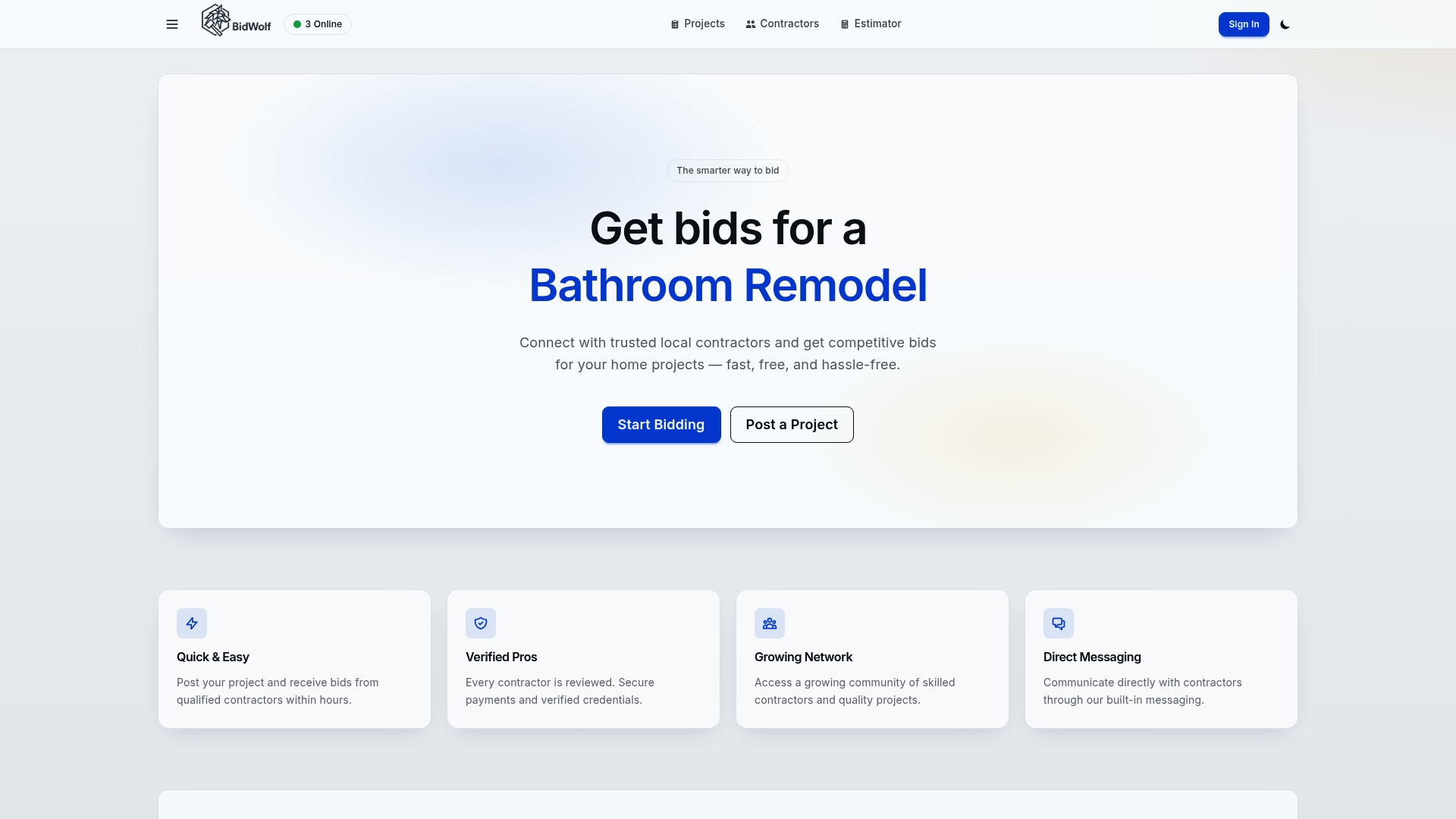
Post your project on the BidWolf platform and receive bids from pre-screened, license-verified local contractors in a standardized format, making comparison straightforward. Every contractor in the BidWolf network goes through a verification process, so you’re not starting from scratch on credential checks. Browse local contractors on BidWolf by trade and location across Texas, from Dallas and Houston to San Antonio and Austin. Not sure what your project should cost? Use the project cost estimator to set a realistic budget before bids come in, so you can spot outliers immediately.
Frequently asked questions
What information should I always include in a project bid request?
Include a clear scope of work, timeline expectations, contract terms, and submission guidelines. A complete bid request packet also covers allowances, exclusions, and a uniform bid format so all responses are directly comparable.
How many contractor bids should I get for my home project in Texas?
Request bids from at least three qualified contractors. Three or more bids give you enough data points to recognize fair market pricing and identify outliers before committing.
Do general contractors in Texas need to be licensed?
No. Texas does not require a general contractor license, but regulated trades including electrical, plumbing, and HVAC must hold current state specialty licenses. Always verify trade-specific licenses separately.
How can I avoid surprises from allowances or change orders in bids?
Standardize your allowance figures in the scope document and require all bidders to use them. Ask each contractor to state their change-order policy in writing before you select a bid, not after you sign a contract.
What should I check before awarding a contract after receiving bids?
Verify active licensing and insurance, compare scope coverage line by line, confirm permit responsibility, and review the payment schedule and timeline in writing. These checks reduce the risk of disputes once work begins.
Recommended
- How to compare contractor bids for home projects in Texas | BidWolf Blog
- Texas homeowner’s checklist: smart tips for choosing contractors | BidWolf Blog
- Smart questions to ask Texas contractors before hiring | BidWolf Blog
- Contractor marketplaces: a complete guide for Texas homeowners | BidWolf Blog