

What is a contractor network: Texas homeowner's guide
TL;DR:
- Finding a reliable contractor in Texas is challenging due to local licensing complexities and unverified online listings. Contractor networks provide verified, accountable partnerships that ensure licensing, insurance, and quality standards across specific jurisdictions, reducing homeowner risks. Using such networks alongside thorough vetting, multiple bids, and clear communication helps Texas homeowners achieve project success, trust, and cost savings.
Finding a reliable contractor in Texas should be simple. It rarely is. Between unlicensed trades, inconsistent insurance, and online directories that will list anyone with a phone number, homeowners face real risk every time a project starts. Understanding what is a contractor network, and how it differs from a basic Google search or lead-generation site, can mean the difference between a smooth remodel and a costly disaster. This guide breaks down exactly how contractor networks work, what protects you as a Texas homeowner, and how to use one to get your next project done right.
Table of Contents
- What is a contractor network and how does it work?
- Risks of hiring contractors outside a vetted network: what Texas homeowners face
- How contractor networks differ from typical contractor directories and lead services
- How to use a contractor network effectively for your Texas home improvement project
- The value of contractor networks: trust, cost savings, and project success
- Why the conventional wisdom on hiring contractors is backwards, and what you really need to know
- Connect with Texas’s vetted contractors easily with BidWolf
- Frequently asked questions
Key Takeaways
| Point | Details |
|---|---|
| Contractor networks explained | They are vetted groups of licensed, insured contractors who meet strict quality standards to protect homeowners. |
| Risks of unvetted contractors | Hiring outside networks risks fake licenses, lack of insurance, permit skipping, and costly project delays. |
| Networks vs directories | Trusted networks limit members and enforce compliance unlike directories or lead generators that prioritize volume. |
| Effective use tips | Use networks to get multiple quotes, verify credentials, and require written contracts for your projects. |
| Value of networks | They build trust, reduce disputes, prevent cost overruns, and help projects finish on time with reliable pros. |
What is a contractor network and how does it work?
A contractor network is not a directory. The distinction matters. As trusted Texas contractor resources define it, a contractor network for homeowners is a curated, verified group of trade professionals screened for licensing, insurance, and quality standards. Every professional in the network has gone through a specific onboarding process before they ever reach your inbox.
Here is what that process typically includes:
- License verification at the city or county level (important in Texas, which has no single statewide contractor license)
- Active insurance confirmation, including general liability and workers’ compensation
- Background and reference checks to assess past project history
- Ongoing compliance monitoring to ensure credentials stay current
- Quality benchmarks such as training standards or trade certifications
The result is a contractor partnership program where members are accountable to the network, not just to you. If a contractor violates standards, the network can remove them. That accountability layer does not exist when you find someone through an ad or a random web listing.
Texas makes this especially important. Licensing rules here are handled locally, meaning an electrical license in Houston does not automatically cover work in Austin or San Antonio. A properly built contractor network platform understands this and verifies credentials at the correct jurisdiction level, not just at face value.

Understanding the benefits of contractor bidding platforms adds further context for why networks outperform informal hiring. When a platform combines verification with competitive bidding, you get both quality assurance and fair pricing in one place.
Pro Tip: When evaluating any contractor network, ask specifically how they verify licenses in your Texas city or county. Networks that rely solely on self-reported credentials are closer to directories than true partner programs.
The contractor network definition also extends to how disputes are handled. Reputable networks set clear expectations upfront for all members, so both you and the contractor know what the standards are before a single nail is driven. That pre-agreed framework is one of the most valuable and underappreciated advantages of contractor networks.
Risks of hiring contractors outside a vetted network: what Texas homeowners face
The risks are specific, and they are more common than most homeowners expect. Texas does not have a uniform statewide contractor license, which means a homeowner in Dallas or Houston has to check local licensing boards for each trade type. A license for HVAC work does not cover plumbing. A general contractor license in one city does not transfer to the next. Most homeowners do not know this, and many contractors count on it.
Here are the most common problems that arise when hiring outside a vetted network:
- Fake or mismatched licenses — A contractor shows you a license that belongs to another trade, another county, or a business name that does not match your contract.
- Insufficient insurance — The contractor carries a minimal or lapsed policy. If a worker is injured on your property, you could be held liable.
- No bond — Bonding protects you if a contractor abandons a job or fails to pay subcontractors. Without it, you have little financial recourse.
- Permit skipping — Unlicensed contractors often avoid pulling permits. That can create legal issues when you sell your home and may void your homeowner’s insurance coverage.
- Low-bid disasters — The cheapest quote sometimes signals a contractor who plans to cut corners, use subpar materials, or walk away mid-project.
As homeowner vetting guidance makes clear, homeowners should request certificates of insurance and verify license numbers on local licensing boards, since checking bonds protects against unfinished work or unpaid subcontractors.
The permit issue deserves extra attention. In Texas, pulling permits is the contractor’s legal responsibility for licensed trades. If a contractor suggests you pull the permit yourself, or tells you the project does not need one, that is a warning sign. Work done without required permits can require costly removal and reinstallation, and it can complicate your home’s resale process significantly.
Using a Texas homeowner’s checklist before hiring any contractor outside a vetted network gives you a structured way to catch these problems before they become expensive ones.
Pro Tip: Ask your contractor’s insurance agent, not the contractor, to send the certificate of insurance directly to you. This confirms the policy is real and active rather than a document the contractor may have edited.
How contractor networks differ from typical contractor directories and lead services
This is where homeowners often get misled. A contractor directory lists professionals. A lead-generation platform sells your contact information to contractors. A contractor network does something fundamentally different: it qualifies members and enforces ongoing standards.
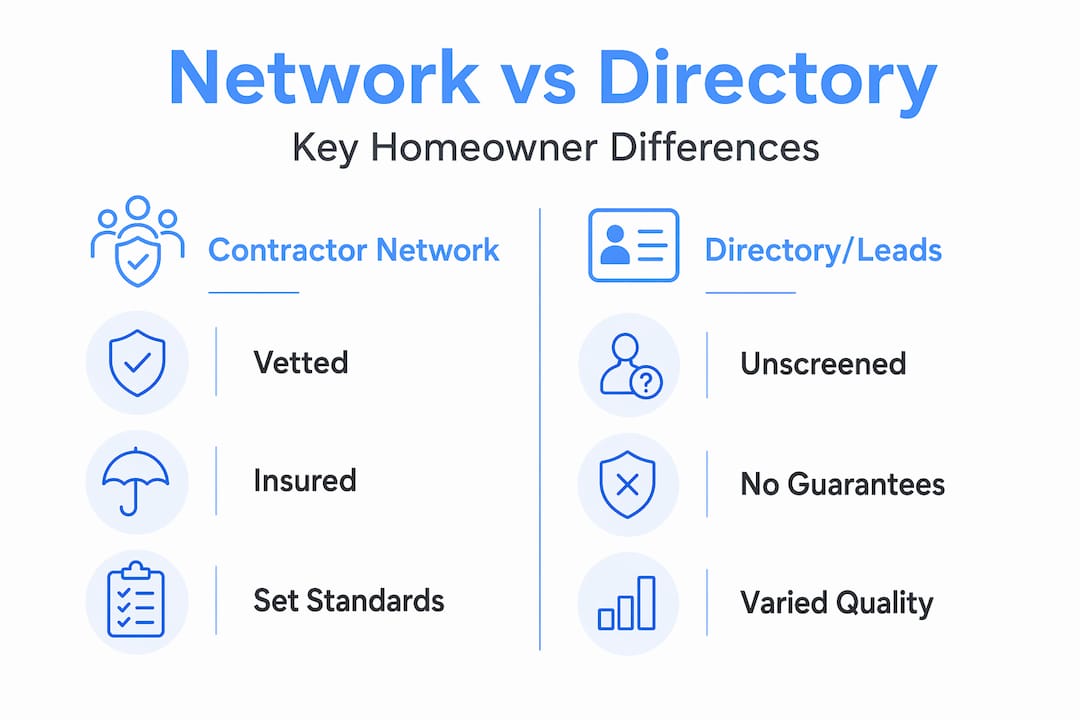
| Feature | Contractor network | Generic directory | Lead-generation service |
|---|---|---|---|
| License verification | Yes, jurisdiction-specific | Rarely | Rarely |
| Insurance confirmation | Required | Self-reported | Self-reported |
| Ongoing compliance | Yes | No | No |
| Contractor accountability | Enforceable standards | None | None |
| Homeowner data handling | Project-focused | Listed publicly | Sold to multiple contractors |
| Member limits per region | Often yes | No | No |
| Dispute resolution support | Yes | No | No |
As quality-focused networks demonstrate, contractor networks prioritize quality and accountability by limiting members per region and requiring ongoing compliance, unlike lead-generation platforms that sell homeowner information to multiple contractors indiscriminately.
The regional limitation point is worth slowing down on. When a network limits how many roofing contractors, for example, can be active in a given zip code, it protects service quality. Contractors who know they earned their spot in the network have more incentive to perform well and maintain their standing. In a lead-gen model, every contractor competes on price alone, which often drives quality down.
The difference between a contractor network and a lead service comes down to accountability. Directories and lead services answer to contractors. Networks answer to homeowners.
Evidence also shows that networks reduce repair costs and improve timeliness by establishing pre-agreed performance criteria and measurable benchmarks before any work begins. That structure protects you from cost overruns and timeline creep, two of the most common homeowner frustrations in Texas renovation projects.
For a deeper look at why the platform you use matters, see how online platforms for home renovations compare to traditional hiring methods in real Texas contexts.
How to use a contractor network effectively for your Texas home improvement project
Joining a contractor network platform does not guarantee a great result on its own. How you use it matters just as much. Follow these steps to get the most from the process.
- Filter by zip code and project type first. Most networks allow you to search by trade specialty and location. Start there to see only contractors licensed for your specific type of work in your Texas city or county.
- Review credentials carefully before contacting anyone. Look for verified license numbers, current insurance certificates, and completed project history. Do not skip this step just because the network says contractors are vetted; confirm it yourself.
- Request at least three detailed quotes. As vetting guidance recommends, homeowners should obtain at least three quotes to compare scope, pricing, and professional approach when using contractor networks. Price is one data point. Scope detail and communication quality are equally important.
- Ask about permits upfront. Any contractor bidding on licensed trade work in Texas should automatically plan to pull the required permits. If they hedge on this question, move on.
- Evaluate communication as a quality signal. A contractor who responds promptly, answers questions clearly, and follows up when they say they will is giving you a preview of how they manage an active job.
- Get everything in writing. Scope of work, materials specified by brand and grade, timeline, payment schedule, and warranty terms all belong in your written contract. Verbal agreements are unenforceable.
- Use the platform’s messaging tools if available. Documented communication protects both parties and makes it easier to resolve any disagreements that arise.
Learning how to go about comparing contractor bids in Texas helps you evaluate quotes beyond just the total price. Knowing the right questions to ask contractors before you hire puts you in control of the conversation from day one.
Pro Tip: When reviewing bids, a quote that is significantly lower than the others is not a bargain. It usually means something is missing from the scope. Ask the low bidder to walk you through their materials list and subcontractor plan line by line.
The value of contractor networks: trust, cost savings, and project success
The primary value of a contractor network is trust. As partner program research confirms, verified partner programs provide accountability rather than just listing contractors for a fee. That accountability starts before the first phone call and carries through to project completion.
Here is what that trust translates to in practical terms:
- Fewer disputes because expectations are set clearly before work begins
- Lower risk of hidden costs since vetted contractors are less likely to cut corners that create expensive problems later
- Faster project timelines because qualified pros know the permitting process and do not run into compliance delays
- Better workmanship because contractors in a network have a reputation to protect within the system
- Financial protection through confirmed insurance and bonding, so you are covered if something goes wrong on the job site
Cost insight: Vetted contractor frameworks consistently show that the cheapest bid is rarely the best outcome. Contractors operating within formal networks and clear performance criteria regularly prevent the kinds of rework and delays that push final project costs well beyond the original budget.
The time savings are real too. When you are not spending hours cross-checking licenses, calling insurance agents, and chasing references on your own, you get to focus on the decisions that actually matter, like selecting the right materials or finalizing your design choices.
If you want to understand how Texas homeowners are already benefiting from this approach, see how finding trusted contractors fast works in practice across different project types and cities.
Why the conventional wisdom on hiring contractors is backwards, and what you really need to know
Most homeowners assume that being flexible and easy to work with will lead to a better experience with their contractor. In practice, the opposite is often true. Homeowners who skip detailed contracts, accept verbal assurances, and avoid asking hard questions tend to have the worst outcomes, not because they encountered dishonest contractors, but because they created conditions where misunderstandings could thrive.
As vetting research shows, most project failures start with rushed decisions and vague paperwork rather than obvious bad actors. The contractor who seemed perfectly reasonable at the estimate stage becomes a problem when the scope was never written down clearly.
Here is what experienced homeowners learn, usually the hard way:
Asking detailed, even uncomfortable questions upfront is not being difficult. It is being responsible. A contractor who becomes defensive when asked for their license number, insurance certificate, or a detailed written scope has told you everything you need to know.
The second piece of conventional wisdom worth challenging is the instinct to trust the lowest price. In Texas home improvement, price is often a proxy for how a contractor manages risk. Contractors who bid low frequently account for that margin somewhere, whether through cheaper materials, skipped permits, or reduced labor on finishing work. A network-verified contractor tends to price honestly because their standing in the network depends on completing jobs as specified.
The third and perhaps most important insight is this: the vetting you do before hiring is your best and only leverage point. Once a contractor is on your property and work has begun, your negotiating position weakens considerably. Networks shift the power dynamic by doing that hard work before you ever reach the selection stage.
Hiring contractors securely in Texas requires treating the process less like a friendly transaction and more like a professional evaluation. The contractors who meet that standard confidently are the ones worth hiring.
Connect with Texas’s vetted contractors easily with BidWolf
You now know exactly what separates a real contractor network from a directory or lead-generation site. The next step is putting that knowledge to work on your actual project.
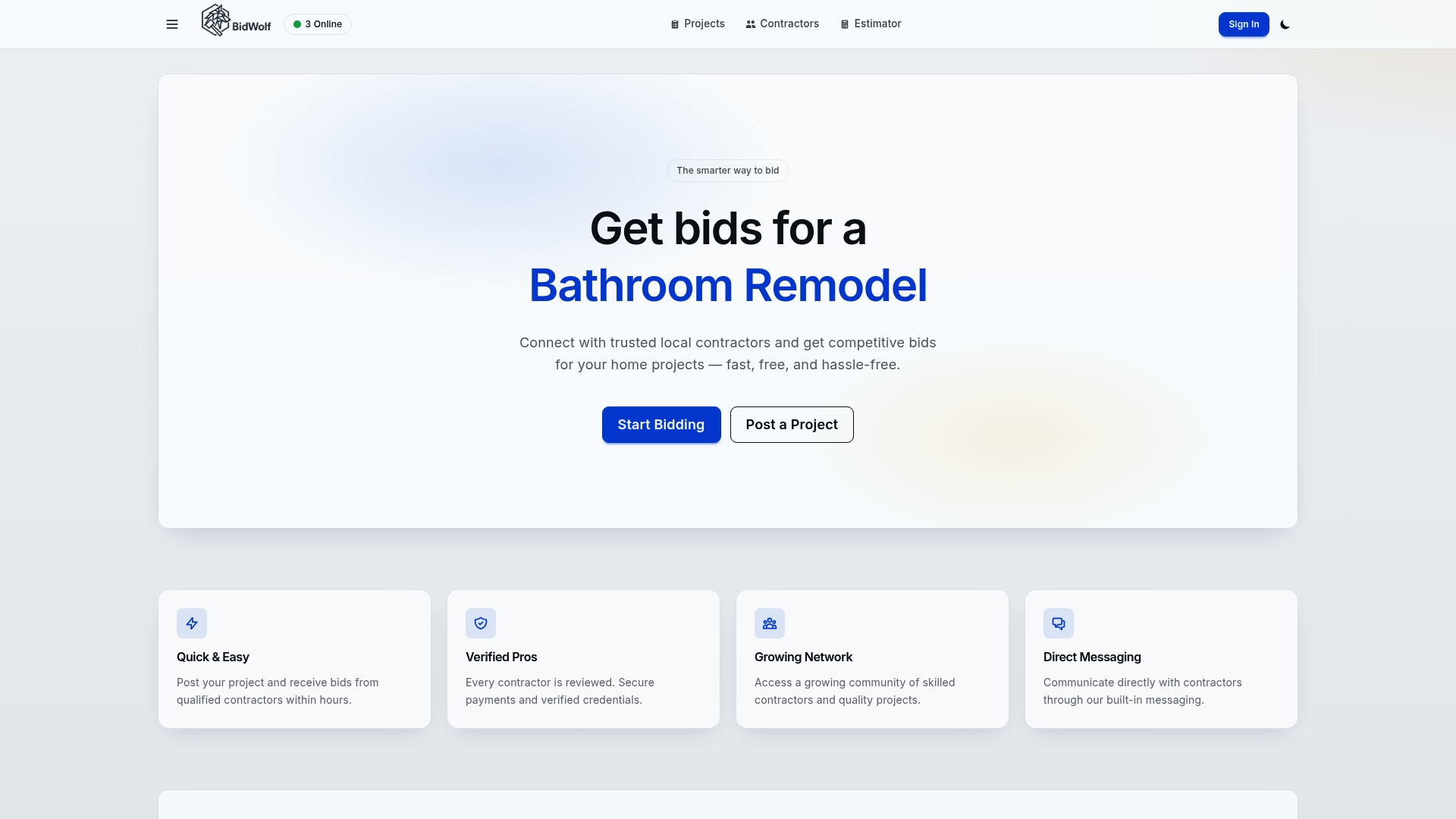
BidWolf connects Texas homeowners with licensed, insured local contractors who meet verified quality and compliance standards before they ever bid on your project. You can post your project on BidWolf in minutes, describe your scope, and receive competitive bids from vetted professionals in your area. The platform gives you tools to compare proposals side by side, communicate directly with contractors through built-in messaging, and manage your project from start to finish, including via the BidWolf mobile app. Before you commit to a budget, use the free project cost estimator to understand realistic pricing for your specific renovation or repair. With these resources in hand, you can move forward with confidence rather than guesswork.
Frequently asked questions
What is a contractor network, and how is it different from a regular contractor directory?
A contractor network is a curated group of verified professionals screened for licensing, insurance, and quality standards, unlike directories that list any contractor regardless of vetting or accountability.
How do I verify if a Texas contractor is properly licensed and insured?
You should request a certificate of insurance sent directly from the contractor’s insurance agent and verify their license number on your city or county licensing board website, confirming it matches the business name on your contract.
Why should I get multiple bids when choosing a contractor from a network?
Getting at least three quotes allows you to compare scope, pricing, and professional approach so you can choose the contractor who offers the best overall value, not just the lowest number.
Can contractor networks help me avoid project delays and cost overruns?
Yes. Networks establish clear performance criteria and pre-agreed terms before work begins, which reduces disputes and keeps projects on time and within budget.
What red flags should I watch for when working with contractors?
Avoid contractors who suggest you pull permits yourself, tell you permits are unnecessary, or cannot produce a license that matches the work type and jurisdiction. As Texas vetting experts note, these are strong indicators of compliance or insurance problems that will cost you more in the long run.