

Your guide to hiring contractors securely in Texas
TL;DR:
- Online contractor platforms pose significant security risks including data breaches and fraud.
- Texas homeowners must vet platforms for verification, escrow, dispute resolution, and encryption features.
- Due diligence on individual contractors involves license checks, insurance confirmation, and written agreements.
Hiring a contractor online seems straightforward until something goes wrong. A bad actor poses as a licensed roofer, collects a deposit, and vanishes. A platform stores your personal documents without proper encryption, and suddenly your information is exposed. These are not hypothetical scenarios. Security incidents from third-party contractors affect 59% of organizations, and construction sector cyberattacks doubled between 2023 and 2024. Texas homeowners face added pressure because of regulatory gaps and a fast-moving local contractor market. This guide gives you a clear, practical roadmap for vetting platforms, verifying contractors, protecting your payments, and recovering quickly if anything goes sideways.
Table of Contents
- Why security matters in online contractor platforms
- How to evaluate the security of a contractor platform
- Vetting individual contractors: What Texas homeowners should do
- Managing payment and personal data securely
- What to do if things go wrong: Recourse and recovery
- The one thing most Texans get wrong about contractor security
- Find secure, vetted contractors for your Texas project
- Frequently asked questions
Key Takeaways
| Point | Details |
|---|---|
| Choose secure platforms | Pick platforms with identity verification and escrow to protect yourself. |
| Verify every contractor | Independently confirm licenses and insurance in Texas before hiring. |
| Use escrow payments | Escrow protects your money and helps resolve disputes safely. |
| Guard your data | Limit personal info you share and stick to official communication channels. |
| Know your recourse | Understand what to do and who to contact if there’s a dispute or data breach. |
Why security matters in online contractor platforms
Online platforms have made hiring easier, but they have also introduced new layers of risk that did not exist when you simply called a neighbor’s recommended plumber. Understanding those risks is the first step toward protecting yourself.
The real cost of a breach or bad hire
When a platform fails to protect your data, the damage goes beyond inconvenience. Research shows that 65% trust companies less after a data breach, and up to 80% of affected users may switch to a competitor. For you as a homeowner, that loss of trust comes with real financial consequences: fraudulent charges, project delays, and the headache of disputing payments.
Notable platform incidents illustrate this clearly. Fiverr, a popular gig marketplace, exposed private contractor documents on Google search results due to improper access controls. Mercor, a hiring platform, suffered a leak of over 4TB of contractor data. These are not isolated edge cases. They reflect a systemic problem with how many platforms handle third-party contractor information.
Key risks homeowners face on online platforms:
- Phishing attacks: Fake emails or messages that mimic legitimate platforms, tricking you into entering your login credentials or payment details on a fraudulent site.
- Ransomware through contractor links: Malicious files sent under the guise of quotes or contracts, which can lock your device or steal data.
- Cloned contractor websites: Fraudsters copy real contractor pages, complete with photos and reviews, then collect deposits and disappear.
- Lead-gen site schemes: Some sites that look like full platforms are actually just lead aggregators that sell your contact information to unvetted contractors.
Why Texas homeowners face unique exposure
Texas has one of the fastest-growing home renovation markets in the country. That growth attracts legitimate professionals, but it also draws bad actors. The state does not mandate blanket background checks for private construction employers, which means the burden of verification falls squarely on you as the homeowner.
Additionally, Texas experiences frequent weather events, including hurricanes, hailstorms, and flooding, that trigger surges in contractor demand. During these periods, unlicensed operators and outright scammers flood the market, knowing that desperate homeowners may skip due diligence. Combine that with a digital hiring environment where common online hiring risks are still poorly understood by many consumers, and you have a recipe for costly mistakes.
“Platforms that do not enforce contractor identity verification are essentially asking homeowners to trust strangers with their homes and their money.”
The good news is that knowing these risks puts you ahead of most. The next section helps you identify which platforms are actually worth trusting.
How to evaluate the security of a contractor platform
Not all platforms are created equal. Some offer genuine vetting, payment protection, and dispute resolution. Others are little more than digital bulletin boards where anyone can post a profile. Knowing the difference before you post your project can save you thousands of dollars and weeks of frustration.
Essential security features to look for
When evaluating any platform, prioritize these core protections:
- Identity verification: The platform should confirm contractor identities using government-issued ID checks, not just email addresses.
- License verification: Good platforms cross-reference contractor licenses with state databases like the Texas Department of Licensing and Regulation (TDLR).
- Escrow payments: Funds held in escrow are released only when you approve completed work, not when the contractor asks.
- Platform guarantees: Look for platforms that offer dispute resolution and some form of satisfaction guarantee, not just a help email.
- Secure communication tools: Built-in messaging keeps your personal contact details off the open web and creates a documented record of all project conversations.
Platforms with escrow payments and verified credentials provide a safety net that lead-gen sites simply cannot match.

Secure platforms vs. lead-gen platforms
| Feature | Secure platforms | Lead-gen platforms |
|---|---|---|
| Identity verification | Yes, required | Rarely enforced |
| License verification | Cross-checked with TDLR | Self-reported only |
| Escrow payments | Standard feature | Not offered |
| Dispute resolution | Dedicated support | None |
| Contractor insurance confirmation | Required | Optional or absent |
| Communication tools | Built-in messaging | Directs you off-platform |
| Data encryption | Industry-standard | Inconsistent |
Red flags on any platform
- No clear ownership or physical address for the company
- Contractors who push you to communicate off-platform immediately
- Sites that collect your address, budget, and contact info before showing any contractors
- Platforms with no visible terms of service or dispute policy
- Reviews that all sound identical or suspiciously perfect
Texas-specific concern: unlicensed handymen can legally perform work under the $500 to $1,000 threshold in Texas, but fake contractor sites have started cloning the profiles of real, licensed professionals to appear credible. Always verify the contractor’s license number independently, even if the platform claims to have done so.
Pro Tip: Before posting a project on any platform, search the platform’s name alongside “complaint” or “scam” in your browser. Texas-specific forums and the Better Business Bureau often surface issues that a platform’s own review system won’t show you.
Choosing the right platform is step one. Step two is vetting the individual contractors you receive bids from.
Vetting individual contractors: What Texas homeowners should do
Even on a trustworthy platform, personal due diligence matters. Platforms vet contractors at sign-up, but licensing can lapse, insurance can expire, and circumstances change. Staying current on a contractor’s status protects you throughout the life of your project.
A practical vetting process for Texas homeowners
Follow these steps before accepting any bid:
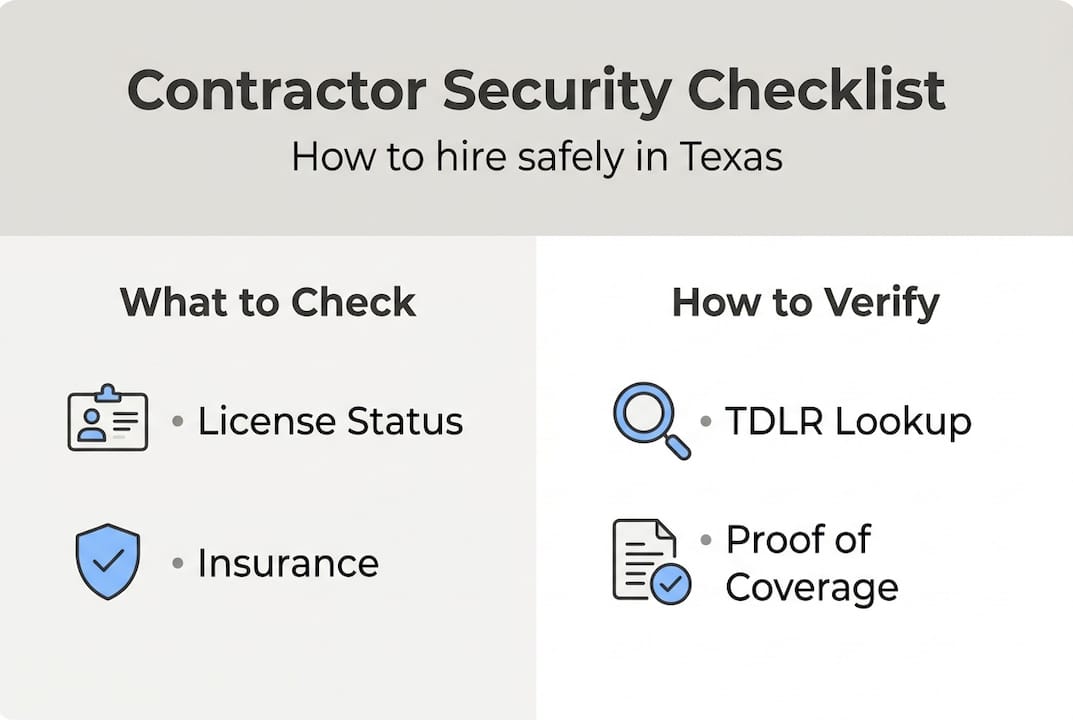
- Verify the license with TDLR: Go directly to the Texas Department of Licensing and Regulation website and search the contractor’s name or license number. Do not rely solely on what the contractor tells you. Texas does not mandate background checks for private construction employers, so this direct verification step is critical.
- Request a Certificate of Insurance (COI): Ask the contractor to provide a COI showing general liability and workers’ compensation coverage. Contact the insurance carrier directly to confirm the policy is active. Workers’ comp is elective in Texas, so confirm what coverage they carry.
- Demand a written contract: Every project, regardless of size, should have a written agreement. It should include a clear scope of work, payment schedule, start and completion dates, materials specifications, and lien waiver terms.
- Check references from recent Texas projects: Ask for at least two references from the past 12 months. Call them. Ask specifically about how the contractor handled problems, not just whether the work looked good.
- Search for complaints or judgments: Run the contractor’s business name through the Texas Attorney General’s Consumer Protection database and the Better Business Bureau.
What to look for and how to verify it
| What to check | How to verify it |
|---|---|
| State license status | TDLR online lookup |
| General liability insurance | Request COI, call insurer directly |
| Workers’ comp coverage | Confirm with insurer, note Texas opt-out rules |
| Business registration | Texas Secretary of State database |
| Past complaints | BBB, AG Consumer Protection portal |
| Lien history | County clerk records for prior projects |
Red flag scenarios to avoid
Some situations signal danger before a project even begins:
- A contractor asks for more than 10 to 15% of the project total upfront in cash.
- The bid comes in significantly lower than all others you received.
- The contractor cannot produce a physical business address or local references.
- You are asked to sign a contract with blank spaces or vague scope language.
- The contractor arrived door-to-door after a recent storm offering discount repairs.
Always manage secure home project payments through a platform that provides a documented trail. Cash transactions leave you with little recourse if the work is substandard or the contractor disappears.
Pro Tip: Escrow is your single best financial protection. Release payments in stages tied to completed milestones, such as framing, rough-in, and final inspection, rather than paying a lump sum at the start or end of a project.
Managing payment and personal data securely
Getting the contractor right is essential. Managing how money and information move through the process is equally important. Many homeowners handle one correctly and neglect the other.
Why escrow beats direct payment
Direct payment to a contractor carries real risk. Once money leaves your account, recovering it after a dispute is difficult and slow. Escrow payment systems hold funds in a neutral account and release them only when you confirm a milestone is complete. This single feature can prevent the most common contractor fraud scenario: the deposit and disappear.
Industry data supports this. Construction no-show rates run between 15 and 20% on average across the industry, but drop to around 2% on verified apps with escrow and accountability features. Homeowner satisfaction rates on verified platforms reach 93% for re-hire intent, a significant gap compared to cold-hire experiences.
Protecting your personal information
When you post a project online, you share details about your home, your budget, and sometimes your schedule. Here is how to keep that exposure minimal:
- Use platform messaging only: Do not share your personal email or phone number in early conversations. Platform messaging creates a documented record and limits what contractors can do with your contact details.
- Avoid uploading unnecessary documents: Some platforms ask for identification or financial documents upfront. Question whether this is required and why before uploading anything sensitive.
- Use a separate email address for platform signups: This limits exposure if the platform itself experiences a breach.
- Enable two-factor authentication: If the platform offers it, turn it on. This prevents someone who obtains your password from accessing your account.
- Review platform privacy policies: Check how the platform stores, shares, and deletes your data. Platforms that share your information with third-party marketing partners create unnecessary risk.
Third-party platform breaches are more common than most users realize. As one high-profile example illustrated, exposed contractor documents on major platforms have affected thousands of users due to misconfigured access settings.
Common data mistakes Texas homeowners make
- Signing up on multiple platforms simultaneously with the same password
- Sharing full Social Security numbers or bank account details over platform chat
- Clicking payment links sent by contractors via external email rather than through the platform
- Approving final payment before completing a walkthrough and physical inspection
- Ignoring platform notifications about unusual account activity
“Keeping every transaction and conversation inside a secure platform is not just convenient. It is your primary layer of legal protection if a dispute goes to arbitration or court.”
Use transparent cost estimates from verified platforms as your pricing benchmark. This also helps you spot bids that are suspiciously low, a frequent signal of either unlicensed work or an outright scam.
What to do if things go wrong: Recourse and recovery
Even with strong precautions, problems can occur. A contractor may abandon a project mid-way. A platform may suffer a breach. A payment may get stuck. Knowing what to do in advance keeps a bad situation from becoming catastrophic.
Steps to take when payments go wrong
- Do not release escrow funds: If work is incomplete or substandard, hold payment in escrow and document your reasons in writing through the platform.
- Contact platform support immediately: Most reputable platforms have dispute resolution teams. File a formal dispute with written evidence, including photos and all correspondence.
- File a complaint with the Texas Attorney General: The Consumer Protection Division handles contractor fraud and deceptive trade practices.
- Contact your credit card company: If you made any payments outside escrow, initiate a chargeback immediately with documentation.
- Consult the Texas Residential Construction Commission rules: While this agency has been restructured, Texas law still provides homeowner protections for construction defects.
Steps to take if your data is compromised
- Change your platform password immediately and enable two-factor authentication.
- Monitor your financial accounts for unusual activity over the following 30 to 60 days.
- Place a fraud alert with the major credit bureaus: Equifax, Experian, and TransUnion all offer this service at no cost.
- Report the breach to the Federal Trade Commission at IdentityTheft.gov for a personalized recovery plan.
- Notify your bank or lender if you shared any financial account information on the compromised platform.
Because 65% of users lose trust in companies after a breach, the smarter move is to choose a platform that prevents the problem rather than fixes it after the fact. Platforms that offer escrow, verified contractor profiles, and built-in dispute resolution give you both proactive and reactive protection.
Pro Tip: Keep all project correspondence, contracts, and receipts inside the platform’s messaging and document storage tools. If you ever need to escalate a dispute, having everything in one place makes your case much stronger and faster to resolve.
The best way to find vetted contractors in Texas is through a platform that has built these protections into the core product, not bolted them on as optional features.
The one thing most Texans get wrong about contractor security
Here is an uncomfortable truth most guides skip over: running a background check is not the same as being protected.
Texas homeowners who focus exclusively on background checks are solving last decade’s problem. A clean background check tells you about a contractor’s criminal history as of the date it was run. It says nothing about their cyber hygiene, their insurance status today, whether their license lapsed last month, or whether the platform you hired them through is leaking your home address to data brokers.
The real security gap in 2026 is at the platform level, not the individual contractor level. We have seen it play out in Texas repeatedly. A homeowner vets a contractor thoroughly, runs a background check, reviews references, and then pays through a platform with no escrow feature. The contractor completes half the work, raises the final invoice 40% above the original bid, and the homeowner has no payment protection mechanism to fall back on.
True security is layered. It means choosing a platform with platform-level safeguards built in, verifying licenses and insurance independently, using escrow for every payment milestone, and keeping all communication documented within the platform. No single step is sufficient on its own.
The contractors who cause the most financial damage to Texas homeowners are not usually convicted criminals. They are unlicensed operators, underinsured tradespeople, and businesses that cut corners because no one held them accountable at the platform level. Background checks rarely catch these patterns. Layered platform protections, combined with your own verification steps, do.
Think of it this way: a background check is one lock on one door. What you actually need is a building with secure walls, monitored cameras, and a verified visitor log.
Find secure, vetted contractors for your Texas project
Protecting yourself starts with choosing the right platform. BidWolf connects Texas homeowners with find vetted Texas contractors who are license-verified, background-checked, and ready to bid on your project competitively. You do not have to guess whether a contractor is legitimate. We verify credentials before they ever receive a bid invitation.
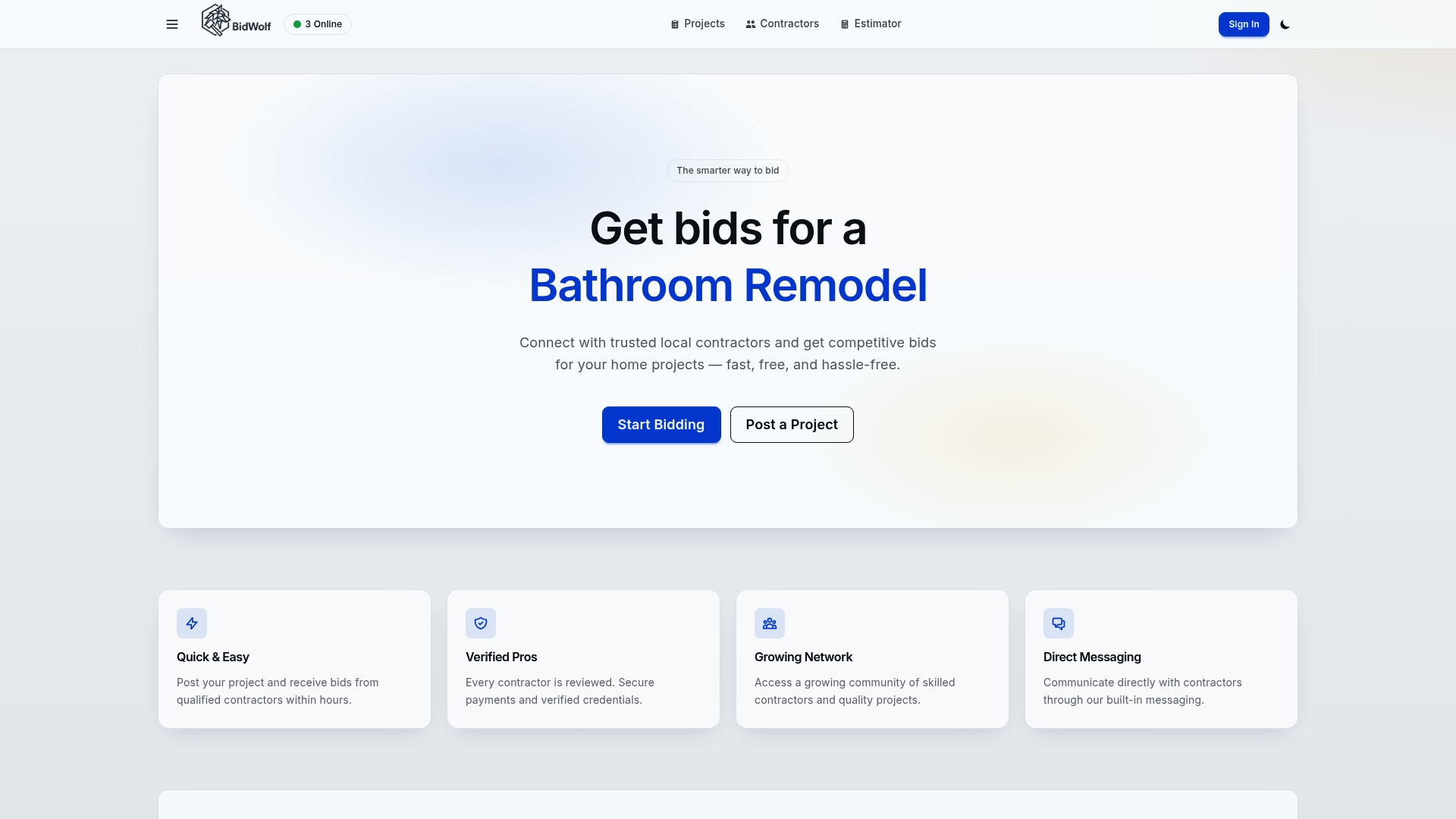
Every project posted on BidWolf benefits from secure escrow payments, transparent pricing, and direct in-platform messaging that keeps your personal contact details private. If you are ready to start your secure home project without the stress of manually vetting strangers, BidWolf makes the entire process straightforward. You post the project, receive competitive bids from verified local professionals, compare your options, and hire with confidence. Get a free estimate today and see what verified Texas contractors will bid for your renovation or repair.
Frequently asked questions
What security features should I look for on a contractor platform?
Look for identity verification, escrow payments, and platform guarantees when choosing an online contractor platform. These three features together protect your identity, your money, and your project outcome.
How can I check if a Texas contractor is legit before hiring?
Always verify licenses and insurance directly with the Texas Department of Licensing and Regulation and request insurance certificates confirmed by the carrier. Never rely only on what the contractor self-reports on their profile.
What should I do if my data is breached on a contractor platform?
Contact platform support immediately, monitor your financial accounts, and file an identity theft report with the FTC. Research shows that 65% of users lose trust post-breach, so switching to a more secure platform is a sound next step.
Does Texas require background checks for contractors hired online?
No state-mandated background checks exist for private construction employers in Texas, so the responsibility to vet contractors falls entirely on you as the homeowner. Use TDLR lookups, reference checks, and secure platforms to fill this gap.
Is paying contractors through escrow really safer?
Yes. Escrow payment systems hold your funds until you approve completed work, which eliminates the most common deposit fraud scenario and gives you real leverage if quality issues arise mid-project.