

Home Project Planning Checklist: A Complete Guide

TL;DR:
- A home project planning checklist organizes every renovation phase to prevent missed steps and control costs. Proper planning, including goal setting, budgeting, contractor selection, and timeline management, is vital for project success. Using detailed progress tracking and final walkthroughs ensures quality control and protects your investment.
A home project planning checklist is a structured tool that organizes every phase of a renovation, from goal setting through final inspection, so nothing gets missed and costs stay under control. Most renovation failures trace back to poor planning, not construction errors. A solid checklist prevents scope creep, keeps your budget honest, and gives contractors clear direction from day one. This guide walks you through every critical step of home renovation planning, with practical advice on budgeting, contractor selection, timeline management, and final walkthroughs. Whether you are tackling a bathroom remodel or a full home renovation, these steps apply.
1. How do you define and prioritize goals in your home project planning checklist?
Clear goals are the foundation of every successful renovation. Renovation failures are commonly caused by a lack of clear problem definition, not construction errors. Before you call a single contractor or pull a single permit, write down exactly what problem you are solving.

A formal problem statement does more than clarify your thinking. Writing a problem statement helps homeowners avoid scope creep and maintain project focus throughout construction. A good problem statement is specific: “The master bathroom has no ventilation, causing mold growth and tile damage” is far more useful than “the bathroom needs updating.”
Once your goals are written, prioritize them. The Home Improvement Directory recommends rating projects on safety, cost, and ROI using a 0–5 scoring method. This turns a vague wish list into a ranked, data-driven priority list.
Here is how to apply that framework:
- Safety first. Score any item that poses a health or structural risk at 5. Faulty wiring, roof leaks, and mold remediation always move to the top.
- Cost impact. Score items that will cost more to delay than to fix now. A small roof leak becomes a major structural repair if ignored for one season.
- ROI. Score items that add measurable resale value. Kitchen and bathroom upgrades consistently return the highest percentage of investment.
- Cosmetic upgrades. Score these last. Fresh paint and new fixtures matter, but they do not belong at the top of a constrained budget.
Separate your list into two columns: must-haves and nice-to-haves. Must-haves are items that fail the safety or cost test if deferred. Nice-to-haves are everything else. This separation protects your budget when unexpected costs appear, and they always do.
Pro Tip: Review your priority list with your contractor before finalizing the scope. Contractors often spot dependencies you missed, like discovering that a kitchen remodel requires an electrical panel upgrade before any other work begins.
2. What are the best practices for budgeting and financial planning?
Budgeting is where most home improvement projects go wrong. Major whole-home renovations typically cost between 5% and 25% of the home’s current market value. That is a wide range, and where you land depends entirely on scope, materials, and your local labor market.
The single most important budget rule is the contingency fund. A 10–20% contingency is advised for unexpected site conditions during renovations. This is not optional padding. It is the financial buffer that keeps your project moving when the demo crew opens a wall and finds outdated knob-and-tube wiring.
The three-column cost tracking method
Budget tracking should use a three-column system: estimated, committed, and actual costs, with weekly reviews to spot variance early. Here is what each column means in practice:
- Estimated cost. Your initial projection before any contracts are signed. This is your planning number.
- Committed cost. The amount locked in by signed contracts and purchase orders. This is your real financial exposure.
- Actual cost. What you have paid to date. Comparing this to committed costs tells you if you are on track or slipping.
Weekly reviews of this table catch problems before they become crises. A variance of more than 10% in any line item is a signal to investigate immediately.
| Cost Category | Estimated | Committed | Actual |
|---|---|---|---|
| Demo and prep | $3,500 | $3,500 | $3,200 |
| Framing and drywall | $8,000 | $8,400 | $7,900 |
| Plumbing | $6,500 | $6,500 | $6,500 |
| Electrical | $4,200 | $4,800 | $4,800 |
| Finishes and fixtures | $12,000 | $11,500 | $9,800 |
| Contingency (15%) | $5,130 | $5,130 | $2,400 used |
Common pitfalls include underestimating committed costs and ignoring material lead times. If you sign a contract before confirming that your tile is in stock, you may pay your crew to stand idle for three weeks. Align your budget reviews with your project schedule, not just your calendar.
Pro Tip: Allocate your contingency fund by category, not as one lump sum. Assign 20% contingency to structural and mechanical work, and 10% to finishes. Structural surprises cost far more than a tile substitution.
For a deeper look at cost benchmarks by project type, the remodeling cost guide from Bidwolf breaks down typical ranges for kitchens, bathrooms, and exterior work.
3. How do you hire and manage contractors efficiently?
Hiring the right contractor is the single decision that most determines whether your project succeeds. A low bid from an unqualified contractor costs more in the long run than a fair bid from a proven professional. Your checklist for this phase should be non-negotiable.
Start with pre-qualification. Before you invite anyone to bid, verify the following:
- License status. Confirm the contractor holds a current, valid license for your state and project type. In Texas, the Texas Department of Licensing and Regulation maintains a public lookup tool.
- Insurance. Require a certificate of general liability insurance and workers’ compensation. Ask to be named as an additional insured on the policy.
- References. Request three recent references from projects similar in scope to yours. Call them. Ask specifically about schedule adherence and how disputes were handled.
- Business history. A contractor with less than two years in business carries higher risk, regardless of how polished their presentation is.
Get at least three bids for every project. Compare bids on scope, not just price. A bid that excludes permit fees, debris removal, or material delivery is not cheaper. It is incomplete. Selecting service providers based on value rather than lowest cost protects you from costly mid-project surprises.
Effective communication between homeowner and contractor includes setting expectations and documenting agreements clearly. Put every agreement in writing. Your contract should specify the exact scope of work, a payment schedule tied to milestones, a process for change orders, and a dispute resolution clause.
Payment schedules matter more than most homeowners realize. Never pay more than 10–15% upfront. Structure payments to milestone completions: rough framing complete, rough mechanical inspections passed, finishes installed, and final walkthrough approved. This keeps the contractor motivated and protects your money if work stalls.
Schedule weekly check-ins with your contractor. These do not need to be long. A 15-minute site visit or phone call to review progress against the schedule catches problems before they compound. Document every conversation with a brief follow-up email confirming what was discussed and agreed.
4. What key items belong in your timeline and procurement plan?
A realistic timeline is not a wish. It is a working document that accounts for contractor availability, permit processing times, and material lead times. Most homeowners underestimate all three.
Material lead times often range from 2 to 6 weeks and can cause costly project delays if not planned. Custom cabinetry, specialty tile, and certain plumbing fixtures routinely run at the longer end of that range. Order long-lead items before demolition begins, not after.
Timeline planning by project phase
| Project Phase | Typical Duration | Key Dependencies |
|---|---|---|
| Design and permits | 2–8 weeks | Permit office processing times vary by municipality |
| Demo and rough work | 1–3 weeks | Permit approval must precede demo in most jurisdictions |
| Mechanical rough-in | 1–2 weeks | Plumbing, electrical, and HVAC must be inspected before close-up |
| Insulation and drywall | 1–2 weeks | Inspection sign-off required before drywall |
| Finishes and fixtures | 2–4 weeks | Material delivery must align with this phase |
| Final inspections | 1–2 weeks | Schedule with municipality; delays are common |
Build buffer time into every phase. A realistic buffer is 20% of the estimated duration for each phase. If rough mechanical work is estimated at two weeks, plan for 2.5 weeks before scheduling the next trade.
Coordinate material delivery with your workflow. Receiving flooring four weeks before it is needed creates storage problems and risk of damage. Receiving it one day before installation creates pressure and errors. Work backward from your installation date to set your order date.
Permit timelines vary significantly by city. In some Texas municipalities, a straightforward permit takes five business days. In others, it takes six weeks. Confirm processing times with your local building department before you finalize your project schedule.
Pro Tip: Confirm material availability before signing any contractor contract. If your chosen tile is backordered, your contractor’s schedule will not wait. Substitute materials or adjust your start date before you are locked in.
5. How do you track progress and conduct a final walkthrough?
Progress tracking is not a one-time event at the end of a project. It is a continuous process that runs from demolition through final inspection. Homeowners who track progress weekly catch problems when they are still cheap to fix.
Use three tools throughout construction:
- Photo documentation. Take dated photos at every stage, especially before walls are closed. These photos protect you if disputes arise about what was installed inside a wall.
- Milestone checklists. Create a checklist for each phase: demo complete, rough framing inspected, mechanical rough-in inspected, drywall complete, finishes installed. Check each item off only after you have personally verified it.
- Written progress notes. After each site visit, write a brief note on what you observed, what was on schedule, and what was behind. Date every entry.
The final walkthrough is a formal inspection you conduct with your contractor before making the final payment. Bring your original scope of work and compare it line by line against what was completed. Any item that is incomplete, damaged, or not to specification goes on a punch list.
A punch list is a written document that captures every remaining item, assigns responsibility, and sets a deadline for completion. Do not make the final payment until the punch list is resolved. This is your primary leverage point, and releasing it early removes your ability to enforce completion.
Test every system before sign-off:
- Run all plumbing fixtures and check for leaks under sinks and at supply connections.
- Test every electrical outlet with a plug-in tester. Verify GFCI outlets in bathrooms and kitchens trip and reset correctly.
- Run the HVAC system through a full heating and cooling cycle. Confirm airflow in every room.
- Test all appliances if they were part of the scope.
- Inspect all exterior work for proper flashing, caulking, and drainage.
Retain all receipts, warranties, and permits after the project closes. Appliance warranties, contractor warranties, and building permits are documents you will need for insurance claims, future renovations, and resale disclosures. Store them in a single folder, physical or digital, labeled with the project name and completion date.
For a complete pre-construction and post-construction reference, the 2026 renovation checklist from Bidwolf covers every phase in detail.
Key takeaways
A home project planning checklist is the most reliable way to control costs, manage contractors, and deliver a renovation that meets your original goals without surprises.
| Point | Details |
|---|---|
| Define goals before budgeting | Write a formal problem statement and score projects on safety, cost, and ROI before spending a dollar. |
| Budget with a contingency fund | Set aside 10–20% of your total budget for unexpected site conditions, not as a last resort but as a planned line item. |
| Verify contractors before inviting bids | Confirm license, insurance, and references before any contractor walks your property. |
| Order materials before demolition | Confirm lead times of 2–6 weeks and place orders before demo begins to avoid idle labor costs. |
| Use a punch list before final payment | Document every incomplete or unsatisfactory item in writing and withhold final payment until the list is resolved. |
What I have learned from watching renovations succeed and fail
What I have learned from watching renovations succeed and fail
The homeowners who finish renovations on budget and on time share one habit: they treat the planning phase as seriously as the construction phase. The ones who struggle almost always skipped something in the first 30 days, usually the problem statement or the contingency fund.
The most common mistake I see is treating the budget as a ceiling rather than a working document. A budget is not a promise. It is a forecast. The three-column tracking method changes how you think about money on a project. When you can see the gap between what you committed and what you have actually paid, you make better decisions about where to spend your contingency.
Contractor selection is where I have seen the most expensive errors. Homeowners choose the lowest bid and then spend twice the savings managing disputes, redoing work, or waiting for a contractor who overcommitted their schedule. The pre-qualification checklist is not bureaucracy. It is the filter that keeps bad outcomes off your project.
The final walkthrough is underused. Most homeowners treat it as a formality. It is not. It is the moment when you have maximum leverage and minimum financial exposure. Use it. Walk every room. Test every system. Write down everything that is not right. A thorough punch list at this stage saves weeks of follow-up calls and frustration.
Bidwolf’s contractor network and project tools exist precisely because this process is hard to manage alone. The platform gives you a structured way to post your project, collect bids, and communicate with contractors in one place. That structure mirrors the checklist discipline this article describes.
Patience is the skill no checklist can teach. Renovations take longer than expected. Materials arrive late. Inspectors reschedule. The homeowners who finish well are the ones who planned for those delays and did not make reactive decisions when they hit.
— Devin
Bidwolf makes contractor matching part of your planning process
Planning a renovation is detailed work. Finding the right contractor to execute that plan should not add more complexity to your process.
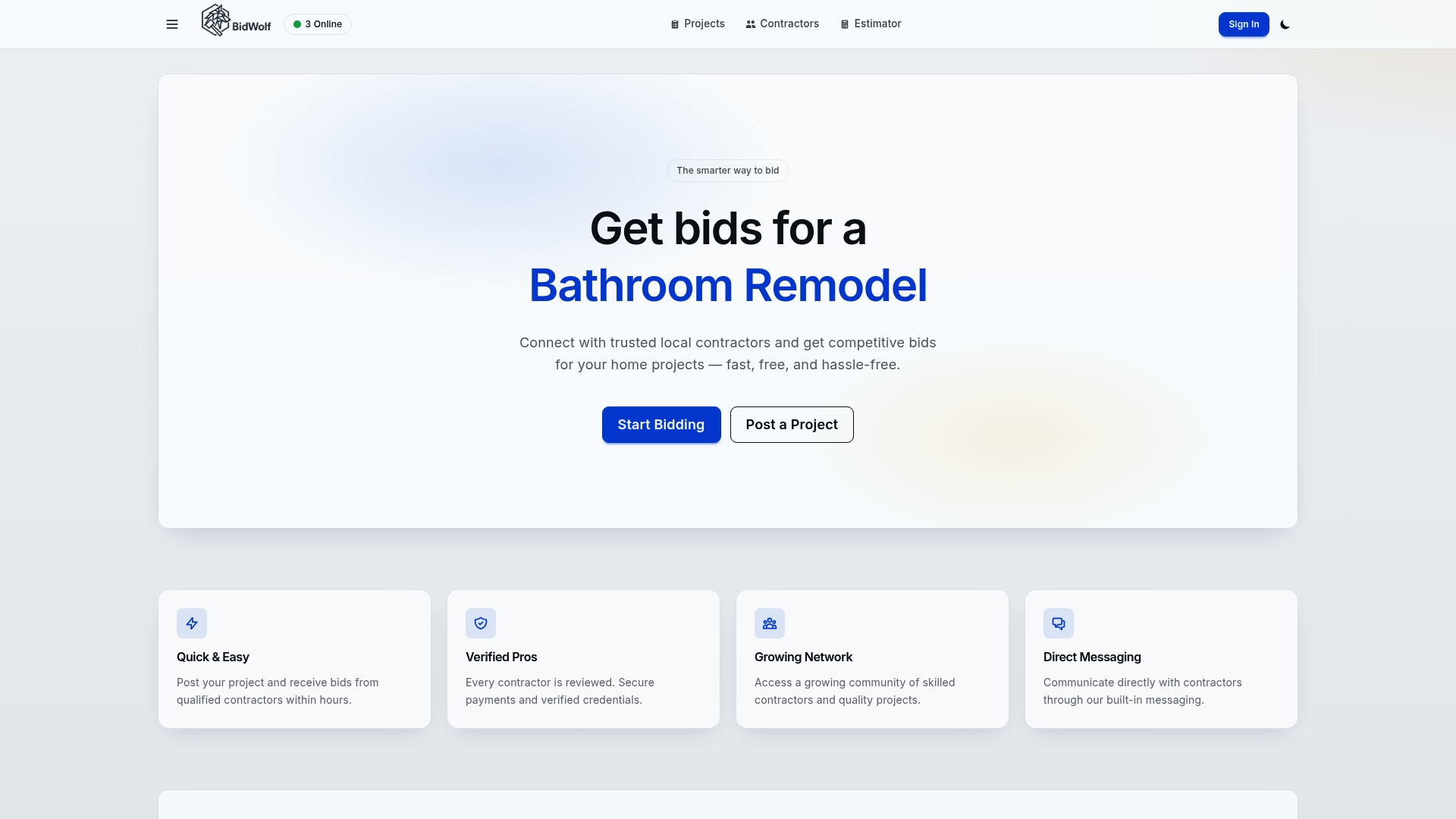
Bidwolf connects homeowners with verified, license-checked local contractors across Texas. You post your project, receive competitive bids, and compare them side by side with built-in messaging to ask questions before you commit. The platform supports every phase of your project management, from initial bids through payment. If you are ready to move from planning to execution, post your project on Bidwolf and receive bids from qualified professionals in your area. You can also browse local contractors by trade and location to find the right fit for your specific project scope.
FAQ
What is a home project planning checklist?
A home project planning checklist is a structured document that organizes every phase of a renovation, from goal setting and budgeting through contractor management and final inspection, so nothing is overlooked.
How much contingency should I budget for a home renovation?
A 10–20% contingency fund is the standard recommendation for unexpected site conditions. Apply the higher end to older homes or projects involving structural or mechanical work.
How many contractor bids should I get?
Get at least three bids for any project. Compare them on scope and completeness, not just the bottom-line price, to identify what each bid includes and excludes.
How do I avoid scope creep on a home renovation?
Writing a formal problem statement before construction begins is the most effective way to define boundaries and prevent scope creep from expanding your project beyond your budget.
When should I order materials for a renovation?
Order long-lead materials before demolition begins. Lead times of 2–6 weeks are common for custom cabinetry, specialty tile, and fixtures, and delays in delivery will stall your entire project schedule.