

Roofing Contractor Best Practices: 2026 Field Guide
TL;DR:
- Roofing contractor best practices, including safety protocols, standardized workflows, and thorough documentation, enhance quality and profitability.
- Consistent leadership and clear communication systems are vital for ensuring implementation and building client trust, leading to market growth.
Roofing contractor best practices are the documented safety, operational, and client communication protocols that separate profitable, scalable firms from those stuck in reactive mode. OSHA fall protection standards, workflow standardization endorsed by Roofing Contractor publication, and certification programs like the GAF–IBHS FORTIFIED Alliance all define what professional roofing looks like in 2026. Contractors who follow these protocols consistently reduce rework, close more claims faster, and build the kind of reputation that generates repeat business. This guide covers the specific standards and strategies you need to operate at that level.
1. Critical safety best practices every roofing contractor must follow
Safety is the non-negotiable foundation of every roofing project, and OSHA sets the legal floor. Fall protection is required at heights of 6 feet or more on residential and commercial roofing jobs, with the specific system required depending on roof slope. This rule is not a suggestion. It is the most frequently cited standard in construction, and violations carry fines that can reach tens of thousands of dollars per incident.
The rules differ based on slope:
- Low-slope roofs (less than 4:12 pitch): Guardrail systems, safety nets, personal fall arrest systems (PFAS), or a combination of warning lines and safety monitors are all acceptable.
- Steep-slope roofs (4:12 pitch and above): Only guardrails, safety nets, or PFAS meet the standard. Warning lines alone are not sufficient.
- Skylights and roof openings: Every opening must be covered or guarded. Unmarked skylights are among the most common causes of fatal falls on roofing jobs.
Compliance goes beyond choosing the right system. Site-specific fall protection plans must be written for each active job, anchor points must carry engineering approval, and all equipment must be inspected before use. Training records with employee signatures are required, and retraining must be documented whenever a worker changes roles or a new hazard is introduced.
Pro Tip: Keep a digital folder for each job site containing the fall protection plan, anchor certifications, equipment inspection logs, and signed training records. OSHA inspectors look for proof that the right system was chosen and that workers were prepared. A complete digital record closes that conversation immediately.
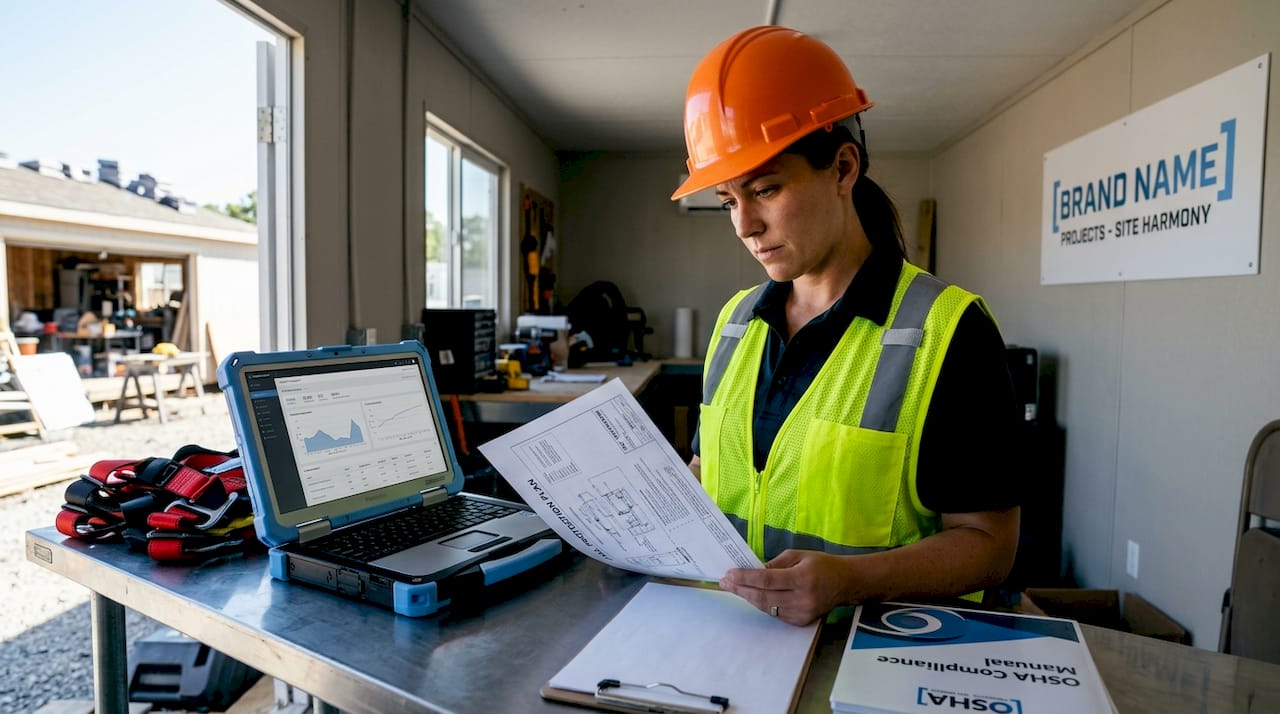
Common citations contractors receive include missing written plans, uncertified anchor points, and no documented rescue procedures. A rescue plan is not optional. It must be written, communicated to the crew, and kept on site.
2. How to optimize roofing operations for quality and efficiency
Operational discipline is what allows a roofing company to grow without quality falling apart. Standardized workflows that use detailed checklists from estimating through final inspection are the single most effective tool for reducing project quality drift. When every crew follows the same sequence, mistakes become visible and correctable instead of buried under the next job.
Here is a practical framework for tightening operations:
- Standardize proposals and contracts. Use templates that define scope, materials, timeline, and payment terms in plain language. Ambiguous contracts are the leading cause of client disputes.
- Run weekly production meetings. Review active jobs, flag scheduling conflicts, and confirm material deliveries. Thirty minutes on Monday prevents three hours of firefighting on Thursday.
- Adopt a CRM or project management platform. Tools like JobNimbus, AccuLynx, or monday.com give you real-time visibility into crew locations, job status, and outstanding tasks. Spreadsheets do not scale.
- Build supplier relationships before you need them. Contractors with preferred vendor accounts at distributors like ABC Supply or Beacon Building Products get priority access during material shortages. That relationship is worth more than any discount.
- Schedule crews with buffer time. Back-to-back scheduling with no slack creates cascading delays. Build in 10 to 15 percent buffer time per week to absorb weather and unexpected scope changes.
- Track key performance metrics. Measure gross margin per job, callback rate, and days from contract to completion. You cannot improve what you do not measure.
Managing multiple renovation bids efficiently also depends on having proposal templates and production checklists ready before the busy season hits. Contractors who build these systems in the off-season gain a measurable edge when volume spikes.
Pro Tip: Set a monthly review of your callback rate. If more than 2 percent of completed jobs generate a callback within 90 days, your installation checklist has a gap. Find it before the customer does.
3. Documentation and communication practices that build client trust
Thorough documentation is not just a legal protection. It is a trust signal that clients read clearly. Slowing down to document post-storm damage with written scopes and photographic evidence signals honesty to homeowners and speeds up insurance approvals. Adjusters who receive a complete, organized file move faster than those who have to chase missing photos or unclear line items.
The documentation practices that matter most include:
- Photo documentation at every stage. Capture pre-installation conditions, underlayment, flashing, and finished surfaces. Time-stamped photos are your defense against any future dispute.
- Written scope of work. Every line item should be specific. “Replace damaged shingles” is not a scope. “Remove and replace 14 squares of GAF Timberline HDZ in Charcoal, including new underlayment and drip edge per IRC R905.2.8.5” is a scope.
- Adjuster alignment visits. When possible, schedule a joint site visit with the homeowner’s adjuster. Walking the roof together eliminates the back-and-forth that delays approvals by weeks.
- Regular client updates. Send a brief update at each project milestone: materials ordered, crew scheduled, work started, inspection passed. Clients who feel informed do not call to ask where you are.
Effective contractor communication using group messaging and project dashboards keeps both crews and clients informed, reducing costly misunderstandings and delays. The contractors who win referrals are not always the fastest. They are the ones who communicated clearly from start to finish.
4. Material selection and technical installation standards
Technical installation quality is where roofing contractor best practices become measurable in long-term roof performance. Drip edge is one of the most commonly misinstalled components on residential roofs, and the code is specific. Per IRC Section R905.2.8.5, drip edge must extend at least 1/4 inch below the roof sheathing, overlap adjacent sections by a minimum of 2 inches, and be fastened no more than 12 inches apart. The installation sequence also differs by location: at eaves, drip edge goes under the underlayment; at rakes, it goes over.
| Installation point | Drip edge position | Common mistake |
|---|---|---|
| Eaves | Under underlayment | Installed over underlayment, trapping water |
| Rakes | Over underlayment | Installed under underlayment, allowing wind uplift |
| Material choice | Galvanized steel, aluminum, or stainless steel | Using non-corrosion-resistant materials |
| Fastener spacing | Maximum 12 inches on center | Spacing too wide, causing edge lift |
Material selection beyond drip edge follows the same logic: match the product to the exposure. Coastal and high-humidity markets require corrosion-resistant fasteners throughout. Using standard steel nails in a salt-air environment is a warranty-voiding mistake that shows up within three years.
Certification programs raise the technical bar across the industry. The GAF–IBHS FORTIFIED Alliance has certified over 100,000 roofing contractors nationwide, with more than half of all designations earned in the past three years. That pace reflects growing market demand for contractors who can document storm-resilient installation, not just claim it. Contractors who hold FORTIFIED designations carry credibility that unverified competitors cannot match. You can also explore resources on the French Roofing blog for practical coverage of how FORTIFIED certification affects real-world installation standards.
Pro Tip: Review your installation checklist against the current IRC and your state’s adopted amendments at least once per year. Code cycles update, and what passed inspection in 2023 may not pass in 2026.
5. How documented protocols drive scalability and reduce labor costs
Documented best practices are not just about quality control. They are a financial tool. Firms with documented protocols achieve a 34 percent increase in labor cost efficiency and reduce costly rework. On a 10,000-square-foot project, that translates to roughly $12,000 in avoided rework costs. That number compounds across a full season.
The operational benefits of documentation include:
- Faster onboarding. New crew members trained against a written standard reach full productivity faster than those trained by word of mouth.
- Consistent quality across multiple crews. When you run two or three crews simultaneously, documented checklists are what keep quality uniform. Without them, quality becomes crew-dependent.
- Defensible warranty claims. If a manufacturer disputes a warranty claim, your installation documentation is your evidence. Undocumented work has no defense.
- Scalable market expansion. Entering a new city or county is far less risky when your processes are written down and transferable. Undocumented operations do not travel well.
Review your documented protocols at least quarterly. The best practices that worked for a five-person crew may need adjustment when you are running fifteen people across three active jobs. Continuous improvement is not a one-time project. It is an ongoing operational discipline.
6. Licensing, insurance, and contractor credibility standards
Licensing and insurance are the baseline credentials that separate professional roofing contractors from unlicensed operators, and clients increasingly know the difference. Most states require roofing contractors to hold a valid contractor’s license, carry general liability insurance with minimum coverage limits, and maintain workers’ compensation coverage for all employees. Operating without these is not just a legal risk. It is a reputation risk that one social media post can amplify permanently.
General liability coverage for roofing typically starts at $1 million per occurrence, with many commercial clients requiring $2 million. Workers’ compensation is non-negotiable in most states, and subcontractors who cannot provide a certificate of insurance should not be on your job site. Their injury becomes your liability.
Beyond the legal minimums, voluntary certifications like GAF Master Elite, CertainTeed SELECT ShingleMaster, and the IBHS FORTIFIED designation signal technical competence to homeowners who are comparing bids. These credentials also affect your access to manufacturer warranty programs, which are a direct sales tool when competing against lower-priced contractors. Knowing how to hire a roofing contractor is something your clients research before they call you. Show up to that search with verifiable credentials.
7. Common roofing mistakes that undermine project quality
The most expensive roofing mistakes are not dramatic failures. They are small, repeatable errors that compound over time. Improper flashing installation around chimneys, skylights, and valleys is the leading cause of leak callbacks on completed roofs. Flashing that is not embedded in roofing cement, not overlapped correctly, or not counter-flashed against masonry will fail within two to five years regardless of shingle quality.
Ventilation errors are the second most common category. Installing new shingles over an inadequately ventilated deck traps heat and moisture, degrading the shingle adhesive strip and voiding most manufacturer warranties. The standard formula is 1 square foot of net free ventilation area per 150 square feet of attic floor space, split evenly between intake and exhaust. Contractors who skip this calculation are setting up a warranty dispute.
Nail placement errors are less visible but equally damaging. Nails driven above the nail line, at an angle, or through the shingle face rather than the nail strip reduce wind uplift resistance significantly. On steep-slope roofs in high-wind zones, this is the difference between a roof that survives a storm and one that does not. Training your crew to identify and correct nail placement in real time is one of the highest-return quality investments you can make.
Key takeaways
Roofing contractor best practices require documented safety plans, standardized workflows, and thorough client communication to deliver consistent quality and profitability.
| Point | Details |
|---|---|
| Safety compliance is non-negotiable | OSHA requires fall protection at 6 feet, with site-specific written plans for every job. |
| Standardized workflows reduce errors | Checklists, CRM tools, and weekly production meetings prevent quality drift across crews. |
| Documentation builds trust and speeds claims | Written scopes, time-stamped photos, and adjuster alignment visits reduce disputes and delays. |
| Technical installation details matter | Drip edge sequence, fastener spacing, and material selection directly affect long-term performance. |
| Documented protocols support growth | Firms with written best practices achieve measurable labor cost efficiency and scale more reliably. |
What I’ve learned about making best practices actually stick
Most roofing contractors know what they should be doing. The gap is not knowledge. It is execution consistency, and that gap almost always traces back to leadership.
I have seen firms invest in OSHA training, buy CRM software, and print out installation checklists, only to watch all of it dissolve within 90 days because the owner or foreman did not model the behavior. Safety culture does not come from a binder. It comes from the person running the job treating every protocol as non-negotiable, every single day. When the foreman skips the fall protection plan because “it’s a quick job,” the crew learns that the rules are optional.
Technology adoption follows the same pattern. Contractors who struggle with CRM tools are usually trying to bolt them onto existing habits rather than replacing those habits. The contractors I have seen succeed with platforms like JobNimbus or AccuLynx started by committing to one workflow, mastering it, and then expanding. Trying to digitize everything at once creates confusion and abandonment.
The area where I think most contractors leave the most money on the table is client communication. In a market where homeowners are comparing three bids, the contractor who sends a project update at every milestone wins the referral even when they are not the cheapest. Clients do not just pay for a roof. They pay for the confidence that the job is being handled professionally. That confidence is built through communication, and it costs nothing to provide.
The contractors who will lead their markets in the next five years are the ones building these systems now, before the next growth cycle forces the issue.
— Devin
Grow your roofing business with BidWolf
Running a tight operation is only half the equation. You also need a steady pipeline of qualified projects to keep your crew productive.
BidWolf connects verified roofing contractors with homeowners actively seeking bids on roofing projects across Texas. The platform lets you review project details, submit competitive bids, and communicate directly with clients through built-in messaging, all from your phone or desktop. Credentials are verified upfront, so you are competing on quality and price, not just availability. Whether you are looking to fill gaps in your schedule or expand into new service areas, find roofing projects on BidWolf and put your documented best practices to work on jobs that are ready to move.
FAQ
What fall protection does OSHA require for roofing work?
OSHA requires fall protection for any roofing work at 6 feet or more above a lower level. Low-slope roofs allow guardrails, safety nets, PFAS, or warning lines with safety monitors; steep-slope roofs require guardrails, safety nets, or PFAS.
How does drip edge installation differ at eaves vs. rakes?
At eaves, drip edge installs under the underlayment; at rakes, it installs over the underlayment. Both locations require a minimum 2-inch overlap between sections and fasteners spaced no more than 12 inches apart per IRC R905.2.8.5.
What are the most common roofing mistakes contractors make?
Improper flashing installation, inadequate attic ventilation, and nail placement errors above the nail line are the three most frequent causes of callbacks and warranty disputes on completed roofs.
How does GAF–IBHS FORTIFIED certification benefit roofing contractors?
The GAF–IBHS FORTIFIED Alliance has certified over 100,000 contractors nationwide, and the designation improves both contractor credibility and documented storm-resilient installation quality, which supports warranty programs and competitive differentiation.
How do documented protocols reduce roofing labor costs?
Firms with documented best-practice protocols achieve a 34 percent improvement in labor cost efficiency, with one example showing $12,000 in rework avoided on a single 10,000-square-foot project through compliance-based installation checks.
Recommended
- Contractor marketplaces: a complete guide for Texas homeowners | BidWolf Blog
- Texas homeowner’s checklist: smart tips for choosing contractors | BidWolf Blog
- How Texas homeowners find trusted contractors fast | BidWolf Blog
- Winning contractor bid examples: secure quality projects in Texas | BidWolf Blog