

The Role of Transparency in Contractor Selection

TL;DR:
- Transparency in contractor selection enhances trust, reduces disputes, and ensures projects finish on time within budget. Legal requirements like California SB 517 push for full disclosure of subcontractors, encouraging accountability and risk mitigation. Using documented bids, milestone payments, and verification records creates a clear, objective process that leads to better contractor relationships and successful remodel outcomes.
Hiring a contractor without clear information is one of the most common ways home renovation projects go sideways. The role of transparency in contractor selection goes far beyond asking for a license number. It shapes how trust gets built, how disputes get resolved, and ultimately whether your project finishes on time and within budget. Most homeowners focus on price and a few reviews, then wonder why things fell apart midway through a remodel. The difference between a smooth project and a costly headache often comes down to how much visibility you had into who you hired, what was agreed upon, and how accountability was tracked from day one.
Key Takeaways
| Point | Details |
|---|---|
| Transparency builds trust | Open communication and documented expectations between homeowners and contractors directly improve project outcomes. |
| Legal disclosures protect you | Laws like California SB 517 require subcontractor disclosures, giving homeowners the right to verify who works on their property. |
| Transparent bidding reduces risk | Published evaluation criteria and documented bids deter favoritism and help you make objective, informed hiring decisions. |
| Milestone payments reduce disputes | Linking payments to verified work phases protects your investment and keeps contractors accountable throughout the project. |
| Performance data drives better renewals | Tracking vendor compliance, response times, and SLA fulfillment turns contractor renewal from a guessing game into an objective decision. |
The role of transparency in contractor selection
When contractors and homeowners talk about transparency, the conversation usually stays surface level. “Get everything in writing” is the advice everyone has heard. But transparency in contractor selection, which professionals in project delivery also call open procurement governance, goes much deeper than a signed contract.

Transparency in this context means every party involved can see the basis for decisions, the criteria used to evaluate bids, the qualifications of everyone working on the project, and the standards by which progress gets measured. It applies before the work starts, during the project, and at close-out.
MDPI research on Integrated Project Delivery directly links shared risk and transparent communication to improved collaboration and accountability on construction projects. When contractors know their work will be documented and measured, behavior shifts. When homeowners can see exactly what they are paying for and when, disputes become rare rather than routine.
Here is what genuine transparency looks like in practice:
- Documented bid criteria shared with all bidders before they submit proposals
- Clear scope of work with a written change-order process
- Subcontractor disclosure so you know every trade working in your home
- License and insurance verification available before work begins
- Milestone-based payment schedules tied to documented progress
“Transparent communication and shared governance are prerequisites for trust, not byproducts of it. When contractors and owners share the same information, they make better decisions together.” Sustainability Journal on IPD and Trust
The connection between transparency and trust is not just philosophical. Projects where homeowners and contractors operate with the same documented expectations produce fewer change orders, fewer payment disputes, and higher satisfaction on both sides. That outcome is worth building your entire hiring process around.
What California SB 517 means for homeowners
Most homeowners do not realize that transparency in hiring contractors is increasingly a legal requirement, not just a best practice. California Senate Bill 517, effective January 1, 2026, is one of the most concrete examples of how legislatures are forcing greater openness into residential contracting.
Under SB 517’s disclosure requirements, general contractors must include a checkbox in their home improvement contracts indicating whether subcontractors will be used. If subcontractors are involved, the contract must include a disclaimer telling homeowners they have the right to request the subcontractor’s name, license number, and contact information.
Why does this matter? Because subcontractor opacity is one of the most common sources of risk in multi-trade renovations. When an unlicensed or uninsured subcontractor performs work in your home without your knowledge, you can be left holding liability that was never yours to carry. Verifying subcontractor lists and licenses proactively helps homeowners avoid hidden legal and financial exposure in complex projects.
Even if you do not live in California, the SB 517 framework is a useful model for what to demand from any contractor, regardless of your state’s specific requirements.
Here is a practical checklist to use at contract signing:
- Ask whether subcontractors will be used and get a written answer.
- Request the name and license number of each subcontractor before work begins.
- Verify every license through your state’s contractor licensing board website.
- Confirm that subcontractors carry their own general liability and workers’ compensation insurance.
- Keep copies of all verification records alongside your contract documents.
Pro Tip: Never sign a home improvement contract that includes vague language like “and other subcontractors as needed.” Request a named list of subcontractors and update that list in writing any time a trade changes. This single step prevents more disputes than almost anything else you can do.
The disclosure workflow created by SB 517 is not burdensome for reputable contractors. In fact, established professionals welcome it because it separates them from less qualified competitors who prefer to keep their supply chain hidden.
Transparent bidding and contractor evaluation
The importance of transparency in bidding is easy to underestimate until you have received three wildly different quotes for the same project. The gap between bids is often less about price and more about what was included, what was excluded, and how each contractor interpreted the scope.
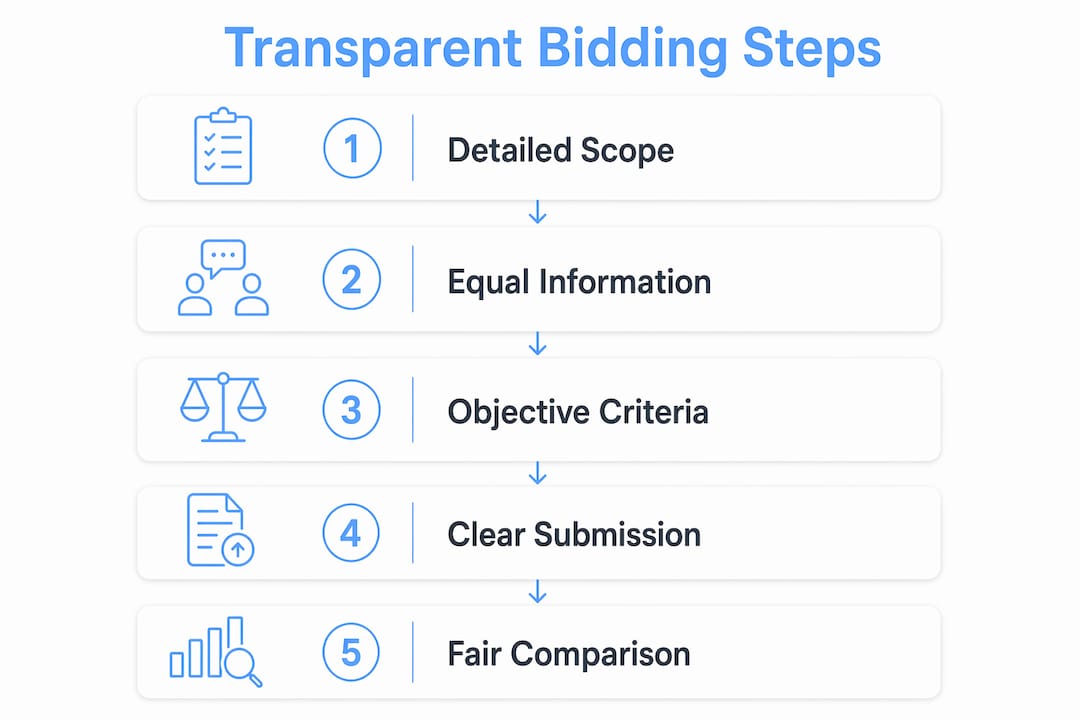
A transparent bidding process means you provide every bidder with the same detailed scope of work and ask them to respond in a standardized format. Procurement transparency guidance frames this as a systemic obligation from planning through contract closeout. When evaluation criteria are published and communicated clearly, the process deters favoritism and corruption. The same principle applies directly to homeowners and property managers comparing contractor bids.
Why documented performance data matters
For property managers handling multiple vendors, subjectivity in renewal decisions is expensive. When you renew a contractor based on “they seem reliable,” you are leaving money and risk on the table. Tracking SLAs, invoice accuracy, and response times gives property managers an auditable record that turns renewal decisions into objective evaluations rather than gut-feel choices.
Quarterly compliance audits and vendor scorecards convert the entire contractor lifecycle into a trackable data trail. Insurance renewal dates, missed response windows, and repeat callbacks all become data points. When rebid time comes, you know exactly which contractors earned the next contract and which ones need to be replaced.
Opaque vs. transparent contractor evaluation
The table below illustrates the real difference in outcomes between opaque and transparent evaluation methods:
| Evaluation type | Criteria visibility | Risk exposure | Common outcome |
|---|---|---|---|
| Opaque selection | Criteria known only to decision-maker | High. Bias and favoritism are likely | Cost overruns, disputes, and poor fit hires |
| Transparent selection | Criteria shared with all bidders upfront | Low. All parties held to same standard | Better bids, reduced disputes, and higher accountability |
| Data-driven renewal | Performance tracked against documented benchmarks | Very low. Decisions are auditable | Objective renewals and measurable service improvement |
Transparency paired with enforcement mechanisms produces the best results. Disclosing criteria is a start, but the process also needs to include clear remedies for when contractors fall short. Homeowners who build this into their contracts from the beginning have far more leverage when problems arise.
Benefits of open contractor selection include more accurate bids, better contractor behavior during the project, and a clear paper trail if disputes ever reach the point of legal action. That last benefit alone justifies the additional effort at the start.
Consider what transparent bidding looks like when you compare contractor bids fairly. Apples-to-apples comparison is only possible when every bidder responded to the same detailed information. Otherwise, you are comparing assumptions, not actual proposals.
Practical transparency tools for homeowners
Knowing that transparency matters is useful. Knowing exactly which tools to use is better. The good news is that most of these tools are contractual, not technical. You do not need specialized software to protect yourself. You need documented agreements and a consistent process.
Milestone payment schedules
A milestone payment schedule breaks your project into defined phases and releases payment only when each phase is verified complete. Milestone-based escrow models use photo or inspection evidence to confirm work progress before funds are released. This single structure eliminates the most common payment dispute scenarios.
The mechanics work like this: funds are held in escrow, the contractor completes an agreed phase, the homeowner or an inspector verifies the work, and then the payment releases. If the work is not complete or not up to standard, the funds stay in escrow. Neither party can dispute what happened because the documentation trail is built into the process.
You can plan these payment phases around natural project milestones such as demolition complete, rough-in inspections passed, finishes installed, and final walkthrough approved.
Documentation that protects you
Every project involves decisions made verbally that later get misremembered. The solution is simple: write everything down and attach it to a payment trigger.
The process transparency artifacts every homeowner should require include:
- Written scope of work with a defined change-order process (no verbal approvals)
- Milestone payment schedule tied to specific verified deliverables
- Lien waivers from the general contractor and all subcontractors at each payment release
- Inspection records and site photos dated and attached to milestone sign-offs
- Permit documentation confirming all applicable work was inspected and approved
Scope, milestone payments, and lien waivers are the three documents that convert verbal disputes into trackable contract evidence. When a contractor claims a phase is complete and you disagree, you settle it by comparing the documented scope against the inspection record. There is nothing to argue about.
Pro Tip: Require lien waivers at every payment release, not just at project completion. A final lien waiver only protects you from the general contractor. Waivers at each milestone protect you from subcontractors and material suppliers who were not paid by the general contractor along the way.
Learning how to choose a contractor in Texas or any other state comes down to whether you can verify the contractor’s behavior before it affects your project. Documented processes make that verification possible.
My honest take on transparency as a contractor selection factor
I have reviewed a lot of contractor hiring decisions, and I keep seeing the same pattern. Homeowners put enormous effort into finding the contractor with the best reviews or the lowest bid, then hand over significant money based on essentially nothing more than a handshake and a vague contract. The frustration that follows is almost always predictable.
In my experience, the contractors who resist transparency are sending you a clear signal. When a contractor pushes back on itemized bids, refuses to name their subcontractors, or resists milestone payments, that behavior tells you more about how your project will go than any number of five-star reviews.
What I have found actually works is treating transparency as a filter, not just a preference. If a contractor cannot clearly explain their licensing, subcontractor relationships, and payment expectations before work begins, they almost certainly cannot manage that information effectively during the project either. Transparency is not a burden for professional contractors. It is how they operate.
The homeowners who have the smoothest renovation experiences are not the ones who found the cheapest bid or the most aggressive sales pitch. They are the ones who asked direct questions, got direct written answers, and set up payment structures that matched progress to money. That process does not require a legal background. It requires the confidence to insist on open answers from the start.
If you want a starting point, read about bid transparency for Texas homeowners and apply the same logic to any contractor conversation you have, regardless of location.
— Devin
How BidWolf makes transparent contractor selection practical
Knowing what transparency looks like in theory is one thing. Having a process that builds it in from the start is another.
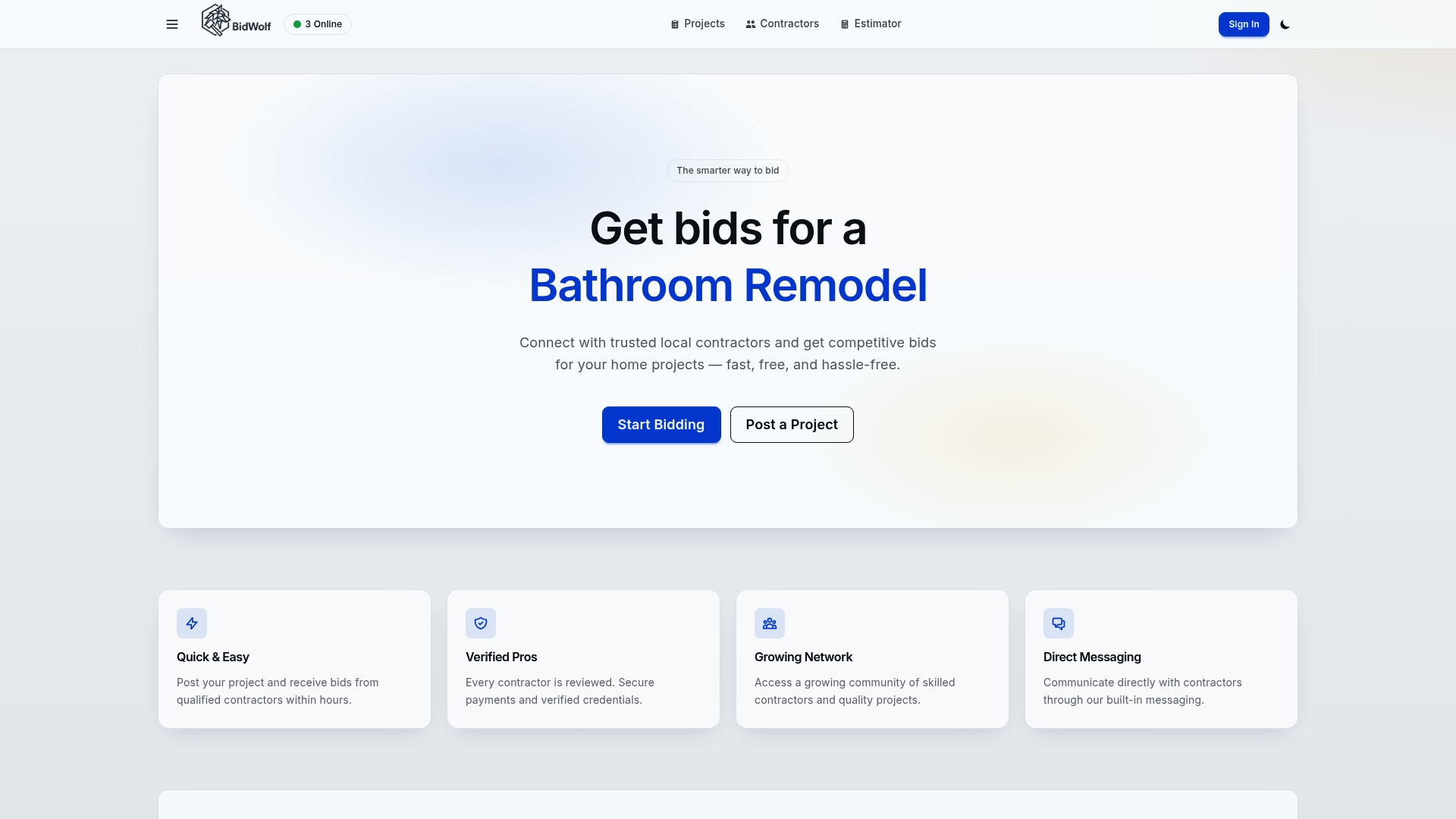
BidWolf is built around the idea that homeowners and property managers deserve clear, documented information before they commit to any contractor. The platform connects you with vetted, license-verified local contractors in Texas who submit competitive, itemized bids on your specific project. You can compare bids side by side, review contractor credentials, and communicate directly through the platform’s built-in messaging before signing anything.
When you post a project on BidWolf, every contractor responding sees the same project details. That single step creates the documented, equal-access bidding environment that produces the most accurate and comparable proposals. You are not managing phone calls or chasing quotes. You are reviewing structured responses from professionals who want your business.
Ready to see verified local contractors with transparent profiles? Browse contractor profiles and start your project with the kind of visibility that protects your investment from day one.
FAQ
What does transparency mean in contractor selection?
Transparency in contractor selection means all parties have access to the same documented information: bid criteria, contractor qualifications, subcontractor lists, and payment terms. It reduces guesswork and gives homeowners a clear basis for comparing and choosing professionals.
Why is transparent bidding important for home projects?
When every contractor bids on the same detailed scope with the same evaluation criteria, bid comparisons become objective rather than guesswork. Transparent bidding surfaces more accurate pricing, reduces the risk of scope disputes, and deters lowball bids that hide costs in change orders.
What is California SB 517 and how does it affect homeowners?
California SB 517, effective January 1, 2026, requires general contractors to disclose whether subcontractors will be used and to provide their names, license numbers, and contact details upon request. It gives homeowners a legally backed right to know who is working in their home.
How do milestone payments protect homeowners during renovations?
Milestone payments release funds only after specific phases of work are verified complete, often through inspection records or dated photos. This structure means contractors are accountable at every stage, and money is never paid ahead of documented progress.
How do property managers use transparency to manage ongoing contractors?
Property managers can track SLA compliance, invoice accuracy, and response times to build an objective performance record for each vendor. That data turns contract renewal from a subjective call into a documented, auditable decision backed by real evidence.