

What Is Fair Bidding for Your Home Renovation?
TL;DR:
- Fair bidding in home renovation involves a transparent process based on standardized requests, equal access, and objective evaluation criteria. It prioritizes value, transparency, and accountability over solely choosing the lowest bid to avoid surprises, delays, and budget overruns. Following structured steps and verifying contractor credentials help homeowners make informed, fair comparisons and build honest working relationships.
When you start collecting quotes for a home renovation, the assumption is simple: the lowest number wins. But that thinking leads to blown budgets, delays, and contractors who disappear mid-project. Understanding what is fair bidding changes how you approach the entire contractor selection process. It shifts your focus from price alone to value, transparency, and accountability. This article breaks down the fair bidding definition, explains how the process actually works, and gives you the tools to compare contractor bids with confidence, so you hire the right person for the job, not just the cheapest one.
Table of Contents
- Key Takeaways
- What is fair bidding and why it matters
- Common types of contractor bidding
- How to evaluate contractor bids fairly
- Bidding tactics and pitfalls to avoid
- Applying fair bidding to your renovation project
- My honest take on fair bidding mistakes
- How Bidwolf makes fair bidding simple
- FAQ
Key Takeaways
| Point | Details |
|---|---|
| Lowest bid is rarely fairest | A significantly low bid often signals missing scope items, cheaper materials, or future cost overruns. |
| Standardized bids enable comparison | Require itemized breakdowns of labor, materials, and overhead so you compare equal proposals. |
| Fair bidding is about process | Fairness means equal opportunity, clear criteria, and transparent evaluation, not just price. |
| Urgency is a red flag | Contractors who pressure you to decide immediately are bypassing the fair bidding process. |
| Technology platforms help | Digital bidding platforms give you structured comparisons, verified credentials, and built-in communication tools. |
What is fair bidding and why it matters
The fair bidding definition comes from procurement principles used across industries, from government contracts to commercial construction. At its core, fair bidding is a structured process built on three pillars: transparency, equal opportunity, and objective evaluation. Every qualified contractor sees the same project requirements. Every bid gets measured against the same criteria. No favoritism, no hidden rules.
For homeowners, this might sound more formal than what you experience when calling around for quotes. But the underlying principles apply directly to your kitchen remodel or bathroom renovation. When you give each contractor the same project details, ask for the same format of response, and evaluate them against the same list of criteria, you are practicing fair bidding.
Here is what the fair bidding process looks like in practice:
- Transparency: The project scope, budget range, timeline, and evaluation criteria are shared upfront with all bidders.
- Equal opportunity: Every contractor you invite gets the same information at the same time, with no back-channel advantages.
- Objective evaluation: You assess bids based on pre-set criteria, such as price, experience, materials quality, and timeline, rather than gut feeling or relationship.
- Accountability: Bids are documented, deadlines are respected, and the selection reasoning can be explained clearly.
“Fairness focuses on the process, not just the price. Defining walk-away ceilings with data removes emotional volatility from your decisions.” — Property Bidding Strategy Guide
There is also a legal and ethical dimension worth knowing. Formal bidding processes impose obligations on both buyers and contractors, including submission deadlines and evaluation transparency. In formal settings, a late bid gets rejected regardless of how good it is. For homeowners, you do not need to run a legal process, but adopting these standards protects you and signals to contractors that you are a serious, organized client.
Understanding the importance of fair bidding goes beyond protecting your wallet. It creates a working relationship built on honesty from the start, which matters when you are inviting someone into your home for weeks at a time.

Common types of contractor bidding
Not all bids arrive the same way. The method used affects how much transparency and fairness you can expect. Here is a breakdown of the four main bidding types and how they apply to home renovation projects.
| Bidding Type | How It Works | Fairness Level | Best For |
|---|---|---|---|
| Open bidding | Posted publicly; any licensed contractor can submit | High | Large projects with many qualified options |
| Selective bidding | Invitations sent to a short list of pre-vetted contractors | High | Mid-size projects where quality matters most |
| Negotiated tendering | Direct negotiation with one contractor without competing bids | Low | Urgent repairs or trusted repeat contractors |
| Sealed bids | All bids submitted simultaneously without seeing competitors | Very high | Projects where price objectivity is critical |
Most homeowners unknowingly use a hybrid approach: they call a few contractors, ask for quotes, and pick from what comes back. This is closest to selective bidding, and it works well when done with structure. The problem is most homeowners skip the structure, so bids arrive in different formats, cover different scopes, and cannot be compared fairly.
Open bidding, by contrast, creates more competition and usually produces a wider price range. Platforms that let you post your project publicly give you access to this model without the administrative work of government-style procurement. Sealed bids are less common in home renovation but show up occasionally in larger remodeling contracts where the project owner wants to prevent price collusion.
Negotiated tendering has its place, especially for emergency repairs or when you have a contractor whose work you trust completely. But using this as your default approach for major projects means you have no market data to evaluate whether you are getting a reasonable price. That gap in information is where fair bidding practices protect you most.
How to evaluate contractor bids fairly
Comparing bids without a framework is where most homeowners go wrong. You look at the bottom line, pick the one that feels right, and hope for the best. Fair bid evaluation requires more structure than that.
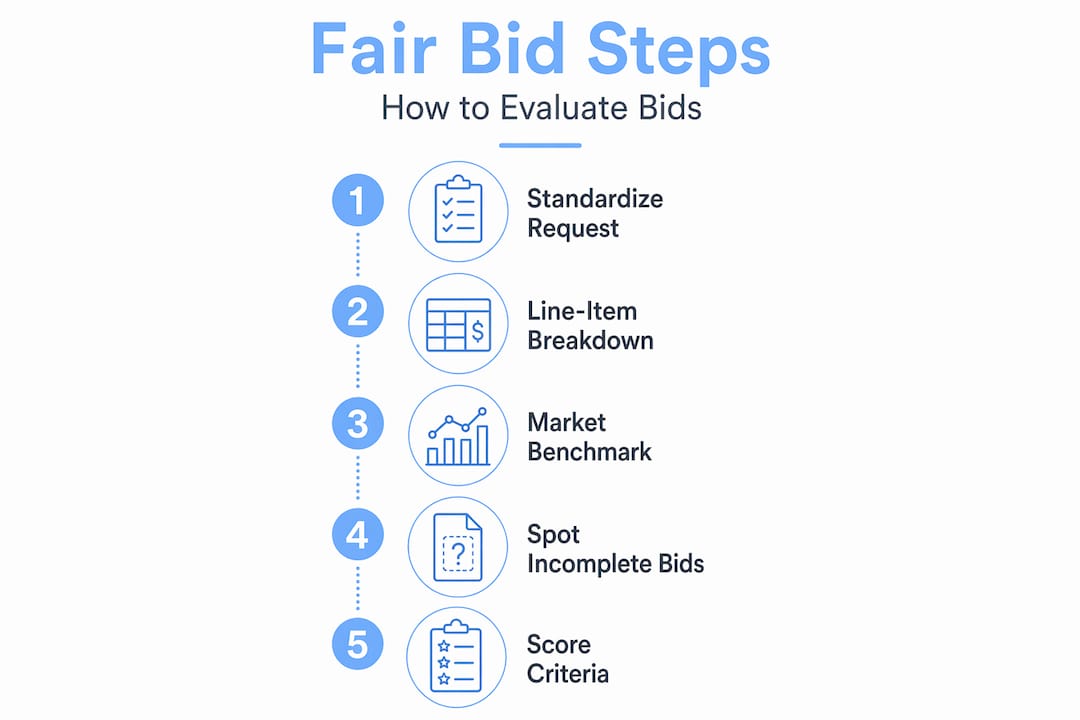
1. Standardize your request before bids are submitted. Send every contractor the same written project description. Include dimensions, materials preferences, timeline expectations, and what you want included in their response. Standardized bid requirements and itemized breakdowns of labor, materials, and overhead are best practice precisely because comparing dissimilar bids leads to hidden charges and cost overruns.
2. Require a line-item breakdown in every bid. Do not accept a single-number quote. Ask for a full breakdown: labor costs, material costs, subcontractor fees, permits, markup, and any contingency allowances. Using a schedule of values forces contractors to justify their pricing structure, which reduces the chance of hidden inflated costs appearing mid-project.
3. Benchmark against market data. Before you even send your project out for bids, gather 3 to 5 comparable project cost estimates to set a realistic price ceiling. If you know a bathroom remodel of your size typically runs between $8,000 and $14,000 in your area, you can immediately flag a $4,500 bid as suspicious and a $22,000 bid as worth scrutinizing.
4. Identify incomplete or misleading bids. Lower bids often reflect missing line items or cheaper material substitutions rather than genuine efficiency. Ask any contractor who comes in significantly below others to walk you through their bid line by line. Legitimate contractors welcome this conversation. Contractors who resist it are usually hiding something.
5. Look at reliability, not just price. Contractors who demonstrate reliability through verified credentials, realistic timelines, and clear communication often deliver better outcomes than the lowest bidder. A contractor who promises to finish your kitchen in three weeks when everyone else says eight weeks is not more efficient. They are setting you up for disappointment.
6. Use a scoring system. Assign weights to each evaluation criterion: price (40%), timeline (20%), references (20%), materials quality (10%), communication (10%). Score each bid against these criteria. This removes gut-feeling bias and gives you a documented reason for your decision.
Pro Tip: Create a simple spreadsheet with each contractor’s name across the top and your evaluation criteria down the side. Fill it in as bids arrive. This one tool alone will make your decision significantly clearer and protect you if a contractor later disputes your choice.
Bidding tactics and pitfalls to avoid
Understanding fair bidding also means recognizing when someone is working against the process. Some tactics are subtle. Others are obvious once you know what to look for.
-
The urgency trap. A contractor tells you the price is only good for 48 hours, or that they have another job lined up and need your commitment by tomorrow. Taking 24 to 48 hours to review bids and check references is standard practice. Any contractor who discourages this is creating pressure that serves them, not you.
-
Artificially low opening bids. Some contractors submit a low number to win the job, then recover their margin through change orders once work begins. These change orders are almost always worded in ways that make them appear necessary and unavoidable. Request that your contract include a clause limiting change orders to genuinely unforeseen conditions.
-
Vague scope descriptions. If a bid says “bathroom renovation, materials included” without specifying tile grade, fixture quality, or labor hours, you cannot evaluate it fairly against a bid that itemizes every line. Vague bids protect the contractor, not you. Push back and ask for specifics.
-
No license or insurance documentation. A bid that does not include proof of licensing and general liability insurance is not a complete bid. Hiring an unlicensed contractor creates personal liability for you if something goes wrong on the job.
-
Walking away with a price floor. Before you start collecting bids, decide on a maximum budget based on your market research. Stick to it. Emotional decisions made under pressure, especially when you love the contractor’s portfolio, regularly push homeowners well past their budgets.
Pro Tip: Ask every contractor for two or three references from projects completed in the past 12 months, specifically projects similar in scope to yours. Then actually call those references. Ask how closely the final cost matched the original bid. That single data point tells you more than any number in the proposal.
Applying fair bidding to your renovation project
Knowing the theory behind fair bidding practices is one thing. Putting it to work on your actual project is another. Here is a practical sequence you can follow from day one.
-
Write a detailed project scope. Before contacting any contractor, document exactly what you want done. Include measurements, preferred materials or material grades, permits you expect to need, and your timeline. The more specific your scope, the more accurate and comparable your bids will be.
-
Invite at least three qualified contractors. Gather bids from a minimum of three contractors. More options give you better market data and reduce the chance that one unrealistic bid skews your perception of fair pricing. Use platforms like Bidwolf to reach vetted local contractors quickly without cold-calling through directory listings.
-
Send the same project description to every bidder. Do not describe the project differently in different conversations. Standardized project information is the foundation of managing multiple renovation bids fairly.
-
Set a bid submission deadline. Give contractors a specific date to submit. Staggered bids are harder to compare and create pressure to decide before you have complete information. A shared deadline creates a level playing field.
-
Review bids systematically. Use your scoring system. Compare line items, not just totals. Verify that each bid includes the same scope items. Flag missing elements and ask contractors to clarify before you eliminate anyone.
-
Check credentials independently. Verify each contractor’s license through your state licensing board and confirm their insurance is current. Do not rely on copies they provide without cross-checking. Bidwolf’s platform does much of this verification work automatically.
-
Make your decision in writing. Communicate your selection and your reasoning to all bidders. This is not legally required for residential projects, but it is good practice. It builds your reputation as a fair client, which matters if you work with these contractors again or need referrals.
Applying these steps consistently takes more time upfront than calling around and picking the first name you recognize. But it dramatically reduces the risk of budget overruns, contractor disputes, and rework costs that turn a $15,000 project into a $25,000 one.
My honest take on fair bidding mistakes
I have seen homeowners go through the bidding process dozens of times, and the pattern of mistakes is remarkably consistent. The biggest one is treating the lowest bid as automatic proof of the best deal. It is not. A significantly low bid almost always signals a problem: missing scope items, plans to substitute cheaper materials, or a contractor who underpriced to win the job and will make up the difference in change orders.
What surprises most people is how little patience matters here. Waiting an extra week to collect all bids, review them carefully, and verify references feels slow. But that week almost always saves you more money than the difference between bids. The homeowners who skip this step are the ones who end up posting frustrated reviews about projects that went sideways.
I also think people underestimate the value of documentation. Asking for itemized bids and keeping records of contractor communication is not bureaucratic. It is protection. When a contractor tells you mid-project that the scope has changed and the price just went up by $4,000, your documented bid and contract are the only things standing between you and an argument you might lose.
The underlying message behind understanding fair bidding is this: the process protects you. Give it the attention it deserves, use platforms that reinforce transparency, and trust data over pressure. Your renovation will be better for it.
— Devin
How Bidwolf makes fair bidding simple
Ready to put fair bidding into practice on your next home renovation? Bidwolf was built specifically to give homeowners the structure and transparency the bidding process requires.

When you post your project on Bidwolf, you describe your project once and receive competitive bids from verified local contractors in Texas. Every contractor on the platform carries verified credentials, so you skip the time-consuming license and insurance verification step. Bids arrive through a standardized format that makes side-by-side comparison straightforward, and the built-in messaging tool keeps all contractor communication in one place. You can also use Bidwolf’s free cost estimator to benchmark your project before bids arrive, so you walk into the process with real market data behind you. No pressure, no guessing, just clear information to help you choose confidently.
FAQ
What is the fair bidding definition in home renovation?
Fair bidding in home renovation is the practice of collecting contractor bids using standardized project requirements, equal access to information, and objective evaluation criteria. The goal is a transparent, comparable process rather than selecting a contractor based on price alone.
How many bids should I collect for a fair comparison?
Experts recommend collecting at least three bids for any significant home renovation project. This gives you enough market data to recognize outliers and make an informed decision without being overwhelmed by too many options.
Why is the lowest bid often not the best choice?
A low bid often lacks scope accuracy or quality assurance, which leads to expensive change orders later. Contractors who underbid frequently recover their margin through additions once the project is already underway.
What should an itemized contractor bid include?
A thorough bid should break down labor costs, material costs, subcontractor fees, permit costs, overhead, markup, and any contingency allowances. Bids that omit these categories make fair comparison impossible and leave you exposed to hidden charges.
How do I protect myself from the urgency trap in bidding?
Take at least 24 to 48 hours to review any bid before committing, regardless of what the contractor says about availability or pricing deadlines. Artificial urgency pressure is a tactic, not a real constraint. Trustworthy contractors will hold their price for a reasonable review period.