
How contractor reviews help Texas homeowners hire wisely
TL;DR:
- In Texas, contractor reviews are vital because the state lacks a statewide licensing system, increasing the risk of scams and unprofessional firms. Homeowners should interpret reviews critically, focusing on recent, detailed feedback and responses to complaints to verify legitimacy. Combining reviews with references, insurance checks, and personal conversations creates a layered approach to hiring trustworthy contractors.
Choosing a contractor in Texas is not as straightforward as it looks. Price quotes vary wildly, word-of-mouth recommendations run dry fast, and the state offers far less regulatory protection than most homeowners realize. Reviews have quietly become one of the most powerful tools you have — not just for checking quality, but for verifying that a contractor is legitimate at all. 81% of homeowners research contractor reviews online before hiring, and 87% won’t even contact a contractor rated below four stars. This guide shows you exactly how to read, evaluate, and act on those reviews so you hire with confidence every time.
Table of Contents
- Why contractor reviews matter more in Texas
- How to read contractor reviews like a pro
- Turning reviews into a shortlist: Practical steps
- How much should reviews influence your decision?
- What most homeowners get wrong about contractor reviews
- Find your next trusted Texas contractor with BidWolf
- Frequently asked questions
Key Takeaways
| Point | Details |
|---|---|
| Reviews are critical in Texas | With minimal contractor regulation, reviews serve as the main filter for homeowners unlike in many other states. |
| Look for patterns, not perfection | One or two negative reviews are normal; pay attention to repeated issues and how contractors respond. |
| Combine reviews with references | Verify online feedback with at least two recent, project-specific references before hiring. |
| Don’t ignore professionalism | Responsiveness, clear communication, and transparency during the hiring process matter more than just star averages. |
| Use platforms for extra assurance | Online platforms can help you cross-check reviews, references, and compare local contractor bids easily. |
Why contractor reviews matter more in Texas
Most states require general contractors to pass licensing exams, carry bonds, and renew credentials on a set schedule. Texas is different. The state does not require a statewide license for general contractors. That means virtually anyone with a truck and a business card can show up at your door and offer to remodel your kitchen or fix your roof. This single fact changes the entire hiring equation.
When licensing is not a reliable filter, something else has to do that job. Reviews, insurance verification, and personal references become your primary screening tools. Skip them, and you are left with little legal recourse if things go wrong. Under Texas’s Residential Construction Liability Act (RCLA), homeowners must send a formal demand letter before they can even file a lawsuit against a contractor — a process that takes time and money. The law puts the burden of research squarely on your shoulders before you sign anything.
What makes Texas riskier than other states:
- No statewide general contractor licensing board
- No mandatory bonding requirements for most trades
- High storm activity creates a surge of out-of-state “storm chasers” after hurricanes, tornadoes, and hail events
- Scammers routinely fabricate reviews or rebrand under a new company name after collecting deposits and disappearing
Storm chaser fraud is especially common after major weather events. These contractors post a burst of positive reviews to look established, then vanish once they have your deposit. Because Texas does not require licensing, there is no central registry to cross-check. Reviews — specifically their patterns, dates, and content — are often the only clue that something is off.
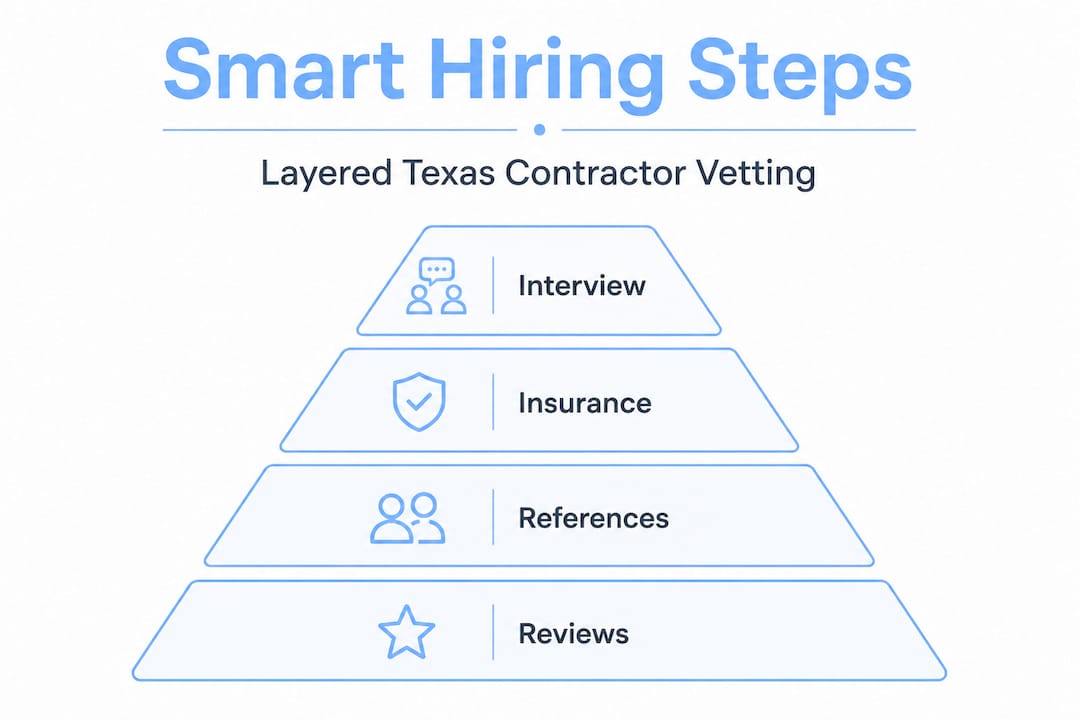
Learning how to hire contractors securely in Texas takes more than a quick Google search. You need a layered approach that starts with reviews but does not stop there. Understanding the landscape of Texas contractor marketplaces is also worth your time, because vetting happens at the platform level before you even make contact with a pro.
How to read contractor reviews like a pro
Knowing that reviews matter is one thing. Knowing how to actually interpret them is another skill entirely. Most homeowners scan for a star rating and move on. That approach misses most of the useful information buried inside those reviews.
Where to look first:
- Google: The highest volume of reviews for most contractors, and harder to game than some other platforms
- Better Business Bureau (BBB): Shows formal complaints, ratings, and how the contractor responded — or did not respond
- Yelp: Useful for spotting review clusters and reading detailed narratives from real customers
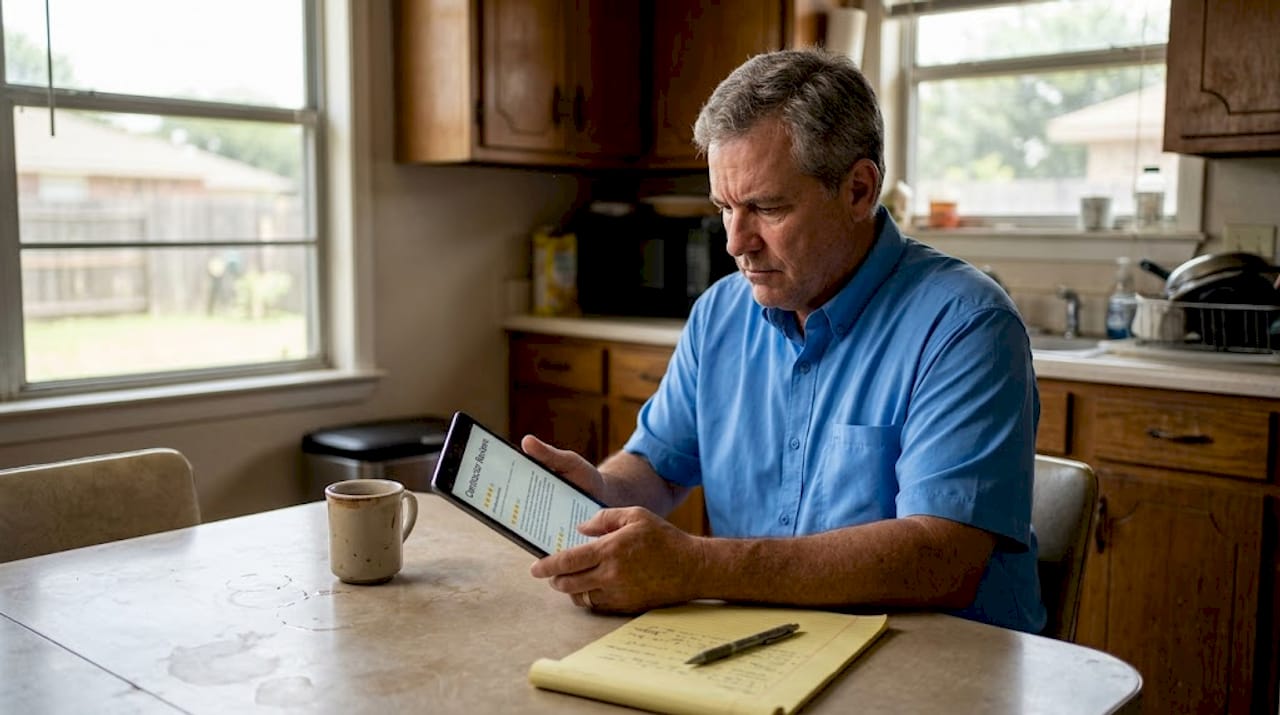
Prioritize recent, detailed reviews that mention specific project types, timelines, and how problems were handled. Vague five-star reviews that say “great job!” tell you almost nothing. A review that says, “They replaced my HVAC on schedule, communicated every delay, and fixed a minor wiring issue at no extra charge” gives you real data to work with.
Red flags to watch for:
- A cluster of 10 or more reviews posted within the same week
- Multiple reviews using nearly identical language or phrasing
- Reviewer profiles that have only one review on their entire account
- Glowing reviews that contain no specific details about the project
- A sudden spike in reviews immediately after a major Texas storm event
On the flip side, pay close attention to how a contractor responds to negative reviews. A professional contractor will acknowledge the concern, explain what happened, and offer a resolution. A defensive or dismissive response — especially one that attacks the customer — is a serious warning sign. It tells you how this contractor handles conflict, which matters a lot when something goes wrong on your project.
Patterns in complaints are more important than individual complaints. If three separate reviewers mention that the contractor stopped responding after receiving partial payment, that is a pattern. One bad review about a personality clash is not. The benefits of using bidding platforms include the fact that many pre-screen contractors and aggregate review data for you, reducing the time you spend hunting across multiple sites.
| Review signal | What it likely means |
|---|---|
| Detailed, recent, project-specific | Genuine and informative |
| Vague, generic praise (“great work!”) | Low value, possibly fake |
| Contractor responds professionally to negatives | Trustworthy communicator |
| Contractor attacks reviewers publicly | Conflict-prone, avoid |
| Cluster of reviews in a short window | Possible fake review campaign |
| Repeated complaints about same issue | Real pattern, take it seriously |
Pro Tip: Don’t just read the one-star reviews in isolation. Read the contractor’s response to each one. That response tells you more about professionalism than the original complaint ever could.
Good communication is the backbone of any successful home project. You can find practical guidance on communicating with Texas contractors before the job even starts, so expectations are clear on both sides. The same qualities you look for in reviews — responsiveness, transparency, accountability — should show up in your early conversations with a contractor too.
Turning reviews into a shortlist: Practical steps
Reading reviews well is a skill. Turning what you learn into a shortlist of reliable candidates is the next step. This is where many homeowners lose momentum. They read a dozen reviews, feel overwhelmed, and end up picking someone based on price alone. There is a better way.
Think of reviews as the first filter in a multi-step process. They help you eliminate obviously risky contractors and identify a handful worth investigating further. They do not replace references, insurance checks, or face-to-face conversations.
A step-by-step approach to building your shortlist:
- Start with a list of 8 to 10 contractors who appear in your area and match your project type
- Apply the review filters above — eliminate anyone with red flags or below a 4-star rating
- Narrow to 4 or 5 contractors with consistent, positive, recent reviews
- Ask each shortlisted contractor for at least 3 recent project references for work similar to yours
- Contact those references directly and ask specific questions (see below)
- Trim again to your final 2 or 3, then compare bids
The reference call is something many homeowners skip because it feels awkward. Do not skip it. A quick 10-minute call with a past customer tells you more than any written review. Here are the four questions that matter most:
- Did the project finish on time, and if not, how did the contractor handle the delay?
- Did the final cost match the original estimate?
- Were there any problems, and how did the contractor deal with them?
- Would you hire this contractor again?
That last question is a simple but powerful signal. A satisfied customer who says “absolutely, without hesitation” is worth more than ten five-star reviews.
According to data from over 1,600 homeowner interviews, 47% of homeowners find their initial contractor through a personal referral, but they still use reviews as an essential filter to confirm their choice. Price was consistently ranked secondary to trust. That matters — it means you should not automatically choose the lowest bid if the review profile doesn’t back it up.
| Step | Purpose | Time needed |
|---|---|---|
| Initial review scan | Eliminate high-risk contractors | 30 minutes |
| Deep review reading | Identify reliable candidates | 45 minutes |
| Reference verification | Confirm reliability on real projects | 30 minutes |
| Bid comparison | Evaluate cost and scope | 1 to 2 hours |
| Final decision | Combine all factors | 30 minutes |
Pro Tip: When you compare contractor bids in Texas, don’t just look at the total price. Look at what’s included. Two bids at similar prices can be very different in scope — and reviews from past customers can tell you whether a contractor’s estimates tend to hold up or balloon mid-project.
You can also use the Texas homeowner checklist as a reference to make sure you’re not missing any verification steps during this process. It covers licensing checks, insurance requirements, and the questions you need answered before signing a contract.
How much should reviews influence your decision?
Once you have a shortlist of well-reviewed contractors, you might wonder whether reviews should be the deciding factor between two similarly qualified candidates. The honest answer is: not entirely.
Research from a large homeowner survey found that 73% of homeowners read contractor reviews, but only 12% named them as the primary factor in their final decision. That gap is telling. Reviews are a powerful filter at the start of the process, but by the time you have narrowed to two or three well-reviewed contractors, other signals start to carry more weight.
What often tips the final decision:
- How quickly and clearly the contractor responded to your initial inquiry
- Whether their bid was detailed and transparent or vague and rushed
- The quality of the conversation you had in person or over the phone
- Whether they asked good questions about your project
- Professionalism in written communication, proposals, and estimates
A contractor who scores 4.6 stars but responds to your messages within an hour and walks you through a thorough written proposal will often be a better hire than a 4.9-star contractor who takes three days to reply and sends you a one-line quote.
Key thresholds to keep in mind:
- Below 4 stars: A red flag for most Texas homeowners. Proceed only if you have a strong personal referral and verified insurance
- 4.0 to 4.4 stars: Acceptable if the reviews are recent, detailed, and complaints are isolated
- 4.5 stars and above: Strong baseline, but still verify with references and insurance
- Unresolved BBB complaints: A serious concern regardless of star rating
Always check a contractor’s BBB profile before hiring. The BBB advises homeowners to look for both the rating and the complaint history — because a contractor can have a decent average rating online while carrying unresolved formal complaints that show a pattern of unprofessional behavior.
Never rely on star ratings alone. Combine them with insurance verification, a reference call, and a direct assessment of how the contractor communicates. Looking at winning contractor bid examples can also help you recognize what a well-prepared contractor looks like on paper, so you can spot the difference between professional and unprepared bids more quickly.
Pro Tip: If you are comparing two contractors with similar review profiles, ask both the same set of questions and compare the quality and speed of their answers. That interaction is a live preview of how they will communicate with you throughout your project.
What most homeowners get wrong about contractor reviews
Here is the uncomfortable truth: most homeowners treat good reviews as the finish line when they should be the starting line.
The pattern goes like this. A homeowner searches online, finds a contractor with 4.8 stars and 60 reviews, and moves forward with minimal additional research. The reviews looked great. What else is there to check? Quite a lot, as it turns out.
Review inflation is a real problem, and it is worse in Texas than in many other states. After major storm events, contractors who are new to the market can generate dozens of reviews quickly, either from associates, paid services, or low-friction clients who post five stars without real scrutiny. A roofing contractor who shows up after a hail storm in Houston with 40 reviews posted over the last two months deserves more skepticism than a contractor with 40 reviews posted over four years.
The more important question is not “how many stars does this contractor have?” but rather “how does this contractor handle problems?” Every contractor eventually encounters a project that hits unexpected complications — material delays, permit issues, subcontractor setbacks. The contractors who handle these situations with transparency and direct communication are the ones worth hiring. You cannot always see that in a star rating, but you can see it in the written content of reviews and in the contractor’s responses to criticism.
Using online platforms for Texas home renovations adds a meaningful layer of protection because platforms like BidWolf verify contractor credentials and encourage accountability through their review and bidding systems. But even the best platform cannot replace a personal conversation with a past customer or a careful read of a contractor’s complaint history.
The most robust hiring process combines all three layers: digital reviews and platform verification, direct reference calls, and a face-to-face or phone conversation before you commit. Homeowners who skip any one of these layers are taking on unnecessary risk, regardless of how impressive the star rating looks on screen. Reviews are essential, but they are the beginning of your due diligence, not the end.
Find your next trusted Texas contractor with BidWolf
Ready to put your review skills to work on a real project? BidWolf makes it easier to find, compare, and hire verified local contractors across Texas.
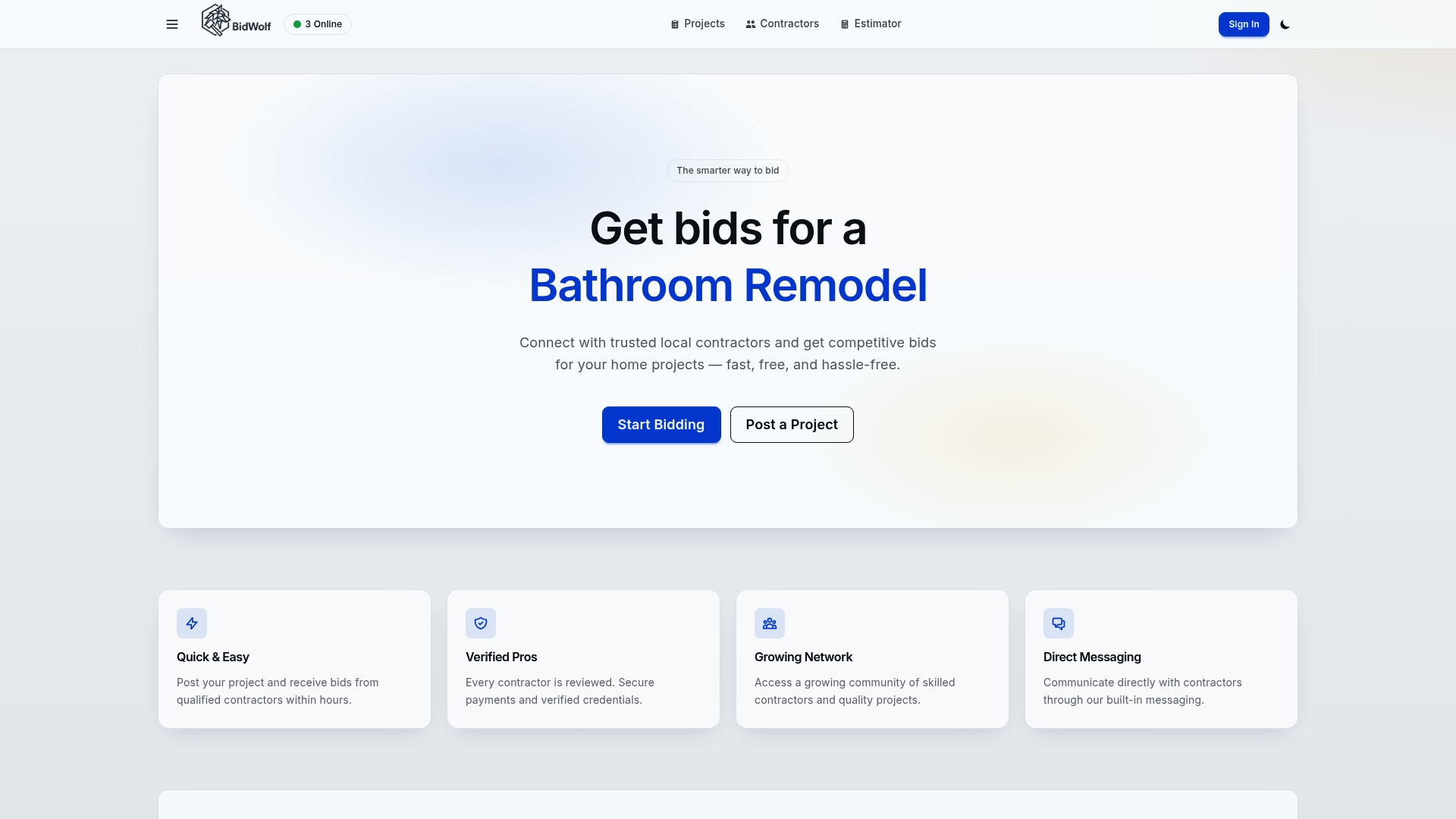
When you post a home project on BidWolf, you receive competitive bids from pre-screened local professionals whose credentials and reviews are already part of their profiles. You can find local contractors by trade, location, and project type, and compare bids side by side without the hassle of chasing down quotes manually. Not sure what your project should cost? Use BidWolf’s tool to estimate your project cost before you post, so you know what a fair bid looks like before the offers start coming in. Take the guesswork out of hiring and connect with contractors who have earned their reputation.
Frequently asked questions
How many contractor reviews are enough before hiring?
Aim for at least 5 to 7 recent reviews along with 2 to 3 direct project references for work similar to yours — this combination verifies both consistency and recency.
Are bad reviews an automatic deal-breaker?
A few negative reviews are normal and do not automatically disqualify a contractor. Focus on patterns in complaints — repeated issues around communication, billing, or unfinished work — and pay attention to how the contractor responded.
How can I tell if contractor reviews are fake?
Watch for reviews clustered in a short time window, near-identical language across multiple posts, or reviewer profiles that have only a single review on their entire account — these are common signs of artificial review activity.
What other checks matter besides reviews when hiring in Texas?
Always verify the contractor carries current insurance, request project-specific references, and check their BBB profile for complaints or unresolved issues. In Texas’s unregulated market, these steps are your primary safeguards.
Should I trust contractors with average reviews but great referrals?
Strong referrals from recent, similar projects can outweigh an average online rating — but only if there is no recurring pattern of unresolved online complaints that the referrals cannot explain.
Recommended
- Texas homeowner’s checklist: smart tips for choosing contractors | BidWolf Blog
- Contractor marketplaces: a complete guide for Texas homeowners | BidWolf Blog
- Your guide to hiring contractors securely in Texas | BidWolf Blog
- How to communicate effectively with Texas contractors | BidWolf Blog
- When to stop DIY cleaning and hire pros: TX guide