
Why Homeowners Prefer Verified Professionals for Renovations

TL;DR:
- Verified professionals pass active license checks, insurance verification, and background screening, reducing project risks. Homeowners prioritize trust and visible credentials, often willing to pay more for verified contractors to avoid legal disputes and budget overruns. Platforms like Bidwolf simplify verification, helping homeowners find qualified local contractors reliably and securely.
Verified professionals are defined as contractors who have passed active license checks, insurance verification, background screening, and third-party accreditation before being hired. This standard, promoted by industry bodies like the Federation of Master Builders, is the clearest predictor of project success for homeowners. The reason why homeowners prefer verified professionals comes down to three measurable outcomes: fewer legal disputes, lower budget overruns, and greater peace of mind. Research shows 82% of homeowners are willing to pay a premium to hire a licensed contractor with proven skills. That figure tells you everything about where homeowner priorities sit in 2026.
What benefits do verified professionals offer homeowners?
The verified contractor advantage is not abstract. It shows up directly in project outcomes, legal exposure, and final costs. Homeowners who hire unverified professionals face a 3x higher risk of legal disputes and budget overruns averaging 34% above the original estimate. By contrast, projects managed by verified contractors average just 7% over budget. That gap represents thousands of dollars on a typical bathroom remodel or roofing job.
Verification signals more than a license number. A verified professional carries active insurance, maintains a clean complaint record, and is accountable to a third party if something goes wrong. That accountability layer is what separates a verified credential from a simple license lookup. When a contractor’s verified status can be revoked for an insurance lapse or a serious complaint, the incentive to perform stays high throughout the project.
Here is what verification directly protects you from:
- Uninsured liability. If a worker is injured on your property and the contractor carries no active insurance, you may be held responsible.
- Permit failures. Unlicensed contractors often skip permits, leaving you with code violations that surface at resale.
- Abandoned projects. Unverified contractors have no accreditation at stake, making it easier to walk away mid-job.
- Hidden cost escalation. Budget overruns of 34% are common with unverified hires, compared to 7% with verified professionals.
- Dispute resolution gaps. Without a third-party record, legal disputes become your word against theirs.
Pro Tip: Before signing any contract, ask the contractor for their license number and insurance certificate. Then verify both independently through your state licensing board and the insurer directly.
The benefits of verified professionals extend beyond the project itself. A correctly permitted and insured renovation protects your home’s resale value and keeps your homeowner’s insurance policy valid. Skipping verification to save money on the front end routinely costs more in the long run. You can read more about verified tradespeople in home projects and why the distinction matters for your specific renovation type.
How does homeowner trust influence the preference for verified professionals?
Trust is the primary driver of contractor selection, and the data confirms it. 78% of US homeowners cite trustworthiness and peace of mind as their top hiring criteria, ranking it well above lowest price at 42%. That means the majority of homeowners are actively willing to spend more if they feel confident in who they are hiring. Price is a factor, but it is not the deciding one.
Online reviews and references play a direct role in building that confidence. 71% of homeowners prioritize verified customer reviews when evaluating contractors. This is not passive browsing. Homeowners now cross-reference reviews across multiple platforms, look for photo documentation of completed work, and check for responses to negative feedback. A contractor who ignores a one-star review signals poor communication habits before the project even starts.
The behaviors that build homeowner trust most effectively include:
- Proactive updates. Contractors who send daily progress reports or check-in calls reduce homeowner anxiety significantly.
- Clean job sites. Contractors who maintain a clean site daily signal professionalism and respect for your home.
- Technical explanations. Walking a homeowner through a decision, rather than just announcing it, builds confidence in the contractor’s judgment.
- Written contracts. Clear scope, timeline, and payment terms in writing remove ambiguity before it becomes conflict.
- Visible credentials. BBB accreditation, updated license certificates, and project photos displayed upfront reduce hesitation.
Pro Tip: When evaluating a contractor, ask for references from projects completed in the last 12 months. Recent references reflect current work quality and communication habits, not past performance from a different crew.
The “trust shift” in homeowner behavior is well documented. Homeowners now want visible proof of credentials before they even make a phone call. BBB accreditation, updated reviews, and project photos have moved from nice-to-have to expected. Contractors who do not display this proof are filtered out early in the search process. Understanding the role of trust in contractor selection helps homeowners recognize what to look for and why it matters beyond gut feeling.
What verification credentials matter most to homeowners?
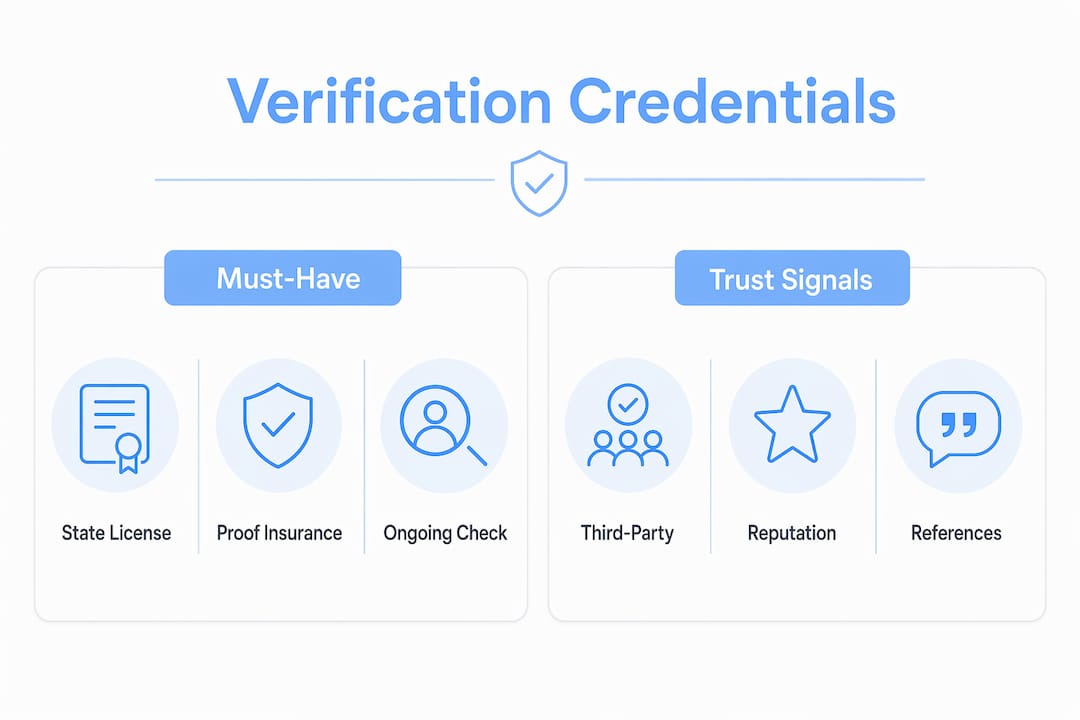
Not all credentials carry equal weight. Homeowners and industry leaders consistently identify four categories as non-negotiable when evaluating a contractor’s verified status.
1. Active state licensing
A license confirms the contractor has met minimum competency standards set by your state. Licensing requirements vary by trade and state, but they universally require passing an exam, completing supervised work hours, and maintaining continuing education. 68% of homeowners support mandatory licensing as a baseline protection. A license number you can verify online is the starting point, not the finish line.
2. Proof of insurance
General liability insurance and workers’ compensation coverage protect you if property is damaged or a worker is injured on site. Ask for a certificate of insurance and call the insurer to confirm the policy is active. An expired policy is as dangerous as no policy at all.
3. Ongoing verification status
Static license checks tell you a contractor was qualified at one point. Ongoing verification means the contractor’s status is monitored continuously. Verified status gets revoked when insurance lapses or serious complaints are filed. This dynamic protection is what platforms and accreditation bodies provide that a one-time license lookup cannot.
4. Third-party accreditation and reputation records
Organizations like the Better Business Bureau and trade associations provide an independent record of complaint history and resolution. A contractor with a clean BBB record and active trade membership has more accountability than one with only a state license.
| Credential | What it confirms | How to verify |
|---|---|---|
| State license | Minimum competency and legal authorization | State licensing board website |
| Insurance certificate | Active liability and workers’ comp coverage | Call the insurer directly |
| Ongoing verified status | Continuous monitoring beyond initial check | Verified contractor platforms |
| BBB accreditation | Complaint history and dispute resolution record | BBB.org search |
| Trade association membership | Adherence to industry standards and ethics | Association member directory |
Referrals from neighbors or friends still carry weight, but they no longer close the deal on their own. Homeowners now independently verify credentials after receiving a referral before signing a contract. The referral opens the door. The verified credentials walk through it.
How can homeowners practically verify professionals before hiring?
Knowing what to look for is only useful if you know how to check it. The verification process does not require legal expertise. It requires a short checklist applied consistently before every hire.
- Search your state licensing board. Every state maintains a public database of licensed contractors. Enter the contractor’s name or license number to confirm active status, trade category, and any disciplinary actions.
- Request and verify the insurance certificate. Ask for a certificate of insurance before the first meeting. Call the insurer listed on the document to confirm the policy is current and covers your project type.
- Check verified status on trusted platforms. Platforms that screen contractors before listing them provide a layer of protection that a Google search cannot. Verified status on these platforms reflects ongoing monitoring, not a one-time approval.
- Read recent reviews with a critical eye. Look for patterns across multiple review platforms. One negative review is not disqualifying. A pattern of complaints about communication, cost overruns, or incomplete work is a clear warning.
- Request project photos and references. Photos of completed work in your project category confirm relevant experience. References from recent clients confirm current performance.
- Review the contract before signing. A clear contract includes a detailed scope of work, payment schedule tied to milestones, start and completion dates, and a process for handling changes. Contractors who resist putting details in writing are a red flag.
Pro Tip: Never pay more than 10–30% upfront as a deposit. Legitimate verified contractors do not require full payment before work begins. Large upfront demands are a common warning sign of unreliable operators.
Specialized renovation marketplaces simplify this process considerably. Platforms that pre-screen contractors for licensing, insurance, and complaint history let you compare bids from qualified professionals without running each check yourself. You can also hire contractors securely in Texas using platforms that handle verification before a contractor ever appears in your search results. For homeowners who want to understand the full case for professional hiring, this guide on why to hire a remodeling contractor covers the practical and financial reasoning in detail.
The communication standard matters as much as the credential check. Contractors who provide regular updates and explain technical decisions clearly consistently earn higher satisfaction ratings and fewer disputes. Hiring a verified professional and then maintaining clear communication throughout the project is the combination that produces the best outcomes. Read more about communication in contractor hiring to understand what good looks like before your project starts.
Key Takeaways
Verified professionals reduce legal risk, control costs, and build the homeowner trust that makes renovation projects succeed from start to finish.
| Point | Details |
|---|---|
| Verification reduces financial risk | Verified contractors average 7% budget overruns vs. 34% with unverified hires. |
| Trust outranks price | 78% of homeowners prioritize trustworthiness over lowest price when selecting a contractor. |
| Credentials require active monitoring | Ongoing verification, not a one-time license check, provides real homeowner protection. |
| Reviews and visible proof are non-negotiable | 71% of homeowners rely on verified reviews; BBB accreditation and project photos now set baseline expectations. |
| Verification platforms simplify the process | Pre-screened contractor platforms remove the burden of individual credential checks from homeowners. |
Why I think skipping verification is the most expensive mistake homeowners make
I have watched homeowners make the same calculation over and over. They find a contractor who quotes $4,000 less than the verified alternative, and they take it. Six weeks later, they are dealing with a permit violation, a half-finished bathroom, and a contractor who has stopped returning calls. The $4,000 they saved is now a $12,000 remediation problem.
The data backs this up. A 34% budget overrun on a $50,000 kitchen remodel is $17,000 in unexpected costs. The verified contractor who quoted $3,000 more upfront was actually the cheaper option by a wide margin. Homeowners who understand this math stop treating verification as a nice-to-have and start treating it as a financial decision.
What I find most interesting is the shift in how homeowners research contractors. Five years ago, a referral from a neighbor was enough to close the deal. Now, homeowners independently verify credentials after receiving that referral. They check the license, call the insurer, read the reviews, and look at project photos before making contact. The bar has moved, and it has moved in the right direction.
The contractors who resist this shift are the ones worth avoiding. A professional who has nothing to hide welcomes the verification process. They hand over their license number, provide an insurance certificate without being asked twice, and point you to their review profiles. That transparency is itself a signal of quality. When a contractor makes verification difficult, that difficulty is the answer to your question about whether to hire them.
My honest advice: treat verification as the first filter, not the last. Before you evaluate price, timeline, or personality, confirm that the contractor is licensed, insured, and actively monitored. Everything else is secondary to those three facts.
— Devin
How Bidwolf connects homeowners with verified local contractors
Bidwolf is built around one core problem: homeowners should not have to run their own background checks before hiring a contractor. The platform pre-screens every contractor for active licensing, insurance coverage, and complaint history before they appear in search results.
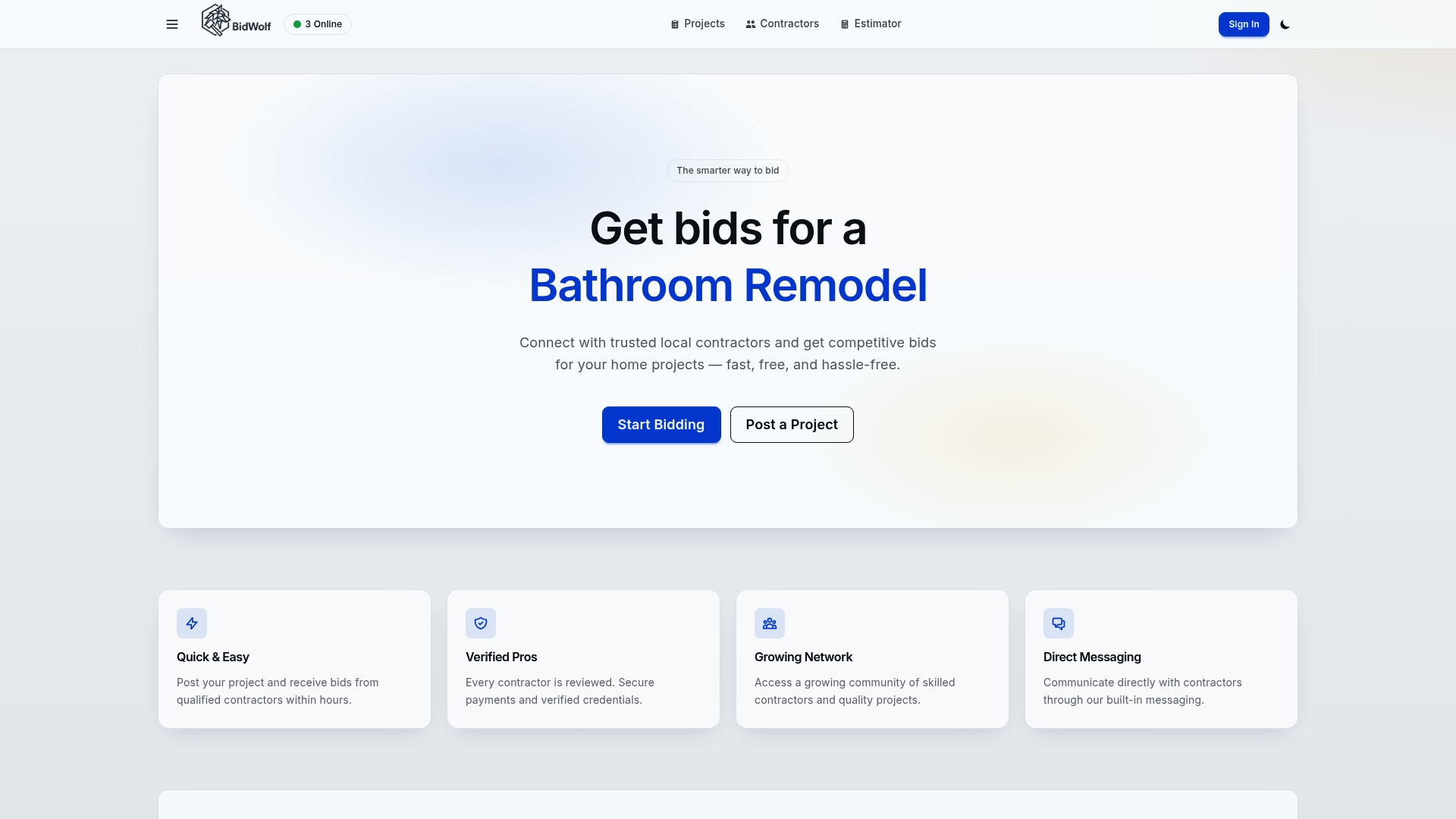
When you post a project on Bidwolf, verified local contractors submit competitive bids directly to you. You compare bids, review credentials, and communicate through the platform’s built-in messaging before making any commitment. Secure payment processing and a growing network of vetted tradespeople across Texas make Bidwolf a practical starting point for any renovation or repair project. If you are ready to find local verified contractors without the manual verification work, Bidwolf handles the screening so you can focus on choosing the right professional for your project.
FAQ
What does it mean for a contractor to be verified?
A verified contractor has passed active checks for licensing, insurance, and complaint history through a third party. Verification goes beyond a one-time license lookup because it includes ongoing monitoring that can revoke status if standards are not maintained.
Why do homeowners pay more for verified professionals?
82% of homeowners are willing to pay a premium for verified contractors because the financial and legal protection outweighs the price difference. Budget overruns and dispute costs with unverified hires typically exceed the savings from a lower initial quote.
How do I check if a contractor is licensed in my state?
Visit your state’s contractor licensing board website and search by the contractor’s name or license number. Confirm the license is active, covers the correct trade category, and shows no disciplinary actions.
What is the difference between licensing and verification?
A license confirms minimum competency at the time of issuance. Verified status adds ongoing insurance checks, complaint monitoring, and third-party accountability that a static license number does not provide.
How do online reviews factor into contractor verification?
71% of homeowners prioritize verified customer reviews when selecting a contractor. Reviews should be recent, cross-referenced across multiple platforms, and examined for patterns in communication, quality, and cost management.