

What Is Bid Comparison? a Homeowner's Guide

TL;DR:
- Bid comparison involves evaluating contractor proposals holistically, considering scope, qualifications, and risk, not just price. Bid leveling is the process of adjusting bids for scope differences, enabling fair, apples-to-apples comparisons. Using structured tools and detailed checklists helps homeowners identify true value, prevent hidden costs, and make confident renovation decisions.
You received three bids for your kitchen remodel. One is $18,000, one is $24,000, and one is $31,000. The obvious move seems to be picking the lowest price and calling it a day. But that assumption costs homeowners thousands of dollars every year. Understanding what is bid comparison means recognizing that price is just one variable in a much larger equation. Scope, qualifications, exclusions, and risk all factor into which contractor actually offers you the best value. This guide breaks down the entire bid comparison process so you can evaluate contractor proposals with confidence and avoid budget surprises.
Table of Contents
- Key takeaways
- What is bid comparison and how it differs from bid leveling
- Common pitfalls when comparing contractor bids
- How to normalize and compare bids step by step
- Benefits of thorough bid comparison
- Modern tools and best practices for bid comparison
- My take on bid comparison complexity
- How Bidwolf makes bid comparison easier
- FAQ
Key takeaways
| Point | Details |
|---|---|
| Bid comparison goes beyond price | Evaluating schedule, qualifications, risk, and scope keeps you from choosing a costly low bid. |
| Bid leveling creates fair comparisons | Normalizing scope and allowances across bids reveals the true cost of each proposal. |
| Exclusions drive hidden costs | Missing line items like permits or cleanup often cause change orders that inflate the final bill. |
| Systematic tools save time | Spreadsheets and digital platforms reduce comparison time by up to 60% and improve accuracy. |
| Best value beats lowest price | The contractor offering true best value delivers quality, schedule, and transparency together. |
What is bid comparison and how it differs from bid leveling
Bid comparison is a holistic evaluation of contractor proposals that looks beyond total price to assess project schedule, team qualifications, technical approach, and overall risk. When you compare bids properly, you are asking: does this contractor understand the full scope of my project, do they have the experience to complete it on time, and are there risks baked into their pricing that could surface later?
Many homeowners treat bid comparison as a simple price ranking exercise. That leads to disappointment. A contractor charging $18,000 may be quoting an entirely different project than the one quoting $31,000. One includes permits, demo, and final cleaning. The other includes labor and materials only. Without a structured approach, you are not comparing contractors. You are comparing apples to oranges.
This is where bid leveling fits in. Bid leveling is the systematic process of adjusting contractor proposals to account for differences in scope interpretation, exclusions, alternate materials, and assumptions, so each bid reflects the same work requirements. Think of it as the preparation step that makes actual comparison possible.
Here is how the two concepts relate:
- Bid leveling is a tactical process. You adjust dollar amounts and scope items to normalize all bids against a single baseline.
- Bid comparison is the broader evaluation. Once bids are leveled, you assess contractor quality, reliability, communication, and value.
- Together, they create an apples-to-apples framework that protects you from hidden costs and poor decisions.
For homeowners and property managers, understanding this distinction matters in practical terms. Leveling takes work upfront, but it prevents the far more painful work of managing change orders and cost overruns mid-project.
“Bid leveling is not optional. It is a critical financial tool that exposes hidden costs invisible when looking only at total price.” This framing from industry experts captures exactly why skipping the leveling step is a risk no homeowner should take.
Common pitfalls when comparing contractor bids
Most bid comparison problems start before you even open a proposal. They start with the project description you gave contractors. If your description was vague, each contractor filled in the blanks differently. That means their bids reflect different projects, even if they all say “bathroom remodel” on the cover page.
Here are the most common pitfalls you will encounter when comparing bids:
- Scope interpretation gaps. Contractor A assumes tile work means floor only. Contractor B includes walls. Contractor C quotes a full wet area installation. None of them are wrong. They are just answering different questions.
- Unrealistic allowances. Allowances are placeholders for items not yet specified, like fixtures or hardware. A bid may show a $500 fixture allowance when the fixtures you want actually cost $1,200. That $700 gap appears as a change order later.
- Hidden exclusions. The lowest bid often excludes items like permit fees, appliance hookups, paint touch-ups, final cleaning, and dumpster removal. These are easy to overlook because they appear in fine print or not at all.
- Format differences. One contractor gives you a detailed line-item breakdown. Another gives you a single lump-sum number. Comparing these is nearly impossible without restructuring both documents first.
- Unclear responsibilities. Who pulls the permit? Who coordinates the inspection? Who handles material delivery? When bids do not specify, you find out at the worst possible moment.
Pro Tip: Ask every contractor to provide an explicit exclusions list as part of their bid. A contractor who refuses to itemize exclusions is a contractor likely to issue change orders freely once the project starts.
The real cost of these pitfalls is not just financial. It is also time. Surprise change orders extend timelines, disrupt your home life, and strain the working relationship with your contractor. A cheapest bid frequently hides exclusions that generate costly downstream expenses, making the low number on page one deeply misleading.
The good news is that all of these pitfalls are avoidable with a consistent process. That process is covered next.
How to normalize and compare bids step by step
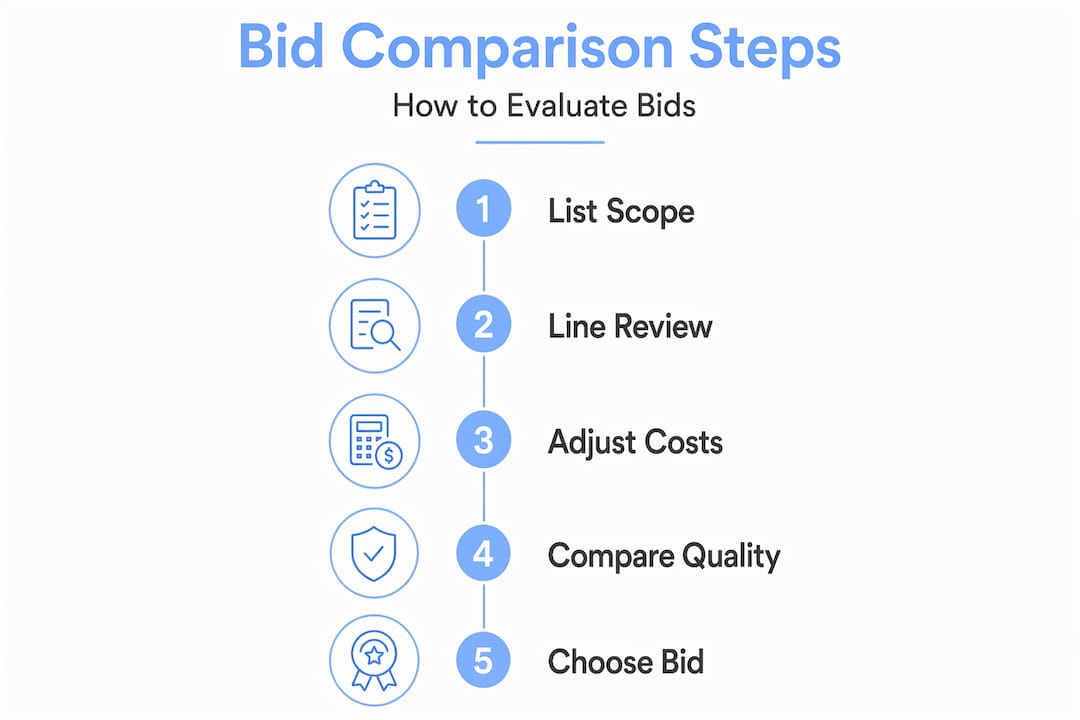
The goal of bid normalization is to rebuild every proposal in your own format, not theirs. This shifts control of the comparison to you and forces every contractor’s numbers into a structure you can evaluate consistently. Here is a practical framework to work through.

Build a master scope checklist
Before you open any bid, write down every task, material, and service your project requires. Include permits, demolition, debris removal, surface prep, materials, labor, inspections, touch-up work, and final cleaning. Creating a master checklist of every scope item forces all bids into a comparable structure rather than letting each contractor define the project for you.
This checklist becomes your control document. Every bid gets measured against it.
Review each bid line by line
Open each proposal and mark every item from your checklist as included, excluded, or unspecified. Pay close attention to notes, assumptions, and language like “as discussed” or “per standard practice.” These phrases are often where scope gaps hide.
Write a dollar value next to every exclusion. If a bid does not include permits and permits cost $400 in your area, add $400 to that bid’s adjusted total. Do the same for every gap you find.
Adjust for allowances
Compare the allowance amounts in each bid against realistic costs for the materials or fixtures you actually want. If your kitchen faucet runs $350 and a bid includes a $150 fixture allowance, adjust upward by $200. Apply this correction to every bid so your final numbers reflect reality, not optimistic placeholders.
Use unit pricing to expose quality differences
Where possible, break lump sums into unit costs. Price per square foot for flooring, price per linear foot for cabinetry, price per fixture for plumbing. Using unit cost conversion reveals material quality differences and hidden cost drivers that lump sum totals completely mask. A contractor charging $8 per square foot for tile installation may be using thinner-set adhesive or skipping a waterproofing membrane. You will not know until you dig into the unit costs.
Set up a comparison spreadsheet
A detailed spreadsheet with columns for scope items, allowances, exclusions, permit responsibilities, and notes is the single most effective tool for exposing hidden bid differences. You can build one in any standard spreadsheet application. The structure matters more than the tool.
Here is a basic framework for your comparison table:
| Scope item | Contractor A | Contractor B | Contractor C | Notes |
|---|---|---|---|---|
| Labor | $8,000 | $9,500 | $11,000 | Contractor A subcontracts |
| Materials | $4,200 | $4,800 | $5,500 | Verify material grades |
| Permit fees | Excluded | Included | Included | Add $400 to Contractor A |
| Demolition | Included | Included | Excluded | Add $600 to Contractor C |
| Final cleaning | Excluded | Included | Included | Add $150 to Contractor A |
| Adjusted total | $22,750 | $24,300 | $24,100 |
That $18,000 Contractor A just became $22,750 once exclusions are accounted for. Now the comparison looks very different.
Pro Tip: Send your master checklist to all contractors before they submit their bids. Ask them to confirm in writing which items are included and which are excluded. This reduces the normalization work you have to do after bids come in and signals that you are a serious, informed buyer.
Benefits of thorough bid comparison
Putting in the work to properly compare bids pays off in ways that go beyond finding a fair price. Here is what a thorough bid comparison process actually delivers:
- Fewer change orders. When scope is clarified upfront, contractors have less room to add charges for items they claim were not included. Change orders are the primary driver of budget overruns on home projects.
- Better contractor selection. A detailed bid comparison reveals which contractor offers the best value when scope is equalized. You see pricing outliers, exclusions, and risk factors that would otherwise stay hidden.
- Stronger contract negotiations. When you walk into a negotiation knowing exactly what each bid covers and what it does not, you negotiate from a position of clarity rather than uncertainty.
- Improved project outcomes. Contractors who submit detailed, transparent bids typically run tighter, more organized projects. The quality of a bid often predicts the quality of the work.
- Reduced stress. Knowing you chose your contractor based on a structured evaluation rather than gut feeling gives you confidence throughout the project.
“Understanding bid differences before signing a contract is the only reliable way to protect your budget and your timeline.” When scope gaps surface during construction instead of before it, they are exponentially more expensive to resolve.
For property managers handling multiple projects across several properties, this benefit compounds. A consistent bid comparison process for renovations allows you to build historical cost data, benchmark contractor pricing over time, and identify which vendors consistently deliver on their proposals.
Modern tools and best practices for bid comparison
Manually working through three or four detailed contractor bids can take four to eight hours per project. That is a real commitment, especially for property managers juggling multiple jobs at once. Manual bid leveling takes two to four hours per major scope, but structured checklists and bid leveling software reduce that time by 40 to 60 percent while improving accuracy.
Here is a comparison of the main approaches:
| Approach | Time required | Accuracy | Best for |
|---|---|---|---|
| Manual spreadsheet | High | Moderate | Single projects, tight budgets |
| Templated checklist | Moderate | High | Repeat project types |
| Bid comparison software | Low | High | Multiple simultaneous projects |
| Professional estimator | Low (your time) | Very high | Large or complex renovations |
Modern procurement platforms reduce bias and provide audit trails that are critical for transparent contractor selection. For homeowners, this means less second-guessing and a clear record of why each decision was made.
When evaluating digital tools for bid comparison, look for these features:
- Side-by-side bid display with adjustable line items
- Ability to flag exclusions and missing scope items
- Notes and question tracking for contractor follow-up
- Document storage for proposals, licenses, and insurance certificates
- Mobile access for reviewing bids away from your desk
Pro Tip: Before selecting any tool or platform, check whether it allows you to add your own scope line items. A platform that only displays what contractors submit misses the core purpose of bid normalization, which is defining the scope yourself.
You can learn more about applying these practices to Texas-specific home projects through this guide on comparing contractor bids in your local market.
My take on bid comparison complexity
Most homeowners underestimate bid comparison because it looks like a simple task from the outside. You get three numbers, you pick the middle one, and you move on. I have seen that approach go wrong in ways that surprise even experienced property managers.
In my experience, the biggest mistake is trusting contractor-defined formats. When contractors control the structure of their bids, they naturally present information in ways that favor their pricing. That is not dishonest. It is human nature. But it means you are comparing three different sales pitches rather than three actual solutions to your problem.
What I have learned is that the homeowners who consistently get great results treat the bid process like a structured interview. They define the scope. They set the format. They ask specific questions about exclusions before bids are submitted. When bids come in, they adjust totals against a single baseline rather than accepting contractor numbers at face value.
I have also found that transparent, fair evaluation actually improves contractor relationships. When contractors know you are comparing bids systematically and not just haggling on price, the best ones step up. They provide more detail. They answer questions clearly. The less reliable ones self-select out.
The shortcut of picking the lowest number feels faster. It almost never is. The hours you save upfront come back as weeks of project delays, unexpected invoices, and difficult conversations with contractors who insist the work you expected was never part of the deal.
Do the comparison work. It is the single highest-return investment you can make before any renovation project.
— Devin
How Bidwolf makes bid comparison easier
Getting three bids from vetted, local contractors used to mean weeks of phone calls, no-shows, and one-page quotes with more questions than answers. Bidwolf changes that process entirely.
With Bidwolf, you post your project once and receive competitive bids from verified local professionals in your area. Every contractor in the Bidwolf network is credentialed and reviewed, so you spend less time vetting and more time evaluating actual proposals. The platform is built to support the kind of structured, side-by-side evaluation this article describes, giving you the transparency you need to make a confident decision.
Whether you are managing a single bathroom remodel or coordinating repairs across multiple properties, Bidwolf puts organized, comparable bids in front of you fast. You can also find local contractors by trade and location, communicate directly through built-in messaging, and manage everything from your phone with the Bidwolf mobile app. Start your next project at bidwolf.io and see how much easier bid comparison can be.
FAQ
What does bid comparison mean for homeowners?
Bid comparison is the process of evaluating multiple contractor proposals to identify the best value for your project, accounting for price, scope, qualifications, and risk rather than just the total cost.
How is bid leveling different from bid comparison?
Bid leveling is the step where you normalize scope and adjust dollar amounts across bids so they reflect the same work. Bid comparison is the broader evaluation that happens after leveling is complete.
Why is the cheapest bid often not the best choice?
The cheapest bid often excludes key items like permits, cleanup, or material allowances, which surface later as change orders that raise the actual project cost above higher bids.
What should every contractor bid include for fair comparison?
Every bid should clearly state what is included and excluded, identify who is responsible for permits, list all material allowances, and specify the project timeline and payment schedule.
How long does a proper bid comparison take?
Manual bid comparison takes two to four hours per project, but using a structured checklist or a platform like Bidwolf can reduce that time significantly while improving the accuracy of your evaluation.