

What Is a Responsive Home Contractor? Your 2026 Guide

TL;DR:
- A responsive home contractor communicates promptly, documents scope changes, and provides predictable updates to keep projects on track. They follow structured processes, assign a single point of contact, and ensure all modifications are approved with signed change orders. Verifying these practices before hiring reduces the risk of costly delays and miscommunications during home renovations.
A responsive home contractor is a professional who communicates consistently, adapts to project changes through documented processes, and maintains clear expectations to keep your renovation or repair on track. The industry term for this standard is contractor responsiveness, and it covers far more than picking up the phone quickly. According to the American Society of Civil Engineers, responsiveness is the top trait construction professionals value above technical credentials alone. That finding reframes how homeowners should evaluate every contractor they consider hiring. A contractor who answers your questions within hours, documents every scope change in writing, and gives you predictable project updates is not a luxury. That contractor is the standard you deserve.
What is a responsive home contractor, and what qualities define one?
Responsiveness in home contracting is defined by three measurable behaviors: timely replies, structured communication, and documented change management. These are not personality traits. They are professional practices that either exist in a contractor’s workflow or they do not. Understanding each one helps you recognize a truly responsive contractor before you sign a contract.

Timely replies within agreed hours
A responsive contractor replies to routine messages within hours, not days, during normal business hours. This does not mean 24/7 availability. It means the contractor has set clear expectations about when and how they respond, and they honor those expectations consistently. Projects stall for weeks when a homeowner cannot get a timely answer on a material selection or an inspection question. Availability, in this context, matters more than credentials alone.
Structured communication with a designated contact
The best contractors assign a single point of contact for your project from day one. That person owns all communication between you and the crew, the subcontractors, and the suppliers. Structured communication plans specify who communicates what, how often, and through which channels. Email and text work well for status updates. Phone calls and on-site meetings are reserved for complex decisions. This separation of channels prevents the ambiguity that causes costly misunderstandings.
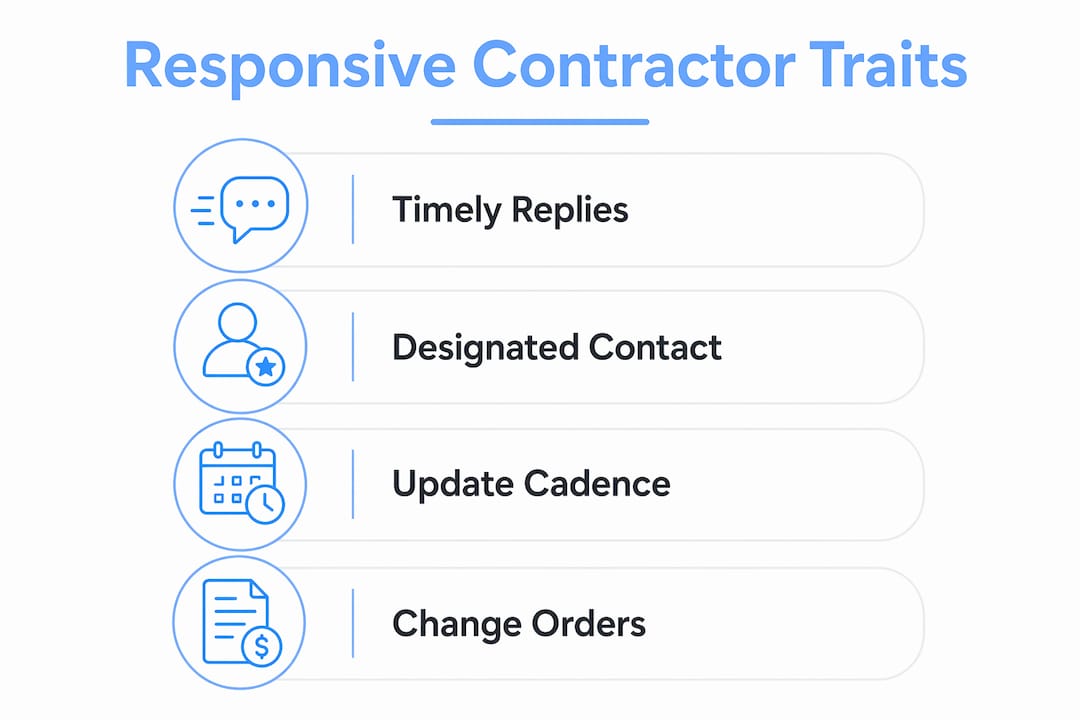
Predictable update cadence
Responsive contractors do not wait for you to ask what is happening. They schedule weekly or biweekly updates tied to project milestones and deliver them without prompting. This predictable rhythm eliminates the frustration of chasing information. You know when your next update is coming, what it will cover, and who will deliver it. That consistency is what separates a professional operation from a contractor who communicates only when problems arise.
Documented change-order processes
Every scope change on a home renovation carries cost and schedule implications. A responsive contractor captures those changes in writing before any work begins. Signed change orders protect both parties from budget surprises and verbal misunderstandings. This practice is not bureaucratic overhead. It is the foundation of a trustworthy working relationship.
Here are the core qualities to look for when assessing contractor responsiveness:
- Replies to calls, texts, and emails within a few hours during business hours
- Assigns a named point of contact for the entire project duration
- Delivers updates on a set schedule rather than only when asked
- Uses the right communication channel for the right type of message
- Requires written, signed approval before executing any scope change
- Maintains a shared log of all project documents and decisions
Pro Tip: Ask any contractor you interview: “What is your standard response time for homeowner questions?” A confident, specific answer signals a professional who has thought through their communication process. A vague answer is a warning sign.
How does a responsive contractor manage project changes?
Project changes are inevitable on any home renovation. A bathroom remodel uncovers water damage behind the tile. A kitchen project requires an electrical panel upgrade. What separates a responsive contractor from an unresponsive one is not whether changes happen. It is how those changes are handled when they do.
A responsive contractor follows a formal change management process every time the scope shifts. Here is how that process works in practice:
- Identify the change. The contractor documents the new scope item in plain language, describing exactly what changed and why.
- Estimate the impact. The contractor calculates the cost and schedule effect before any additional work begins. Written change orders with detailed cost analysis are the standard tool for this step.
- Get written approval. The homeowner reviews and signs the change order before work proceeds. No verbal agreements. No assumptions.
- Update the project log. The change order is added to a shared tracking system so the field crew and office team are aligned on the current scope.
- Communicate the update. The contractor notifies all relevant parties of the approved change and its impact on the overall schedule.
This workflow converts what could be a disruptive surprise into a manageable business transaction. Tracking change orders as a workflow, with logging and regular circulation, minimizes internal miscommunication and prevents delays from compounding.
Pro Tip: Before signing any contract, ask to see a sample change order form. A contractor who has a clean, detailed template ready is far more likely to use it consistently than one who improvises.
The table below shows the difference between how responsive and unresponsive contractors handle common project changes:
| Scenario | Responsive contractor | Unresponsive contractor |
|---|---|---|
| Hidden water damage discovered | Documents scope, estimates cost, gets signed approval before proceeding | Fixes it verbally and adds cost to final invoice |
| Material upgrade requested by homeowner | Issues a written change order with price difference and timeline impact | Agrees verbally and forgets to document |
| Subcontractor schedule conflict | Notifies homeowner immediately with revised timeline | Delays the project without explanation |
| Permit requirement changes | Updates scope documentation and communicates impact | Proceeds without informing the homeowner |
Centralizing all project documentation in a shared digital system is the operational backbone of responsive change management. A single source of truth for schedules, scope, and change orders prevents conflicting information from circulating between the field crew and the office. Tools like shared folders, project management apps, or contractor platforms that include built-in messaging all serve this function.
How do homeowners identify and hire a truly responsive contractor?
Identifying a responsive contractor before you hire them requires asking the right questions and knowing which answers to trust. Most contractors will describe themselves as communicative and reliable. The goal is to verify those claims through specific, concrete evidence.
Start with these questions to ask during your initial consultation:
- “What is your standard response time for homeowner messages during a project?”
- “Who is my designated point of contact, and what happens if that person is unavailable?”
- “How do you handle scope changes? Can I see a sample change order?”
- “How often will I receive project updates, and in what format?”
- “Can you share references from past clients specifically about your communication?”
When you check references, do not just ask whether the project was completed on time and on budget. Ask the previous homeowner whether the contractor communicated proactively, how quickly they responded to questions, and how they handled unexpected changes. Those answers reveal far more than a five-star rating.
Watch for these red flags during the hiring process:
- Slow to respond during the bidding phase. If a contractor takes days to reply before you have even hired them, the pattern will not improve once the project starts.
- Reluctant to put communication expectations in writing. A contractor who resists documenting response times or update schedules is signaling that they do not plan to honor them.
- Vague about their change-order process. Any contractor who says “we’ll figure it out as we go” is describing a recipe for budget overruns and disputes.
- No designated point of contact. If you cannot identify who owns communication on your project, no one does.
Digital platforms like BidWolf simplify this vetting process by connecting homeowners with verified local contractors who have documented track records. Contractor profiles on BidWolf include verified credentials and reviews that reflect real communication experiences, not just finished-product photos. Using a platform that pre-screens for responsiveness reduces the risk of hiring a contractor who disappears mid-project.
Clear communication expectations should also appear in your contract. Specify response time standards, update frequency, the change-order approval process, and the designated point of contact. A contractor who is willing to sign those commitments is a contractor who intends to keep them. Choosing a reliable contractor starts with verifying these commitments before work begins, not after problems surface.
What can homeowners expect from working with a responsive contractor?
Working with a responsive contractor changes the entire experience of a home renovation. The most immediate difference is that you stop chasing information. Predictable communication rhythms built during pre-construction meetings give every party a shared understanding of when updates happen and who delivers them. You receive your weekly progress report on the agreed day, with photos and a summary of what was completed and what comes next.
Responsive contractors also establish clear escalation paths for urgent issues. If a pipe bursts during a bathroom remodel or a structural concern surfaces during a kitchen renovation, you know exactly who to call and how quickly to expect a response. That clarity prevents panic and keeps the project moving. Structured weekly meetings between the homeowner, contractor, and key subcontractors create a formal space to surface and resolve issues before they compound.
The table below compares what homeowners typically experience with responsive versus unresponsive contractors across key project phases:
| Project phase | With a responsive contractor | Without a responsive contractor |
|---|---|---|
| Pre-construction | Clear timeline, signed communication plan, named contact | Verbal promises, no written schedule |
| Active construction | Weekly updates, documented changes, progress photos | Silence until problems arise |
| Scope changes | Written change orders with cost and timeline impact | Surprise additions on the final invoice |
| Problem resolution | Immediate notification with proposed solution | Delayed disclosure or no disclosure |
| Project closeout | Punch list documented and signed off | Disputes over incomplete items |
Proactive problem-solving is another hallmark of a responsive contractor. Rather than waiting for you to notice that tile grout does not match the sample you approved, a responsive contractor flags the discrepancy before installation and presents options. This behavior reflects mutual respect. It treats you as a partner in the project rather than a client to be managed. Strong client relationships grow from consistent daily communication behaviors and clear documentation, not from a single impressive conversation at the start of the project.
Progress photos are a practical tool that responsive contractors use to keep homeowners informed between formal update meetings. A photo of the framing before drywall goes up, or the rough plumbing before the walls close, gives you a visual record of work that will soon be invisible. That transparency builds confidence and reduces the anxiety that often accompanies a major home renovation.
Key takeaways
A responsive home contractor is defined not by personality but by documented processes: timely replies, structured communication, written change orders, and predictable updates that keep your project on track.
| Point | Details |
|---|---|
| Responsiveness is a process, not a trait | Look for contractors with documented communication plans and change-order workflows, not just friendly demeanor. |
| Change orders must be written and signed | Verbal agreements on scope changes lead to budget disputes; always require written approval before work proceeds. |
| Predictable updates eliminate chasing | Responsive contractors deliver scheduled updates tied to milestones so you never have to ask what is happening. |
| Vetting requires specific questions | Ask about response times, designated contacts, and change-order processes before signing any contract. |
| Digital platforms accelerate vetting | Platforms like BidWolf connect homeowners with pre-screened contractors who have verified communication track records. |
Why contractor responsiveness is the single most underrated hiring criterion
I have reviewed hundreds of renovation projects over the years, and the pattern is consistent. Homeowners who regret their contractor choice almost never cite poor craftsmanship as the primary complaint. They cite silence. They describe weeks of unanswered texts, surprise charges on the final invoice, and scope changes that nobody documented. The work itself was often acceptable. The communication was the failure.
The ASCE finding that responsiveness outranks technical skill as the top trait construction professionals want from their partners does not surprise me at all. Technical problems have technical solutions. Communication breakdowns compound. A contractor who goes quiet mid-project does not just create frustration. They create financial exposure, because decisions get made without your input and costs accumulate without your approval.
My honest advice: treat the bidding phase as a communication audition. How quickly does the contractor respond to your inquiry? How clearly do they explain their process? Do they ask good questions about your project, or do they rush to quote a number? The contractor who communicates well before you hire them is the contractor who will communicate well when your kitchen walls are open and a decision needs to be made by noon. If a contractor is slow to respond during the direct messaging phase of bidding, that pattern will not improve once they have your deposit.
Set your communication expectations in writing before the project starts. Specify response times, update frequency, and the change-order process in the contract. Then monitor the cadence from day one. If a contractor misses two consecutive scheduled updates without explanation, address it directly and immediately. Most communication breakdowns are recoverable if you catch them early. They become project-ending disputes when they are ignored for weeks.
— Devin
Find responsive contractors faster with BidWolf
Hiring a contractor who communicates well and manages changes professionally should not require weeks of research and cold calls.
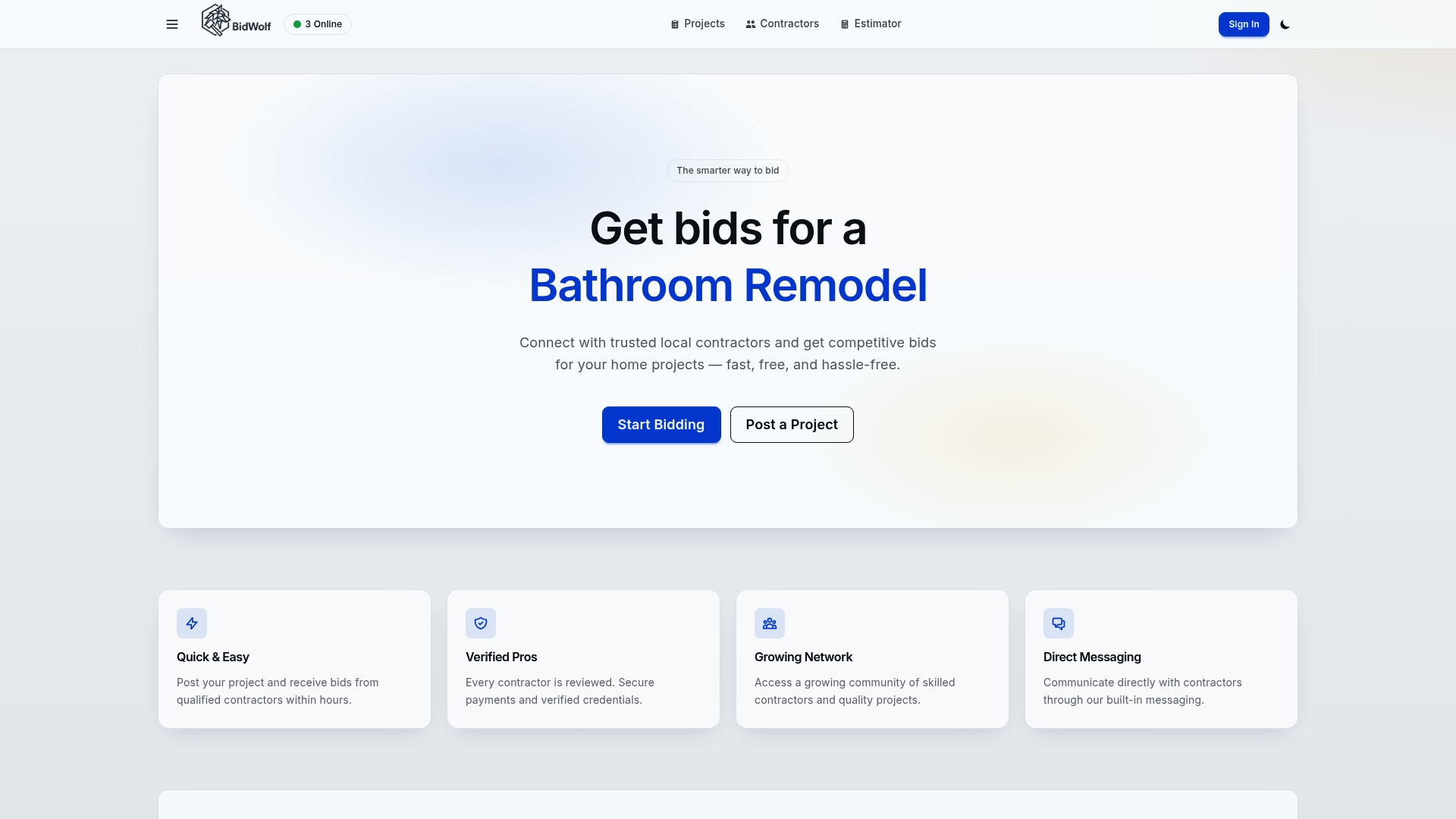
BidWolf connects Texas homeowners with vetted, verified contractors who have real communication track records you can review before reaching out. You post your project in minutes, receive competitive bids from local professionals, and communicate directly through BidWolf’s built-in messaging system. Every contractor profile includes verified credentials and client reviews that reflect actual responsiveness, not just finished photos. Whether you are planning a bathroom remodel, a roofing repair, or a full kitchen renovation, BidWolf gives you the tools to find a contractor who shows up, communicates clearly, and delivers on their commitments. Start your project today and get bids from responsive professionals in your area.
FAQ
What is a responsive home contractor?
A responsive home contractor is a professional who replies to homeowner messages within agreed timeframes, delivers predictable project updates, and manages scope changes through written, signed change orders. Responsiveness is defined by documented processes, not just personality.
What are the top traits of a responsive contractor?
The top traits include timely communication, a designated point of contact, a structured update schedule, and a formal change-order process. Consistent communication behaviors and clear documentation are the foundation of every strong contractor-client relationship.
What questions should I ask a home contractor about responsiveness?
Ask about their standard response time for homeowner messages, who your designated contact will be, how they handle scope changes, and how often you will receive project updates. Request a sample change order form to verify they have a formal process in place.
How do I spot an unresponsive contractor before hiring?
Slow replies during the bidding phase, reluctance to put communication expectations in writing, and vague answers about their change-order process are the clearest warning signs. A contractor who communicates poorly before you hire them will not improve once the project begins.
How does BidWolf help homeowners find responsive contractors?
BidWolf pre-screens contractors and provides verified profiles with client reviews that reflect real communication experiences. Homeowners can post a project and receive bids from vetted local professionals, then communicate directly through the platform’s built-in messaging system.