
Online Profiles in Contracting: Your 2026 Trust Guide
TL;DR:
- Online profiles act as essential trust signals that influence clients’ hiring decisions and help contractors stand out. Maintaining active, consistent profiles, responding to reviews, and showcasing recent work significantly increase leads and credibility. Prioritizing Google Business Profile and ensuring cross-platform consistency give contractors a competitive advantage in winning projects.
Your online profile is the qualification filter that determines whether a potential client calls you or moves on to the next contractor on the list. The role of online profiles in contracting goes far beyond a simple web listing. Platforms like Google Business Profile, LinkedIn, SAM.gov, and industry directories now function as your first impression, your credential check, and your trust signal all at once. Clients and procurement staff research you online before they ever pick up the phone, and what they find shapes every decision that follows.
How online profiles shape contractor credibility and client choice
Online profiles are the first screening tool clients use, and the data backs that up clearly. 73% of homeowners read reviews during contractor research, but only 12% say reviews are the primary factor in their final decision. That gap matters. Reviews filter out contractors who look untrustworthy, but the actual hiring decision comes down to trust cues like professionalism, responsiveness, and the quality of your profile presentation.

Think of it this way: reviews get you past the first cut, but your profile wins the job. A contractor with a 4.2-star rating who responds to every review, posts project photos, and keeps contact information current will consistently outperform a 4.8-star competitor with a dormant, incomplete profile.
Why responsiveness is a trust signal, not just good manners
Review response behavior has a measurable impact on whether clients choose you. Consumers who see responses to all reviews are 88% likely to hire that business, compared to only 47% for businesses that never respond. That is nearly double the conversion rate from one habit alone.
Responding to reviews signals that you are attentive, professional, and accountable. Clients hiring a contractor for a bathroom remodel or a roofing job are making a significant financial decision. They want to know you will communicate well throughout the project, and your review responses are the clearest preview of that behavior they can find before hiring you.
Profile images and visual proof build offline trust
A PLOS ONE study on online profile images found that professional photos increase user trust and satisfaction, and those effects carry directly into offline service decisions. Contractors who use professional headshots, branded vehicle photos, and high-quality project images consistently see stronger engagement on their profiles.
Visual proof of work is especially powerful in trades like tile work, landscaping, and kitchen remodeling where the quality of the finished product is the entire value proposition. Before-and-after project photos do more persuasive work than any written description. Pair strong visuals with verifiable credentials like license numbers and insurance documentation, and your profile becomes a credibility package that is hard to dismiss.
Pro Tip: Ask satisfied clients to leave a review immediately after project completion, while the experience is fresh. Send a direct SMS link to your Google Business Profile review page to remove any friction from the process.
What platforms and profile elements drive real results?
The impact of online profiles depends heavily on which platforms you use and how completely you fill them out. Not all platforms serve the same purpose, and a scattered approach wastes time. The table below maps the major platforms to their primary function for contractors.
| Platform | Primary Function | Key Profile Elements |
|---|---|---|
| Google Business Profile | Local search visibility and lead generation | Business name, photos, reviews, hours, services |
| Professional credibility and B2B networking | Work history, licenses, endorsements, portfolio | |
| SAM.gov | Federal and government contract qualification | Entity registration, NAICS codes, certifications |
| Industry directories | Niche discoverability and peer credibility | License verification, specialty services, ratings |
| Personal/business website | Full brand control and portfolio showcase | Project gallery, contact form, credentials, testimonials |
Google business profile: your highest-roi platform
A fully completed and actively managed Google Business Profile generates 3 to 5 times more calls than an incomplete one. That is the single most impactful profile action most contractors can take. The maintenance requirement is minimal. About 15 minutes per week spent responding to reviews, adding project photos, and updating service information keeps the profile fresh and competitive.
Treat your Google Business Profile as a conversion storefront, not a static directory listing. Clients searching for “roofing contractor near me” or “licensed electrician in Austin” are ready to hire. Your profile is the first thing they see. A complete profile with recent photos, active reviews, and accurate contact details converts that search intent into a phone call.
SAM.gov and government contracting databases
For contractors pursuing public sector work, government contracting professionals spend 2 to 4 hours on online market research before shortlisting vendors. Profile completeness on SAM.gov and similar procurement databases directly affects whether you appear in that research. An incomplete or outdated SAM.gov registration is not just a missed opportunity. It is a disqualification.
Your SAM.gov profile should include accurate NAICS codes, current certifications, and up-to-date contact information. Procurement staff cross-reference these details against your website and other public records. Any discrepancy raises a red flag and can remove you from consideration before you ever submit a bid.
Pro Tip: Set a calendar reminder every six months to audit your SAM.gov registration, Google Business Profile, and business website for consistency in your business name, address, phone number, and service descriptions.
Does profile consistency across platforms actually matter?
Profile consistency is one of the most overlooked factors in contractor reputation management, and it is one of the most damaging when ignored. Serious buyers and procurement staff practice what verification professionals call “pattern checking.” They compare your website, government filings, social media, and directory listings to see if the details align.
Cross-platform inconsistencies in business location, contact information, and service descriptions are a primary trigger for deeper scrutiny or outright disqualification. A contractor whose Google listing shows one address, whose website shows another, and whose state license database shows a third is sending a clear signal of disorganization or misrepresentation. Neither impression wins contracts.
The risks of dormant and outdated profiles
A profile that has not been updated in 12 months tells a story you do not want told. It suggests the business may be inactive, unreliable, or indifferent to its own presentation. Clients notice the date on your last review response. They notice when your most recent project photo is from three years ago. Dormancy weakens the trust signals that your profile is supposed to project.
The importance of digital identity in contractor selection mirrors how verifiable credentials work in formal digital systems. Clients expect your profile to function as a bundled proof of who you are, what you do, and that you are currently active. A static profile fails that test.
Here are the most common consistency failures contractors make:
- Business name formatted differently across platforms (LLC included on one, omitted on another)
- Phone numbers that differ between Google, the website, and directory listings
- Service areas listed on Google that do not match the website’s coverage map
- License numbers present on the website but absent from directory profiles
- Profile photos that are years old and no longer reflect the business accurately
Building a consistency maintenance routine
The fix is straightforward. Create a master document that lists your exact business name, address, phone number, license numbers, service areas, and a standard business description. Use that document as the source of truth every time you update or create a profile. Review it quarterly and update every platform simultaneously when anything changes.
This practice also protects you during the contractor verification process that serious clients and procurement teams conduct. When your digital footprint is consistent, verification becomes a confirmation of your credibility rather than a source of doubt.
How to optimize your online presence for more contracting work
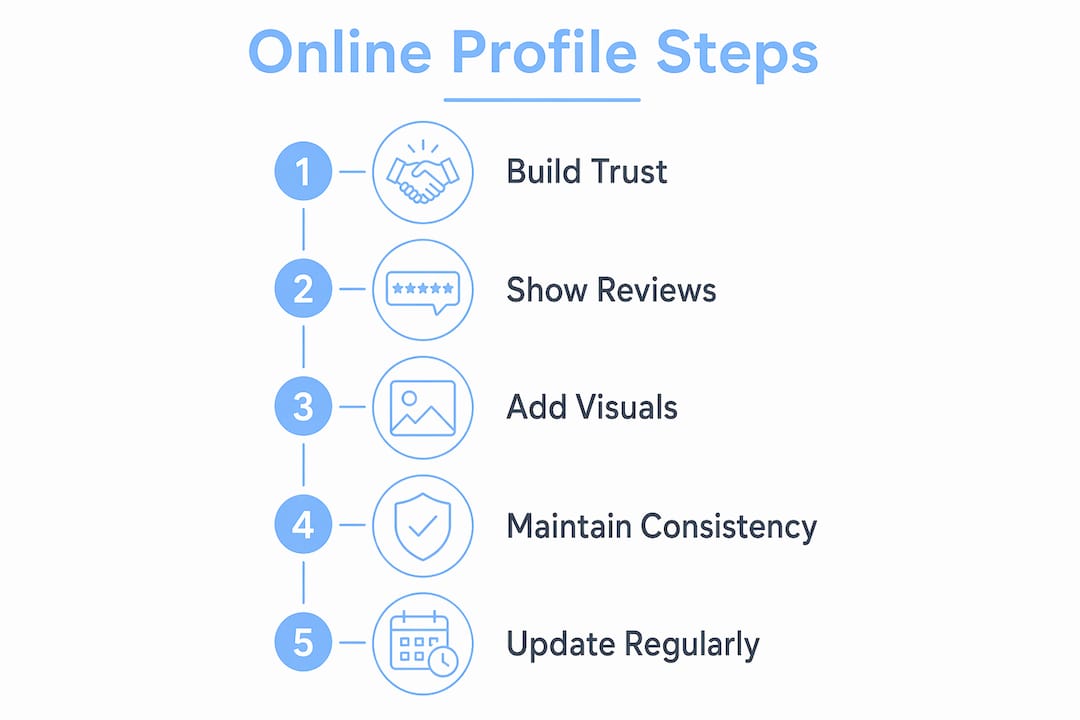
Building a strong digital presence requires a structured approach. The following steps move you from a basic listing to a profile system that actively generates leads and builds trust with potential clients.
-
Claim every relevant platform. Start with Google Business Profile, then LinkedIn, then any industry-specific directories relevant to your trade. An unclaimed profile is worse than no profile because someone else’s review activity shapes the first impression without your input.
-
Populate profiles completely before promoting them. A half-finished profile with missing photos and no reviews is a credibility liability. Fill in every field, upload at least five project photos, and add your license number and insurance information before you direct any traffic to the profile.
-
Build a review generation system. Send a direct SMS link to your Google review page within 24 hours of completing a job. The timing matters. Clients are most likely to leave a review when the positive experience is recent. Automate this step with a simple text template so it happens consistently after every project.
-
Respond to every review within 48 hours. Positive reviews deserve a thank-you that reinforces the specific work you did. Negative reviews require a calm, professional response that acknowledges the concern and offers a resolution. Both types of responses are visible to every future client reading your profile.
-
Update your project portfolio monthly. Add new project photos with brief descriptions that include the location, the scope of work, and the materials used. This keeps your profile fresh and gives search algorithms new content to index. It also gives clients a current view of your work quality and range.
-
Synchronize your information across all platforms quarterly. Use your master document to check that your business name, address, phone number, and service descriptions match exactly across Google, LinkedIn, your website, SAM.gov (if applicable), and any directories. Fix discrepancies immediately.
-
Add verifiable credentials to every profile. Your state contractor license number, insurance carrier, and any trade certifications should appear on every platform that allows it. Clients searching for a licensed contractor want to verify credentials quickly. Make that verification effortless.
The benefits of online profiles compound over time. A profile with 50 reviews, consistent information, and monthly photo updates carries far more weight than a new profile, regardless of star rating. Start building that history now.
Key takeaways
A contractor’s online profile is the single most accessible trust signal a client can evaluate before making contact, and managing it actively is the difference between winning bids and being screened out.
| Point | Details |
|---|---|
| Profiles act as a qualification filter | Clients and procurement staff research you online before deciding whether to contact you. |
| Review responses nearly double hire rates | Responding to all reviews lifts consumer willingness to hire from 47% to 88%. |
| Google Business Profile drives the most leads | A complete, active profile generates 3 to 5 times more calls than an incomplete one. |
| Consistency across platforms prevents disqualification | Mismatched business details trigger deeper scrutiny and can remove you from consideration. |
| Active profiles outperform dormant ones | Regular updates, new photos, and review engagement signal that your business is current and reliable. |
Why most contractors are treating their profiles like resumes when they should treat them like storefronts
I have reviewed hundreds of contractor profiles over the years, and the most common mistake is treating an online profile as something you set up once and forget. Contractors spend real money on trucks, tools, and insurance, and then leave their Google Business Profile sitting with three photos from 2021 and no review responses. That profile is doing active damage to their business every day.
The contractors who consistently win work in competitive markets understand something that most do not. Your online profile is not a resume. It is a storefront that is open 24 hours a day, and every element of it either builds or erodes trust with every person who visits it. The trust signals homeowners rely on are not complicated. They want to see recent work, a responsive business owner, and information that checks out when they verify it.
The other mistake I see constantly is inconsistency. A contractor will have a polished website and a completely neglected Google listing with an old address. Serious clients notice that. Procurement professionals absolutely notice that. It reads as either disorganization or something worse.
The contractors who treat their profiles as active business tools, updating them regularly, responding to every review, and keeping credentials current, are the ones who show up at the top of search results and get called first. That is not luck. It is the compounding result of consistent, deliberate profile management over time.
The expectation from clients is only going to increase. Transparency and verifiability are becoming baseline requirements, not differentiators. Contractors who build that infrastructure now will have a significant advantage over those who wait.
— Devin
How Bidwolf helps contractors win more projects through better profiles
Bidwolf is built for contractors who want their profile to do real work. When you create your contractor profile on Bidwolf, you get direct visibility with homeowners actively posting projects across Texas, from bathroom remodels to roofing and electrical work. Your profile on Bidwolf includes your credentials, past project history, and client reviews, all in one place where homeowners are already looking to hire.
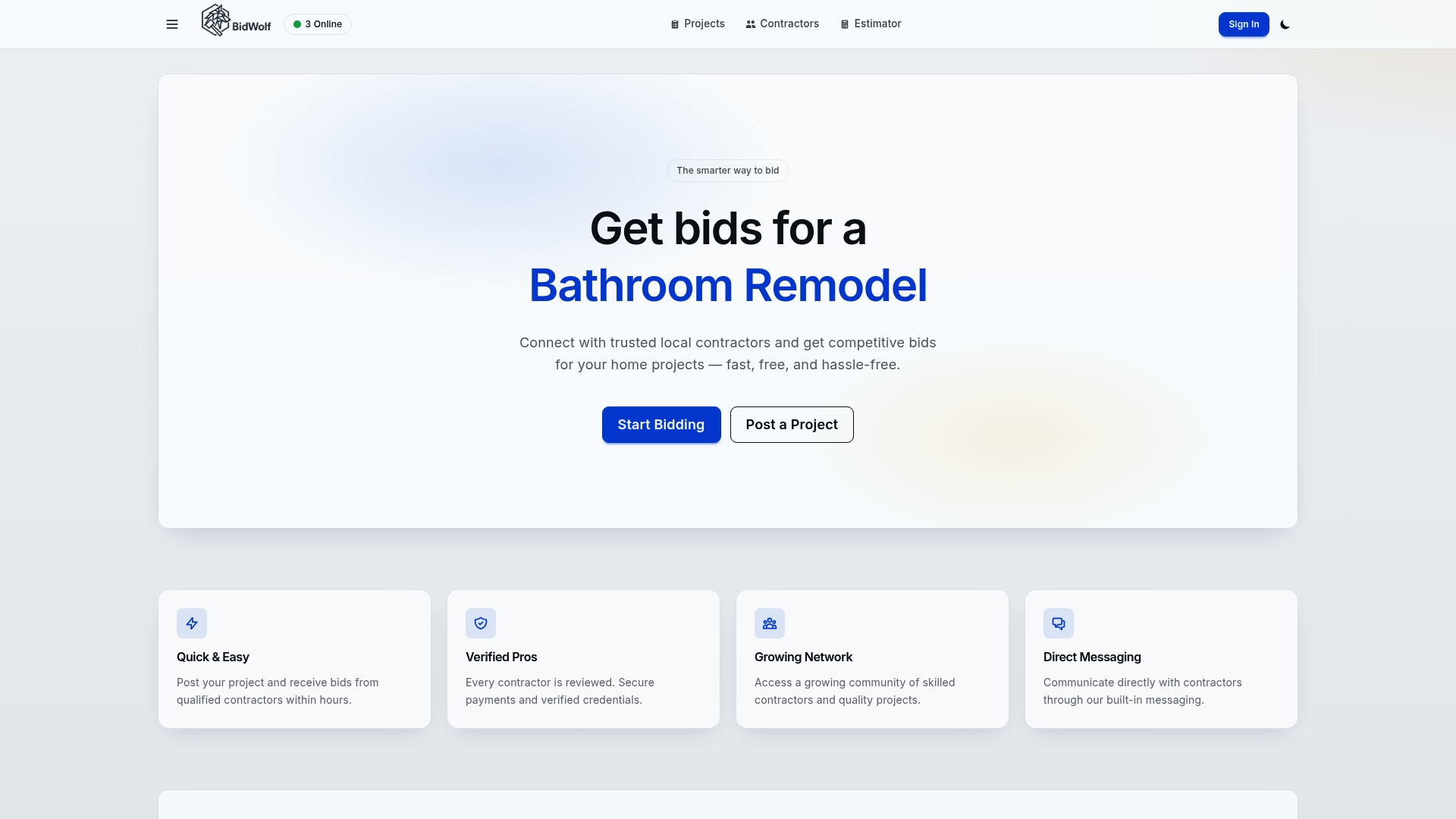
Bidwolf’s built-in messaging, verified credentials display, and competitive bidding system put your profile in front of clients at the exact moment they are ready to make a decision. You can manage your bids, communicate with clients, and update your project portfolio directly from the Bidwolf mobile app. Browse open projects near you and start building your verified contractor presence today.
FAQ
What is the role of online profiles in contracting?
Online profiles serve as a digital qualification filter that clients and procurement staff use to verify credibility, check credentials, and assess trustworthiness before making contact. A complete, active profile increases the likelihood of being shortlisted for both residential and commercial contracting work.
How do online reviews affect a contractor’s chances of getting hired?
Reviews primarily screen out untrustworthy contractors rather than directly winning jobs. Only 12% of homeowners cite reviews as their primary hiring factor, but 73% read them during research, making a solid review history a baseline requirement rather than a differentiator.
Which platform matters most for contractor visibility?
Google Business Profile is the highest-impact platform for most residential contractors. A fully completed and actively managed profile generates 3 to 5 times more calls than an incomplete one, with a maintenance requirement of roughly 15 minutes per week.
Why does profile consistency across platforms matter?
Serious clients and procurement teams cross-reference your website, directory listings, and public business records to verify your information. Inconsistencies in your business name, address, or license details trigger doubt and can disqualify you from consideration before you submit a bid.
How often should contractors update their online profiles?
Contractors should respond to new reviews within 48 hours, add project photos monthly, and conduct a full cross-platform consistency audit every quarter. A responsive contractor who keeps profiles current signals reliability to every potential client who visits.