
Lead Generation Steps for Contractors: 2026 Guide

TL;DR:
- Effective contractor lead generation depends on building a digital foundation with an optimized Google Business Profile, a fast, localized website, and call tracking to measure performance. Responding to leads within five minutes, preferably with automated follow-up sequences, greatly increases booking chances. Combining owned channels, referral programs, and targeted paid ads creates a reliable system for consistent, scalable growth.
Lead generation for contractors is the structured process of attracting, qualifying, and converting potential clients into paying customers through a repeatable, measurable system. Most contractors who struggle with inconsistent work are missing one thing: a defined set of lead generation steps that runs whether they are on a job site or not. This guide covers the exact contractor client acquisition steps you need, from building your digital foundation with Google Business Profile and a conversion-ready website, to automating follow-up with CRM tools, running Google Local Service Ads, and tracking cost per booked job. Every tactic here is grounded in 2026 data and built for contractors who want predictable growth, not just occasional referrals.
What are the lead generation steps for contractors?
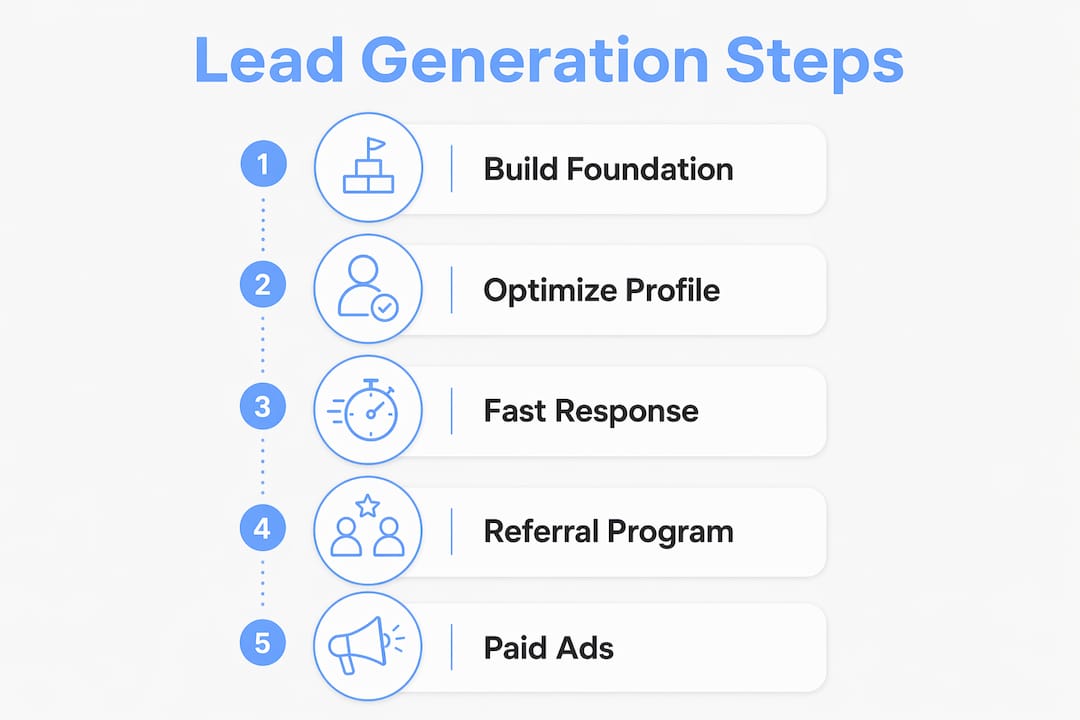
The lead generation steps for contractors form a layered system built on owned digital assets, fast response processes, referral programs, and paid advertising channels. Each layer compounds over time. Owned channels like your website and Google Business Profile (GBP) get cheaper per lead the longer you invest in them, while paid channels fill gaps immediately. The contractors who grow most predictably treat their marketing like project management: with systems, schedules, and accountability.
Step 1: Build your digital foundation
Your Google Business Profile is the single highest-priority asset in your lead generation system. GBP and local SEO cost between $0 and $30 per lead once established, compared to $50 to $60 per call from Google Local Service Ads. That cost gap makes your GBP the most important page you will ever “publish.” Fill every field: services, service area, hours, photos, and a keyword-rich business description.

Photos matter more than most contractors realize. Businesses with 100+ photos on their GBP receive 520% more calls than those with fewer than 10 photos. Upload job-site before-and-after shots weekly. This signals activity to Google and builds trust with homeowners browsing your profile before they call.
Your website needs to do three things well: load fast on mobile, clearly state your service areas, and make it easy to request a quote. Create individual service area pages for each city or neighborhood you serve. A roofing contractor in Dallas, for example, should have separate pages for Plano, Frisco, and McKinney, each with localized content. This is how local SEO for contractors generates high-intent organic leads at scale.
Set up call tracking from day one. Assign a unique phone number to each marketing channel: one for your GBP, one for your website, one for any paid ads. This data feeds directly into your CRM and tells you exactly which channels are producing.
Key digital foundation checklist:
- Complete your GBP with 100+ photos, all service categories, and weekly posts
- Build a mobile-optimized website with dedicated service area landing pages
- Install call tracking numbers per channel using tools like CallRail or WhatConverts
- Claim and optimize your profiles on Yelp, Houzz, and the Better Business Bureau
- Earn local backlinks from supplier websites, trade associations, and local news
Pro Tip: Request Google reviews immediately after job completion. Text review requests get a 25 to 35% response rate, while email requests get only 5 to 10%. Send the text within 24 hours of finishing the job, when satisfaction is highest.
| Digital asset | Cost range | Time to results |
|---|---|---|
| Google Business Profile | $0/month | 1 to 3 months |
| Local SEO website pages | $500 to $2,000 setup | 3 to 6 months |
| Call tracking software | $50 to $150/month | Immediate data |
| Google Local Service Ads | $50 to $60 per call | Immediate leads |
How fast do you need to respond to new leads?
Speed is the single biggest conversion lever in contractor lead generation, and most contractors underestimate how much they are losing by calling back hours later. Responding within 5 minutes can increase conversion rates by up to 400%. That number reflects a real behavioral pattern: homeowners submit a request, then immediately start calling the next contractor on the list. The first company to respond wins the appointment in most cases.
The data gets sharper when you look at the first minute. Contacting a lead within one minute can increase conversion rates by up to 391%. This means the difference between a booked job and a lost one is often just a few minutes of delay. When you are on a roof or under a sink, that delay is almost guaranteed without a system in place.
Here is a proven follow-up sequence to implement immediately:
- Minute 1 to 5: Send an automated SMS acknowledging the inquiry. Use a CRM like Jobber, ServiceTitan, or HouseCall Pro to trigger this automatically when a new lead form is submitted.
- Minute 5 to 15: Attempt a live phone call. If unanswered, leave a brief voicemail and send a follow-up text.
- Day 1, end of day: Send a personalized email referencing the specific project type they mentioned. Generic emails get ignored.
- Day 3: Second call attempt plus a text asking if they have questions.
- Day 7: Follow-up email with a relevant project photo or testimonial from a similar job.
- Day 14 and beyond: Monthly check-in until they book, decline, or ask to be removed.
80% of sales require five or more contact attempts, yet most contractors stop after one. That single habit change, committing to a multi-touch sequence, separates contractors who consistently book jobs from those who complain about bad leads.
“The lead was not bad. The follow-up was.” This is the most common diagnosis when contractors audit their lost estimates. The project was real, the budget was there, and another contractor got the job because they called back twice.
Pro Tip: If you cannot answer calls during job hours, use an AI receptionist service or a live answering service like Ruby Receptionists. AI-powered call answering lets you maintain responsiveness without hiring additional office staff, and it captures lead details in real time.
Slow lead response costs contractors 30 to 50% of potential business. That is not a minor inefficiency. For a contractor doing $500,000 in annual revenue, fixing response time alone could represent $150,000 to $250,000 in recovered revenue.
How do referral programs and paid ads work together?
Referral programs and paid advertising solve different problems. Referrals produce high-quality, high-trust leads at near-zero cost. Paid ads produce volume on demand. A well-run contractor business uses both, with referrals as the foundation and paid channels as the accelerator.
Referral programs generate 30 to 40% of total annual revenue for contractors who manage them well. The key word is “manage.” Referrals do not happen automatically. You need a system that prompts your team to ask, rewards customers for referring, and tracks where each referral came from.
Building a referral program that actually works:
- Train every technician and crew member to ask for referrals at job completion. Script it: “If you know anyone who needs [service], we would really appreciate the introduction.”
- Offer a clear incentive: $50 to $100 gift cards, account credits, or a free service call work well depending on your average job value.
- Send a follow-up text or email after each completed job with a direct referral link. Automated SMS has a 98% open rate, making it the most reliable channel for referral requests.
- Track every referral source in your CRM so you know which customers refer most often. Prioritize those relationships.
For paid channels, Google Local Service Ads (LSAs) are the highest-performing option for most home service contractors. LSAs produce close rates of 45 to 55% because leads are exclusive and high-intent. Compare that to shared lead platforms, where the same lead goes to three to five contractors and close rates drop to 10 to 20%. The math strongly favors LSAs over platforms that sell the same lead to your competitors.
Paid channel comparison:
| Channel | Cost per lead | Close rate | Lead exclusivity |
|---|---|---|---|
| Google Local Service Ads | $50 to $60/call | 45 to 55% | Exclusive |
| Google Search Ads | $30 to $80/click | 20 to 35% | Exclusive |
| Shared lead platforms | $15 to $50/lead | 10 to 20% | Shared (3 to 5 contractors) |
| Referral program | Near $0 | 60 to 80% | Exclusive |
Pro Tip: Use paid ads to fill scheduling gaps, not as your primary lead source. When your calendar has open slots two weeks out, turn up your LSA budget. When you are booked solid, scale it back. This prevents overspending and keeps your cost per booked job in check.
Relying on word-of-mouth or expensive lead aggregators leads to wasted budget and inconsistent lead flow. The contractors who grow most reliably combine owned channels, referrals, and targeted paid ads, each tracked separately so they know exactly what each dollar produces.
How do you measure and optimize your lead generation system?
Measurement turns a collection of marketing tactics into a real system. Without tracking, you are guessing which channels work. With tracking, you can double down on what produces results and cut what does not. Marketing spend must be tracked meticulously using call tracking and CRM source tags to calculate cost per lead and cost per booked job by channel.
The metrics that matter most for contractor lead generation:
- Cost per lead (CPL): Total spend on a channel divided by leads generated. Track this monthly per channel.
- Cost per booked job (CPBJ): Total spend divided by jobs actually scheduled. This is more important than CPL because it accounts for close rate differences.
- Close rate by channel: LSA leads might close at 50%, while shared platform leads close at 15%. Knowing this changes how you allocate budget.
- Lead response time: Average minutes from lead submission to first contact. This directly predicts your conversion rate.
- Revenue per lead source: Which channels produce your highest-value jobs, not just the most jobs.
Tracking phone numbers per channel and integrating them with your CRM gives you granular data to make these calculations automatically. Tools like CallRail, Jobber, and ServiceTitan all support this kind of source attribution.
Use a 30-60-90 day framework to build and optimize your system:
- Days 1 to 30: Audit your current lead sources. Set up call tracking. Complete your GBP. Launch or fix your website’s service area pages.
- Days 31 to 60: Launch your follow-up automation sequences. Start your referral program. Test one paid channel with a defined budget.
- Days 61 to 90: Review CPL and CPBJ by channel. Cut underperformers. Increase budget on your top two channels. Refine your follow-up sequence based on response data.
Pro Tip: Allocate 5 to 10% of gross revenue to marketing and lead generation. Successful contractors invest at this level and treat it as a fixed operating cost, not a discretionary expense. Below 5%, growth stalls. Above 10%, evaluate whether your conversion rate justifies the spend.
Owned channels like your website and GBP create compounding value over time, unlike paid leads that require continuous spending. A well-optimized GBP and a strong local SEO presence will cost less per lead every year as your rankings and reviews grow. That is the long-term payoff of investing in your digital foundation first.
Key takeaways
A contractor’s lead generation system works only when owned digital assets, fast response automation, referral programs, and paid channels operate together as a single tracked process.
| Point | Details |
|---|---|
| Digital foundation first | Complete your GBP with 100+ photos and build service area pages before spending on paid ads. |
| Speed determines conversion | Responding within 5 minutes increases conversion rates by up to 400%; automate your first response. |
| Follow up more than once | 80% of sales require 5+ contact attempts; build a 2-week multi-touch sequence into your CRM. |
| Referrals beat aggregators | Referral programs generate 30 to 40% of revenue at near-zero cost; shared lead platforms close at 10 to 20%. |
| Track every dollar | Measure cost per booked job by channel monthly and reallocate budget to your top performers. |
Why most contractors are one system away from consistent leads
I have worked with enough contractors to say this plainly: the problem is almost never a lack of skill or reputation. It is the absence of a system. Contractors who treat lead generation as something that “just happens” through word-of-mouth are essentially hoping their schedule fills itself. That works in a hot market. It fails the moment competition increases or a slow season hits.
The contractors I have seen grow most consistently share one habit: they treat their marketing calendar the same way they treat a project schedule. They set weekly tasks for GBP posts, review requests, and follow-up calls. They review their CRM numbers every Friday. They know their cost per booked job the same way they know their material costs.
The automation piece is where I see the biggest untapped opportunity. Most contractors I talk to are still calling leads back manually, hours after the inquiry came in. Setting up a CRM like Jobber or HouseCall Pro to send an instant SMS takes about two hours to configure. That two-hour investment can recover tens of thousands of dollars in leads that would otherwise go to whoever called back first.
One more thing worth saying: do not neglect your contractor profile optimization. Your GBP, your website bio, and your marketplace profiles are often the first thing a homeowner reads before deciding whether to contact you. A thin, photo-free profile loses jobs before the phone ever rings. Invest the time to make every profile look like the work of a contractor who takes pride in their business, because that is exactly what homeowners are looking for.
— Devin
Get more project leads with Bidwolf
Bidwolf connects verified contractors with homeowners actively posting home improvement projects across Texas, from bathroom remodels and roofing to electrical work and landscaping. The platform puts real, ready-to-bid projects in front of you without the wasted spend of shared lead aggregators.
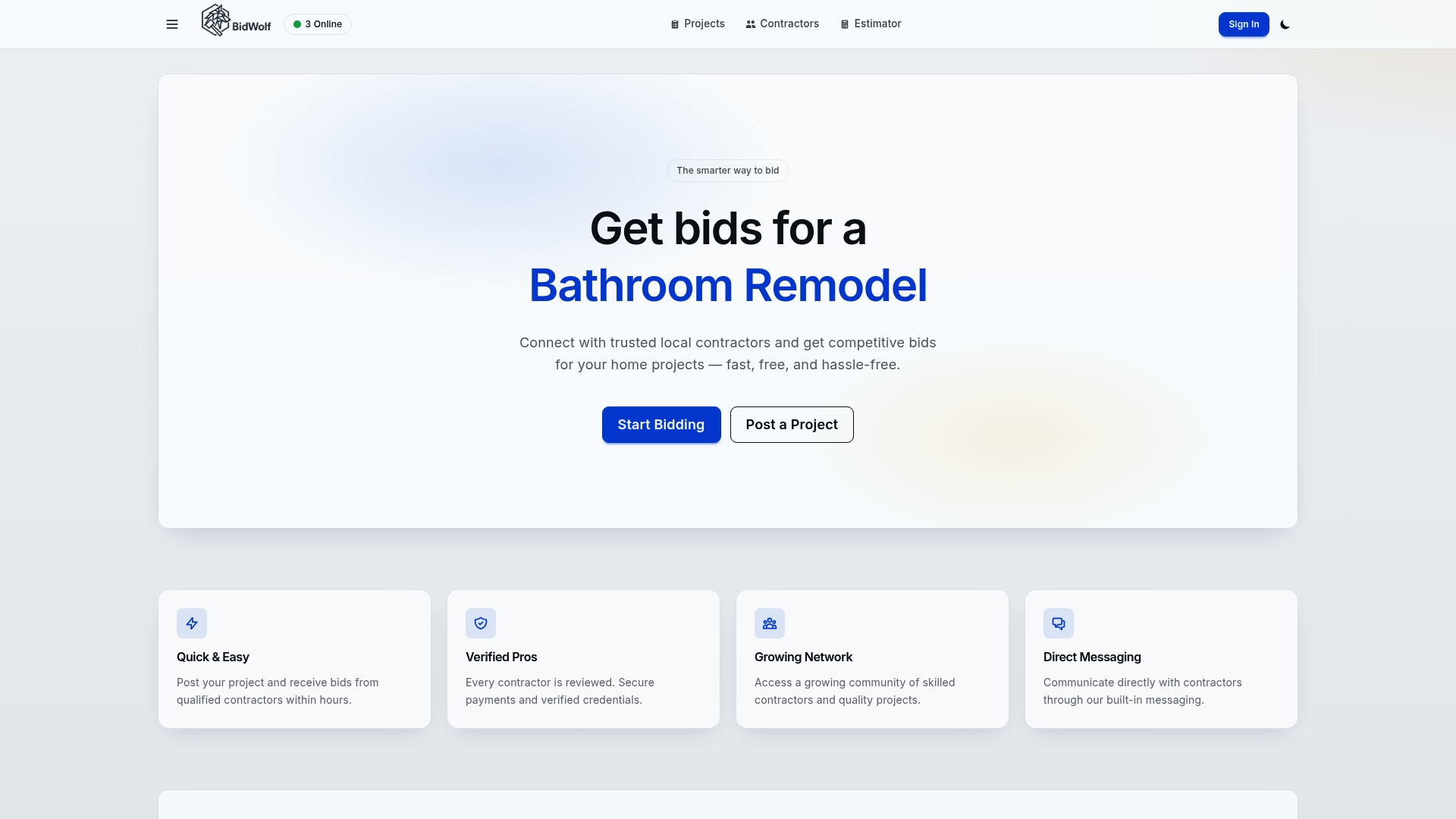
When you join as a contractor on Bidwolf, you get access to a growing pipeline of local project leads, built-in messaging to communicate directly with homeowners, and a verified profile that builds trust before the first conversation. Bidwolf is built for contractors who want a reliable, transparent way to find new clients and win more bids. Post your first project bid today and see how the platform fits into your lead generation workflow.
FAQ
What are the most important lead generation steps for contractors?
The most important steps are completing your Google Business Profile, building a mobile-friendly website with service area pages, setting up automated CRM follow-up, launching a referral program, and tracking cost per booked job by channel. These steps build a system that produces leads consistently rather than relying on sporadic referrals.
How quickly should a contractor respond to a new lead?
Contractors should respond within 5 minutes of receiving a new lead. Responding within that window can increase conversion rates by up to 400%, and contacting a lead within the first minute can increase conversions by up to 391%. Automated SMS through a CRM is the most reliable way to hit this target.
Are Google Local Service Ads worth it for contractors?
Google Local Service Ads are worth it for most home service contractors. LSAs produce exclusive leads with close rates of 45 to 55%, compared to 10 to 20% for shared lead platforms. At $50 to $60 per call, the cost is higher than organic leads but significantly more efficient than buying shared leads from aggregators.
How many follow-up attempts should a contractor make?
Contractors should make at least 5 contact attempts before closing a lead as lost. Research shows 80% of sales require 5 or more contact attempts, yet most contractors stop after one or two. A structured sequence of texts, calls, and emails spread over two weeks captures the majority of bookable leads.
How much should a contractor spend on lead generation?
Contractors should allocate 5 to 10% of gross revenue to marketing and lead generation. Treating this as a fixed operating cost rather than a discretionary expense produces more predictable growth. Below 5%, most contractors see stagnant lead volume. Above 10%, the focus should shift to improving conversion rates before increasing spend further.