

Best Practices for Contractor Profiles That Win Clients

TL;DR:
- Creating a complete, consistent, and updated contractor profile signals professionalism and builds trust online.
- Regularly adding geo-tagged photos, specific descriptions, and authentic reviews improves local search rankings and client engagement.
Your profile is often the first thing a potential client sees before they ever call you. In the home improvement market, where dozens of contractors compete for the same jobs, the best practices for contractor profiles can mean the difference between a full pipeline and a silent phone. Clients make fast judgments based on what they see online. A complete, current, and well-positioned profile signals professionalism and builds trust before a single conversation happens. This guide breaks down exactly what makes contractor profiles work in 2026, from photos and reviews to niche positioning and AI-era search signals.
Table of Contents
- Key takeaways
- Best practices for contractor profiles: the essential framework
- 1. Keep NAP data consistent across all listings
- 2. Upload more photos than you think you need
- 3. Write a business description that passes the specificity test
- 4. Post updates at least twice a week
- 5. Build your FAQ and Q&A section for AI-driven search
- 6. Manage reviews for velocity, variety, and authenticity
- 7. Position your profile with a defined niche
- 8. Align your service areas with your actual coverage
- 9. Use local keywords naturally in your profile copy
- 10. Treat your profile as a living document
- A deep look at the elements that make or break contractor profiles
- My take on what actually moves the needle
- Get more out of your profile with Bidwolf
- FAQ
Key takeaways
| Point | Details |
|---|---|
| NAP consistency matters | Keep your name, address, and phone number identical across every online listing to protect local search rankings. |
| Photos drive real results | Profiles with over 100 photos receive 520% more calls than profiles with fewer than 5 photos. |
| Review velocity beats review count | Earning 5 to 10 new reviews monthly signals activity and authenticity more than a one-time spike. |
| Freshness is a ranking factor | Profiles not updated within 30 days lose visibility as AI search algorithms favor recent activity signals. |
| Niche positioning converts faster | Clear, specific positioning in your profile description eliminates confusion and attracts better-fit clients. |
Best practices for contractor profiles: the essential framework
Before you optimize anything, you need a clear picture of what a complete profile actually requires. Most contractors fill in the basics and stop. That gap is where opportunities are lost.
Here are the core elements every contractor profile must have:
- NAP consistency. Your business name, address, and phone number must match exactly across every platform where you appear. Inconsistent NAP data causes AI search algorithms to flag your listing as untrustworthy, which pushes you out of local recommendations.
- Service categories. Choose your primary category with precision. If you specialize in bathroom remodels, say that clearly. Broad categories like “general contractor” dilute your relevance in targeted searches.
- Business description. Write a description that tells clients what you do, who you serve, and what makes you different. Avoid generic phrases like “quality work at great prices.” State specifics instead, such as which neighborhoods you serve or which types of projects you focus on.
- High-quality, geo-tagged photos. Upload photos that are recent, clearly lit, and representative of your actual work. Geo-tagged photos act as a hidden relevance signal, reinforcing your service area claims in local search results.
- Regular posts and Q&A updates. Adding fresh content to your profile at least twice a week prevents the ranking drops that come with inactivity.
- Authentic reviews. Ask for reviews consistently and respond to every one. A steady stream of genuine feedback builds trust with both clients and search algorithms.
Pro Tip: Run what’s called the “One-Line Test” on your profile description. Ask yourself: can a stranger read one line of your description and know exactly what problem you solve and for whom? If not, rewrite it until the answer is yes.
1. Keep NAP data consistent across all listings
This sounds simple, but it’s one of the most commonly broken rules in contractor profile management. Your business name, address, and phone number need to be identical everywhere: Google, Yelp, contractor directories, and any other platform you appear on.
Even a small variation, like “St.” on one platform and “Street” on another, creates a signal conflict. AI-driven local search treats inconsistent NAP data as a sign of an unreliable or outdated business. The fix is straightforward. Audit every listing you have and correct discrepancies so your information reads exactly the same everywhere.
2. Upload more photos than you think you need
The data here is hard to ignore. Profiles with over 100 photos receive 520% more calls than those with fewer than 5 photos. That is not a marginal difference. It is a signal that photo quantity directly correlates with client engagement.
The practical approach is to add 5 to 10 new photos per month. Photograph completed projects from multiple angles. Include before-and-after shots where possible, as they tell a story clients can relate to. Geo-tag your photos before uploading them so that local search algorithms pick up the geographic relevance of your work. A kitchen remodel photo tagged to a specific neighborhood in Austin carries more local ranking weight than an untagged upload.
3. Write a business description that passes the specificity test
Vague descriptions are the most common mistake contractors make. Phrases like “serving homeowners for over 20 years” or “committed to quality” appear on thousands of profiles and tell clients nothing useful.
Your description should answer three questions in the first two sentences: What do you do? Where do you do it? Why should a client choose you over the next contractor? Consider adding a brief section that explains your approach to a typical project. Describing your decision-making process in a portfolio or profile context is one of the most effective ways to demonstrate professionalism and separate yourself from competitors who just list services.
A description like “We handle full bathroom remodels for homeowners in North Dallas, specializing in barrier-free designs for aging-in-place clients” is more specific, more searchable, and more convincing than any generic claim about quality or experience.
4. Post updates at least twice a week
Think of your profile as a publishing channel, not a static business card. Profiles not updated within 30 days experience significant visibility drops as AI search prioritizes recently active listings. Posting twice a week is the threshold that keeps your profile in good standing.
Your posts do not need to be elaborate. Share a photo of a project in progress with a short caption. Answer a common client question. Highlight a recently completed job. Each update sends a freshness signal to the algorithm and gives potential clients a reason to engage with your profile. Include a clear call to action in each post, such as “Request a free estimate” or “See more of our recent projects.”
5. Build your FAQ and Q&A section for AI-driven search
This is one of the most overlooked elements in contractor profile optimization. Answer Engine Optimization, or AEO, is the practice of structuring your profile content so that AI-powered search tools can surface your answers directly in results. FAQ sections with direct answers to questions like “How much does a bathroom remodel cost in Dallas?” or “Who is the best roofer near me?” dramatically improve your chances of appearing in AI-generated search summaries.
Seed your Q&A section with 8 to 10 questions that match what clients actually type into search. Write clear, direct answers without fluff. Update this section every few months to keep the content current and relevant.
6. Manage reviews for velocity, variety, and authenticity
Most contractors chase a perfect 5-star rating. Counterintuitively, that can hurt you. Profiles with a 4.7 average rating and a mix of 3 to 5 star reviews tend to rank better than those with a suspicious string of perfect scores, because AI systems flag uniformly perfect ratings as potentially fraudulent.
What you want is 5 to 10 new reviews monthly across a range of star ratings. Ask satisfied clients for a review right at project completion, when the experience is fresh. Respond to every review, including the critical ones. A thoughtful response to a 3-star review demonstrates professionalism and often reassures potential clients more than ten 5-star ratings with no contractor response.
Pro Tip: Create a simple follow-up text or email template that you send to clients one to two days after project completion. A short, friendly message with a direct link to your review page removes friction and significantly increases review submission rates.
7. Position your profile with a defined niche
Broad positioning is a common trap. Saying you do “everything from roofing to landscaping” might feel like it opens more doors, but narrow and explicit niche positioning actually increases conversion by eliminating ambiguity and helping clients self-select quickly.
When a homeowner with a specific problem finds your profile and sees that you specialize in exactly that type of project, the decision becomes easy. You become the obvious choice rather than one of many options. Pick the service you do best and the client type you serve most effectively, then build your profile language around that intersection. You can still take other jobs. But your profile should lead with your strongest position.
Understanding how Texas homeowners find trusted contractors makes it clear that specificity is not a limitation. It is a trust signal.
8. Align your service areas with your actual coverage
Claiming a service area that is too wide creates problems on two fronts. It reduces your relevance in the neighborhoods where you actually work, and it generates leads from clients you cannot realistically serve well.
Be precise about the zip codes and neighborhoods you cover. Use local terms that clients in those areas actually use. A roofing contractor who specifies “Katy, Cypress, and Spring, TX” will rank better in those communities than one who lists “Greater Houston Area.” Match your service area claims to the geo-tagged photos you upload and the local keywords you use naturally in your profile text.
9. Use local keywords naturally in your profile copy
Local keyword use is not about stuffing terms into your description. It is about writing the way your clients think. When someone in Fort Worth searches for “deck builder near me” or “fence contractor Fort Worth,” your profile copy needs to reflect that language naturally.
Read your own description out loud. If it sounds like a keyword list, rewrite it as a conversation. The goal is to use geographic terms and service-specific language in a way that reads clearly and ranks well. Your profile copy can also include local landmarks or neighborhood references that add geographic context without feeling forced.
Pro Tip: Search your own services in your target area and read the top-ranking profiles. Note which specific terms appear in their descriptions and look for gaps in your own copy. This competitive audit takes 15 minutes and often reveals one or two keyword phrases that are missing from your profile.
10. Treat your profile as a living document
Contractors who treat their profiles as evolving assets consistently outperform those who set up their profile once and leave it alone. Profile decay is real. A listing that looked complete six months ago may now be missing current photos, outdated service information, or a stale description that no longer reflects your work.

Schedule a monthly profile audit. Review your photos and remove outdated or low-quality images. Update your description if your services or focus areas have changed. Check your Q&A section and add new questions that reflect what you are actually hearing from clients. This habit takes less than an hour a month and protects the ranking gains you have built over time.
A deep look at the elements that make or break contractor profiles
To really sharpen your approach, here is a side-by-side comparison of how the major profile elements perform when done well versus poorly.
| Profile element | Done well | Done poorly |
|---|---|---|
| Photos | 50+ recent, geo-tagged, before/after shots updated monthly | 3 to 5 stock-looking images uploaded at account creation |
| Reviews | 5 to 10 new reviews monthly with consistent responses | A cluster of reviews from years ago with no new activity |
| Business description | Specific, niche-focused, answers what/where/why | Generic claims about quality with no geographic context |
| Service categories | Primary category precisely matched to top service | Multiple broad categories with no clear primary focus |
| Posts and Q&A | Updated twice weekly with CTAs and direct answers | Empty Q&A section, posts from months ago |
| NAP consistency | Identical across all platforms and directories | Minor variations in address or phone format across listings |
The patterns in this table are consistent across best contractor profiles examples on competitive platforms. The gap between strong and weak profiles is rarely about talent. It is almost always about consistency and attention to the details that search algorithms and clients both notice.
When evaluating your own profile against competitors, look at photo count, review recency, and description specificity. Those three factors, more than anything else, separate contractors who get steady inbound leads from those who rely entirely on word of mouth.
My take on what actually moves the needle
I’ve looked at contractor profiles across dozens of markets and the pattern that stands out most is not what people add to their profiles. It’s what they fail to maintain.
The contractors I see consistently winning new clients are not necessarily the most skilled. They are the ones who show up consistently online. A profile updated every week signals to both the algorithm and the client that this is an active, reliable business. That signal matters more than most contractors realize.
What I’ve found is that vague positioning is the single biggest conversion killer. I’ve seen contractors with 300 reviews lose leads to competitors with 40 reviews because the competitor’s profile made it immediately clear who they serve and what they specialize in. Clients do not have time to figure out what you do. Your profile should make it obvious in three seconds.
The review velocity point also gets underestimated. Total review count feels impressive, but a contractor with 200 reviews and no new ones in six months looks dormant. A contractor with 50 reviews and 8 new ones this month looks active and trusted. Freshness beats volume every time.
My honest advice: set a weekly calendar block of 30 minutes for your profile. Upload photos, write a short post, check for new reviews, and respond to them. That single habit, done consistently, compounds over months into a profile that generates leads on autopilot.
— Devin
Get more out of your profile with Bidwolf
Optimizing your contractor profile is only half the equation. You also need to be visible where high-intent clients are actively searching for help.
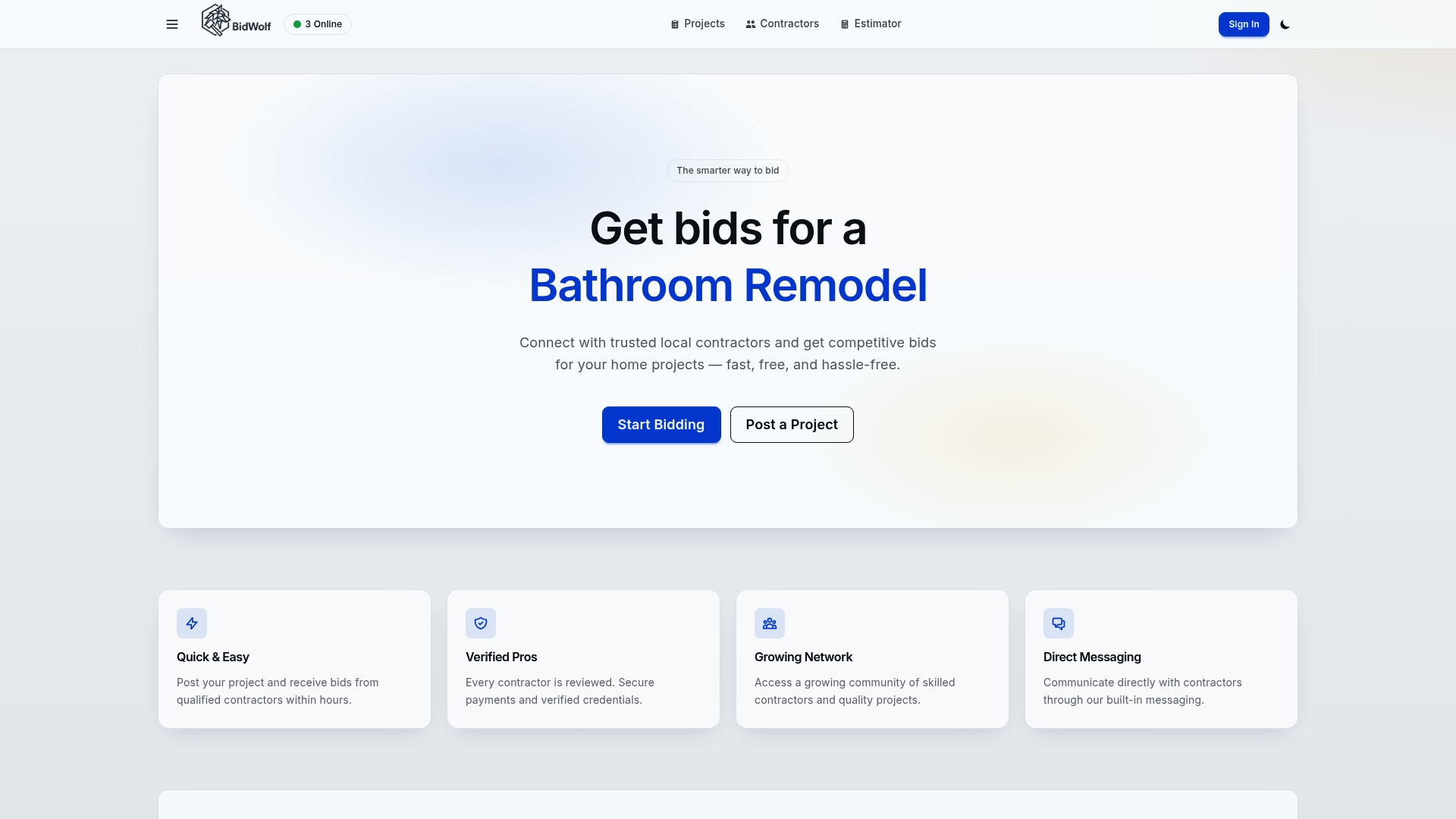
Bidwolf connects verified contractors with homeowners across Texas who are ready to hire. When you create your contractor profile on Bidwolf, you get access to a marketplace built around transparency, verified credentials, and competitive bidding. Homeowners post real projects and you respond with real bids. No guessing, no cold outreach. You can also browse active projects right now to see what homeowners in your service area are looking for. If you are ready to put your optimized profile in front of clients who are already looking, Bidwolf is where that happens.
FAQ
What should a contractor profile include?
A strong contractor profile includes consistent NAP data, a specific business description, high-quality geo-tagged photos, a populated Q&A section, recent reviews, and regular post updates. These elements together signal both trustworthiness and relevance to local search algorithms.
How often should I update my contractor profile?
You should update your profile at least twice a week with new photos or posts, and conduct a full audit monthly. Profiles inactive for 30 days lose significant visibility as AI search systems favor recently active listings.
How many reviews do I need to rank well?
Review velocity matters more than total count. Earning 5 to 10 new reviews each month signals consistent activity and authenticity, which carries more ranking weight than a large but stagnant review total.
Does a perfect 5-star rating help my profile rank higher?
Not necessarily. A 4.7 average rating with a natural mix of scores tends to perform better than a uniform 5.0, which AI systems may flag as inauthentic. Responding to all reviews, including lower ratings, reinforces your credibility.
What is the fastest way to improve my contractor profile visibility?
Geo-tag and upload at least 10 new photos, write two short posts with calls to action, and add five relevant Q&A entries. These three steps, done in a single session, create immediate freshness signals that search algorithms reward quickly.