

Tips for Growing Your Contractor Business in 2026

TL;DR:
- Most contractors plateau because their growth tools stop working around $750K in revenue, leading to inefficiencies.
- Successful expansion requires implementing systems across hiring, lead generation, operations, referrals, and marketing, not just hustle.
Most contractors hit a ceiling not because they lack skill, but because the tools that built their first $500K in revenue stop working somewhere around $750K. Word of mouth slows. You’re buried in jobsite problems. Every estimate runs through you. These are some of the most common tips for growing contractor business owners actually need to hear: growth requires systems, not just hustle. This article gives you concrete, field-tested strategies covering hiring, lead generation, operations, referrals, and marketing investment so you can break through the plateau and build something that lasts.
Table of Contents
- Key takeaways
- 1. Get your labor model right before you scale
- 2. Target the right clients, not just more clients
- 3. Build a lead generation system that runs without you
- 4. Free yourself from the jobsite bottleneck
- 5. Build a referral program that actually generates leads
- 6. Increase marketing investment as revenue grows
- 7. Run all seven business systems at once
- My honest take on contractor growth
- Find more projects with Bidwolf
- FAQ
Key takeaways
| Point | Details |
|---|---|
| Labor model matters first | Choosing the right mix of employees and subcontractors protects margins and allows you to scale capacity without overextending. |
| Diversify your lead sources | Relying on one lead channel caps growth; combining SEO, paid ads, and referrals creates steady, resilient pipeline volume. |
| Fix conversion before scaling | Most contractors lose 50 to 70% of leads to slow follow-ups; fixing conversion systems multiplies revenue without adding marketing spend. |
| Build referral programs intentionally | Referred customers have higher retention and profit margins, but they rarely refer without a structured ask and a small incentive. |
| Systems enable sustainable growth | Successful contractors run seven core systems simultaneously, from lead generation to financial management, to grow without burning out. |
1. Get your labor model right before you scale
The very first scaling decision you face is whether to hire employees or lean on subcontractors. Get this wrong and you will either bleed overhead during slow months or sacrifice quality when you are slammed. Scaling a contracting business starts with building a tight core team and using subcontractors for overflow or specialty work rather than treating them as a primary workforce.
Here is a practical framework for making this decision:
- Use subcontractors when demand is inconsistent, when you need a specialized trade you don’t regularly perform, or when you’re testing a new service line before committing to payroll.
- Hire employees when a role runs more than 30 hours per week consistently, when quality control requires direct supervision, or when your business depends on that person’s relationship with clients.
- Cross-train your core crew on at least two related tasks so you’re never held hostage by one person calling in sick on a critical job day.
- Define roles clearly in writing. Ambiguity about who handles job cleanup, material ordering, or client communication causes mistakes that cost money and damage reputation.
Understanding direct hire vs. temp staffing can also help you think through the financial and operational tradeoffs before committing to a hire.
Pro Tip: Before posting a job listing, write out exactly what you need the person to do in a typical week. If you cannot fill that list with 35 or more hours of clear work, a subcontractor is likely the smarter financial choice for now.
2. Target the right clients, not just more clients
One of the most practical successful contractor tips you’ll ever get: stop trying to reach everyone. The Associated General Contractors of America recommends moving away from broad-market marketing toward account-based marketing, where you focus your resources on a defined list of high-value project types and clients.
Here’s what that shift looks like in practice:
- Identify your three most profitable job types from the last 12 months. Calculate actual margin, not just revenue.
- Build a profile of your ideal client for each job type: property type, location, project size, how they found you, and what they cared about most.
- Create targeted messaging for each profile across your website, Google Business Profile, and any paid advertising. Generic messaging converts poorly.
- Allocate your marketing budget toward channels where that specific client type searches. For residential remodeling, Google Search Ads often outperform social ads for high-intent buyers.
- Track marketing ROI beyond cost-per-lead. A lead that turns into a $35,000 project is worth more than five leads that each become $4,000 jobs. Measure revenue generated per channel, not just lead volume.
A strong real-world example: a multi-channel campaign combining Google Ads with an existing lead platform generated over $990,000 in revenue within 90 days for one contractor who had previously depended on a single source. That level of result comes from diversification, not just spending more on one channel.
Contractor marketing strategies targeting local homeowners can give you more specific channel guidance if you operate in Texas markets.
3. Build a lead generation system that runs without you
Many contractors confuse lead generation with marketing spend. They are not the same thing. A system runs consistently. Spending money on ads is not a system until it’s connected to a follow-up process, a CRM, and a way to measure what’s working. Many contractors lose 50 to 70% of leads due to slow follow-ups and weak proposals, which means fixing your conversion rate may be more valuable than generating more leads in the first place.
Over-reliance on a single lead source is also a serious risk. Strategic lead source diversification with proper measurement and CRM integration is what separates stagnant businesses from growing ones.
Your lead system should include at least three channels: organic search (SEO and Google Business Profile), paid advertising (Google Ads or Facebook Ads), and referrals. Each channel feeds different types of buyers at different stages of their decision process. When one slows down seasonally, the others carry the load.
On the conversion side, set a standard response time of under 90 minutes for new inquiries during business hours. Use a CRM to track every lead from first contact to signed contract. Review weekly to spot where leads are dropping off. Often the fix is not more leads. It’s a faster proposal or a better follow-up sequence.
4. Free yourself from the jobsite bottleneck
If every decision on every job runs through you, your business cannot grow past the number of hours in your week. This is the number one operational reason that growing a construction business stalls out at the $1 million mark. The solution is not working harder. It’s hiring a production manager or trusted crew lead to own jobsite execution so you can focus on business development, estimating, and planning.
Practical steps to build that operational layer:
- Promote from within first. Your best field worker who communicates well and takes initiative is often a better production manager candidate than an outside hire. They already know your processes.
- Document your job handoff process. What information does the production manager need before day one of a job? Materials, access, client preferences, scope details, and timeline expectations should all be in writing.
- Set weekly check-ins instead of constant calls. A Monday morning 20-minute meeting for the week’s priorities and a Friday wrap with any issues beats 12 texts per day.
- Track profitability by job. If you only know your overall margin at the end of the year, you’re flying blind. Review actual vs. estimated costs for every completed job to find where you’re losing money.
- Use project management tools like Buildertrend, Jobber, or CoConstruct to manage scheduling, communication, and documentation without paper trails or memory gaps.
Pro Tip: If a production manager hire ($65,000 to $90,000 annually) feels like a big risk, do the math on what your time is worth. If you’re billing $200 per hour on your best work and spending 25 hours a week on jobsite management, you’re making a $5,000 per week decision by staying in that role.
Managing projects from a mobile app can reduce friction for crews in the field and give you visibility without being physically present.

5. Build a referral program that actually generates leads
Most satisfied clients will not refer you unless you ask at the right moment and make it easy. Referred customers have a 37% higher retention rate and 25% higher profit margin than clients who find you through paid channels. Yet most contractors leave this entirely to chance.
Here’s how to build a referral program that works:
- Time your ask correctly. The best moment is five to seven days after a job is completed. The client is still excited about the result but has had enough time to see it in their home. A thank-you call or note with a simple referral ask converts far better than asking during the job.
- Make the ask specific. “If you know anyone planning a kitchen remodel in the next year, I’d really appreciate an introduction” outperforms “Feel free to refer anyone.” Specificity tells the client exactly who to think of.
- Offer a small incentive. A $50 to $100 gift card for any referral that becomes a signed contract is enough to create real motivation without cheapening your brand. Some contractors also offer a discount on a future service, which brings the client back too.
- Create a written referral tracking process. Know who referred whom and follow up with the referrer once the job is complete. A quick thank-you call or card closes the loop and encourages them to refer again.
- Ask for online reviews as part of the same follow-up. Google reviews directly impact your local search ranking. Building local SEO visibility through reviews and neighbor relationships is one of the lowest-cost ways to increase contractor profits over time.
6. Increase marketing investment as revenue grows
One of the least-discussed contractor business growth ideas is the idea that your marketing budget should be a percentage of revenue, and that percentage should increase as you scale. When you’re under $1 million in annual revenue, allocating 3 to 5% to marketing is common. Once you’re pushing past that ceiling toward $3 million, that number should move to 8 to 10% of revenue to sustain the lead volume needed for growth.
| Revenue stage | Recommended marketing spend | Primary channel mix |
|---|---|---|
| Under $500K | 3 to 5% of revenue | Google Business Profile, referrals, local SEO |
| $500K to $1M | 5 to 7% of revenue | Add Google Ads, begin email follow-up |
| $1M to $3M | 8 to 10% of revenue | Paid search, Facebook retargeting, CRM automation, SEO content |
| $3M+ | 8 to 10% with dedicated sales staff | All channels plus dedicated business development role |
Adding a second trade or service line is another way to expand contractor services without doubling your overhead. Maintenance contracts are especially effective because they create recurring, predictable cash flow that smooths out the slow seasons. However, multi-trade expansion depends on the readiness of your operational systems rather than just acquiring new skills. Adding a second trade before your first one runs smoothly tends to strain both.
A critical warning: scaling too fast without operational capacity leads to bottlenecks, burnout, and margin erosion. Growth is only sustainable when your systems and people can handle the added volume without a drop in quality.
7. Run all seven business systems at once
Successful contractors build seven core systems simultaneously: lead generation, lead conversion, reputation management, operational efficiency, financial management, team development, and strategic marketing. Contractors who try to fix only one or two of these systems hit growth limits quickly because the others become bottlenecks.
For example, improving your lead generation without fixing lead conversion means you’re paying more to generate the same number of signed contracts. Fixing operations without addressing your team’s skill development leads to churn and inconsistency. All seven systems interact. Treat them as a connected set, not a checklist you work through one at a time.
A practical way to audit where you stand: rate each of the seven areas from 1 to 10 based on how consistently and reliably it runs without your direct involvement. Any area rated below 6 is likely limiting your overall growth right now. Start there.
My honest take on contractor growth
I’ve spent a lot of time observing how contractors grow and where they get stuck. What I’ve seen consistently is that the biggest obstacle is not a lack of leads or marketing budget. It’s the owner’s inability or unwillingness to let go of the work they’re good at.
Most contractors became contractors because they’re excellent at a trade. That skill is a real asset, but it becomes a liability when the business needs a leader more than it needs another craftsperson on the tools. I’ve watched skilled tradespeople stay stuck at $700K for four or five years simply because they could not stop being the best worker on every job long enough to build the systems their business needed.
What I’ve found actually separates contractors who break through from those who don’t is this: the ones who grow treat their business as the product, not the work they produce. They document processes. They delegate with clear expectations. They review numbers weekly, not annually. They hire for roles they personally dislike or aren’t suited for, even when it feels expensive.
The uncomfortable truth is that you can have excellent marketing and still not grow if your operations are fragile. You can have great operations and still plateau if your marketing is inconsistent. Sustainable growth requires all the pieces working together, and that only happens when the owner steps back far enough to see the whole picture.
— Devin
Find more projects with Bidwolf
Growing your contractor business means having a consistent flow of the right projects. Marketing and referrals take time to build. Bidwolf gives you a direct path to homeowners who are already ready to hire.
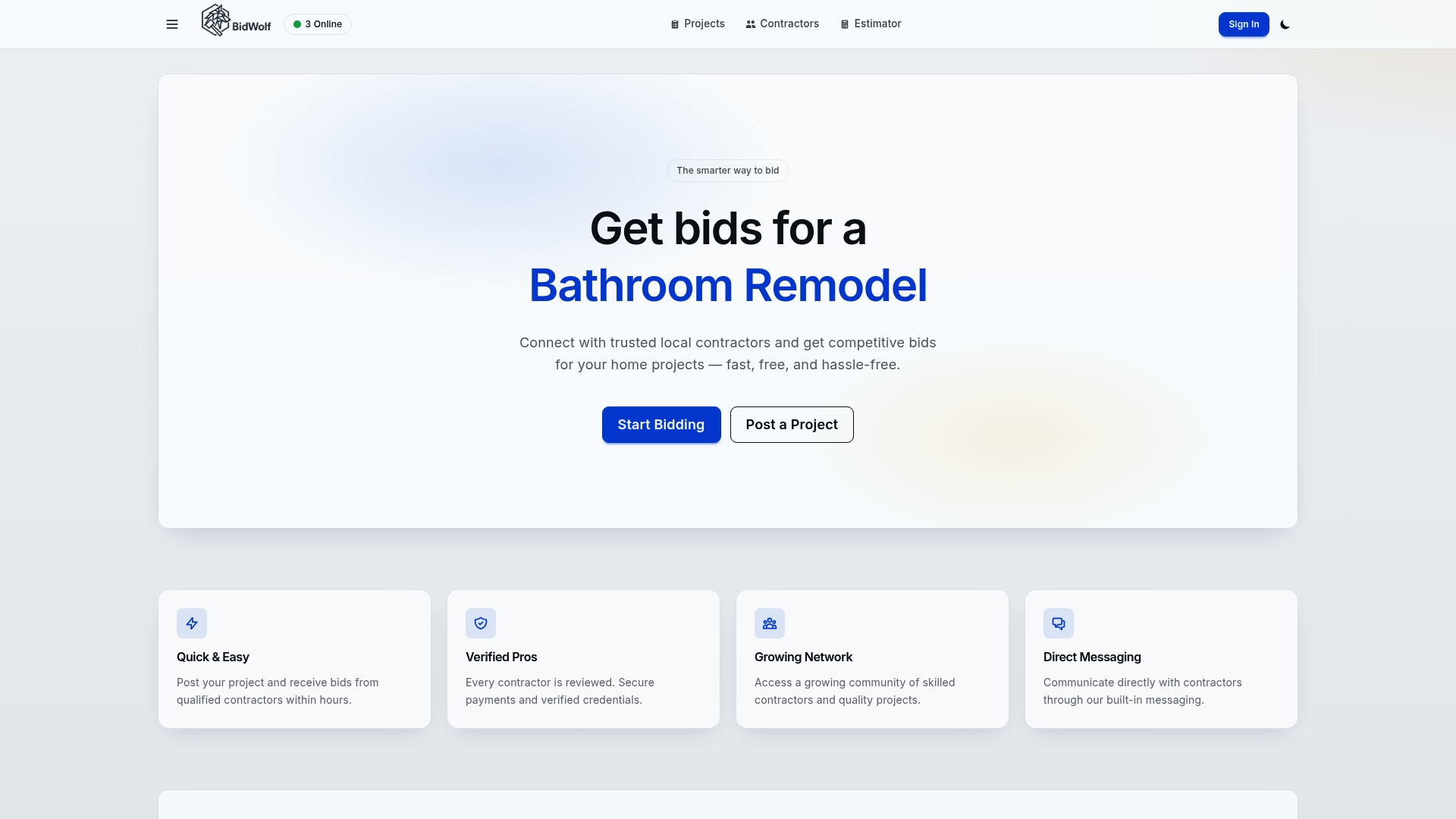
Bidwolf is a verified contractor marketplace where Texas homeowners post real projects and receive competitive bids from local professionals. You get direct messaging with clients, built-in bid management, and access to a growing pipeline of home improvement projects across roofing, remodeling, electrical work, landscaping, and more. The platform is built to help you find and bid on projects without the guesswork. If you’re looking to connect with more local clients and fill your schedule with quality work, Bidwolf is built for exactly that.
FAQ
What are the best tips for growing a contractor business?
Focus on building systems in seven areas: lead generation, lead conversion, operations, reputation, team development, financial management, and marketing. Contractors who run all seven systems consistently see the most sustainable growth without burnout.
How do I get more clients as a contractor?
Diversify your lead sources across SEO, Google Ads, and a structured referral program. Referred clients tend to have higher retention and profit margins, so a simple referral ask five to seven days after job completion is one of the most cost-effective ways to build your client base.
When should a contractor hire employees vs. use subcontractors?
Hire employees when a role runs consistently above 30 hours per week and quality control requires direct supervision. Use subcontractors for overflow, specialty work, or new service lines you’re testing before committing to payroll.
How much should a contractor spend on marketing?
Marketing spend as a percentage of revenue should increase as you scale. Contractors under $1 million typically allocate 3 to 5%, while those scaling to $3 million often need to invest 8 to 10% of revenue to sustain the lead volume required for growth.
How do I stop being the bottleneck in my own business?
Hire a production manager or promote a reliable crew lead to own jobsite execution. Document your job handoff process, track profitability by job, and use project management software so information flows without running everything through you personally.