
Contractor Lead Generation: What You Need to Know

TL;DR:
- Contractor lead generation involves a full system to attract, respond to, and convert potential clients into booked jobs. Focusing on response speed, quality, and multi-channel integration ensures consistent, profitable lead flow and long-term growth. Building owned channels like SEO and referrals offers sustainable results, reducing reliance on paid lead sources.
Most contractors assume lead generation means buying a list of names or signing up for a lead service. That’s a piece of it, at best. What is contractor lead generation, really? It’s the full system you use to attract people who need your services, get them to reach out, and convert that interest into a signed job. Lead generation for contractors covers every touchpoint from a homeowner’s first search to the moment they book an estimate. When you understand it that way, everything changes, including how you spend your marketing budget and how consistently work flows in.
Table of Contents
- Key takeaways
- What contractor lead generation actually means
- The main channels contractors use to get leads
- Why speed is the most overlooked conversion lever
- Building a lead generation system that works consistently
- Buying leads vs. building your own channels
- My take on what actually moves the needle
- Start generating better leads with Bidwolf
- FAQ
Key takeaways
| Point | Details |
|---|---|
| Lead gen is a system | Generating leads consistently requires a repeatable process, not one-off campaigns or random referrals. |
| Speed to lead wins jobs | Responding within 5 minutes makes you 21 times more likely to qualify a lead than waiting even 10 minutes. |
| Channel mix matters | Combining 2-3 channels aligned with your trade, service area, and team capacity outperforms single-channel reliance. |
| Quality beats volume | Tracking leads from inquiry to booked job reveals which sources deliver profitable work, not just phone calls. |
| Owned channels compound | SEO, referrals, and a strong website build lead flow that gets cheaper over time, unlike paid leads. |
What contractor lead generation actually means
Lead generation for contractors is the process of attracting potential customers who need construction, repair, or remodeling services and converting that interest into booked jobs. A lead is created the moment someone shows intent: a phone call from your Google listing, a form fill on your website, a direct message on Instagram, or a click on your ad that lands on a contact page. The channel doesn’t matter as much as the intent behind the action.
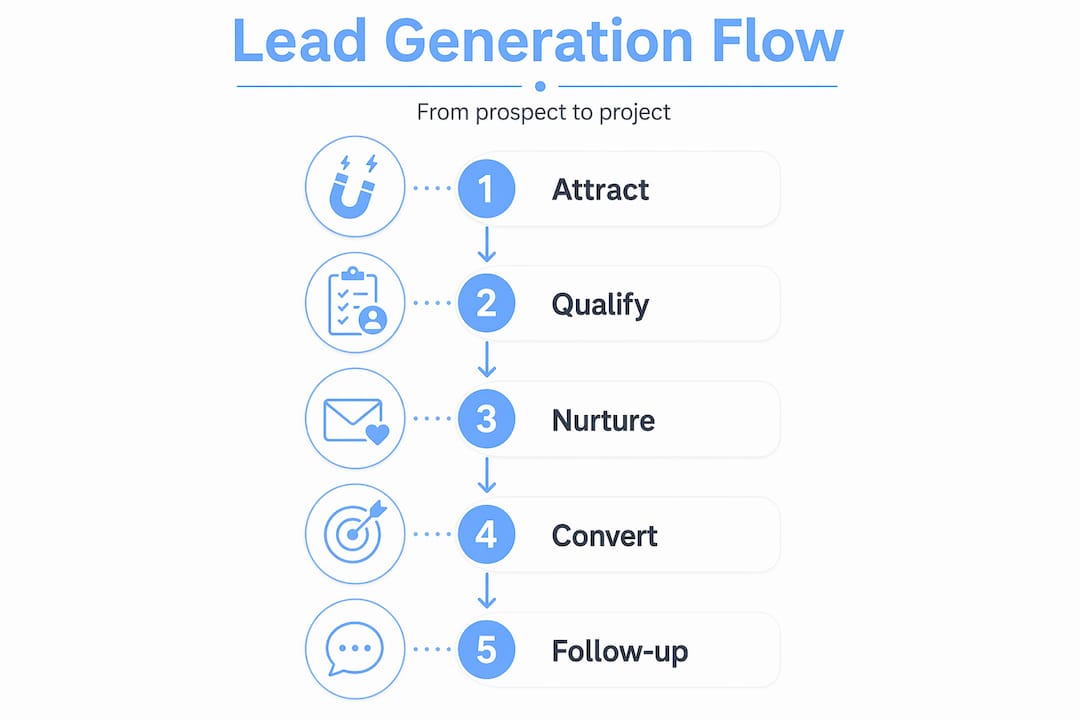
Where most contractors go wrong is treating lead generation as a single event rather than a pipeline with stages. A well-functioning system moves a prospect through four clear steps: inquiry, contact, estimate, and booked job. Each step requires a specific action from you, and each step is where leads can fall out. If you don’t track where leads drop off, you’ll keep blaming your marketing budget when the real problem might be that nobody is returning calls fast enough.
Lead quality and lead volume are not the same thing. A high-volume campaign that delivers 40 inquiries a month from tire-kickers costs you more than a tighter campaign that sends 12 motivated homeowners ready to schedule. A repeatable lead system focuses on consistent, qualified inquiries rather than sheer numbers. That means knowing which sources generate leads that actually convert, and putting more weight behind those.
Here’s what a basic lead pipeline looks like in practice:
- Inquiry: Homeowner calls, fills a form, or messages you through any channel
- Contact: You reach them, confirm the project scope, and schedule an estimate
- Estimate: You visit the site, present pricing, and follow up in writing
- Booked job: Signed contract, deposit collected, project scheduled
A CRM (customer relationship management) tool ties this all together. Even a simple spreadsheet works at first. The goal is to see every lead, know its current stage, and never let one go silent without follow-up.
Pro Tip: Set up a dedicated phone number for each major lead source. When a call comes in, you’ll know immediately whether it came from Google Ads, your website, or a lead marketplace. That data tells you where to invest next month.
The main channels contractors use to get leads
Understanding what is lead generation for contractors means understanding the channels that actually produce results. There’s no single best channel; the right mix depends on your trade, your market, and how fast your team can respond. Here’s how the most common options break down.
Local SEO and Google Business Profile
When someone searches “bathroom remodel contractor near me,” the contractors who appear in the local map pack get the majority of clicks. Optimizing your Google Business Profile with accurate categories, photos of completed work, and consistent review requests costs nothing but time. It compounds over months, meaning a profile you build today keeps generating calls years from now.

Google Local Services Ads
Google Local Services Ads charge contractors per valid lead, not per click. A valid lead includes a phone call, a booked appointment, or a message from a homeowner in your service area. You also get a “Google Screened” or “Google Guaranteed” badge, which builds trust before a homeowner even reads your profile. This model means your budget goes directly toward people who take action, not passive browsers.
Referral networks and past clients
Referrals close at a much higher rate than cold leads because trust transfers. A homeowner who hears about you from a neighbor is already halfway sold. Systematizing referrals means asking every satisfied client for a recommendation, offering a small incentive where appropriate, and staying in contact with past customers through a simple email or seasonal check-in.
Your own contractor website
A website with service-specific landing pages and a short contact form works significantly better than a generic homepage. Conversion-optimized landing pages paired with CRM automation reduce the gap between inquiry and scheduled estimate. If your site sends all traffic to one page with no clear call to action, you’re losing leads that your competitors are capturing.
Social media
Facebook and Instagram work well for visual trades like kitchen remodeling, landscaping, and painting. Before-and-after photos perform well organically and can be boosted as paid ads with local targeting. Nextdoor is particularly useful for neighborhood-level visibility and generates highly local referral traffic for contractors who engage there consistently.
Third-party lead marketplaces
Platforms that aggregate homeowner project requests and distribute them to contractors can deliver volume quickly. The tradeoff involves shared vs. exclusive leads: shared leads go to multiple contractors simultaneously, meaning you are competing the moment the lead is created. Exclusive leads cost more but eliminate that race. Evaluating cost per lead alongside exclusivity is what separates contractors who profit from marketplaces from those who burn through budget.
| Channel | Cost Structure | Lead Exclusivity | Speed to ROI |
|---|---|---|---|
| Local SEO | Time investment | Organic (yours alone) | Slow (3-6 months) |
| Google Local Services Ads | Pay per lead | Semi-exclusive | Fast (days) |
| Social media ads | Pay per click/impression | Non-exclusive | Medium (weeks) |
| Referral networks | Relationship investment | Fully exclusive | Varies |
| Lead marketplaces | Pay per lead (shared or exclusive) | Shared or exclusive | Fast (days) |
| Content marketing | Time + minimal cost | Organic | Slow but compounding |
Pro Tip: Content marketing generates 3x more leads than traditional outbound at 62% lower cost. Publishing project guides, FAQ pages, and case studies on your website builds a lead source that improves with every piece you add.
Why speed is the most overlooked conversion lever
You can run the best ads in your market and still lose jobs to a competitor who responds faster. The research on this is clear: responding within 5 minutes makes you 21 times more likely to qualify a lead than waiting even slightly longer. When response time stretches to 10 minutes, qualification likelihood drops by roughly 80%.
| Response time | Relative qualification likelihood |
|---|---|
| Under 1 minute | Highest possible conversion rate |
| 1 to 5 minutes | 21x more likely to qualify vs. 10+ minutes |
| 5 to 10 minutes | Significant drop-off begins |
| Over 10 minutes | Lead likely already called a competitor |
| Over 30 minutes | Most leads are effectively lost |
Homeowners searching for a contractor are often contacting two or three people at the same time. The first contractor to respond professionally sets the standard. If that’s not you, someone else gets the estimate appointment.
Tactics that help you respond faster:
- AI-powered answering services that capture lead details and send you an instant notification
- Callback automation triggered when a form is submitted on your website
- A trained in-house receptionist with a script for qualifying new inquiries
- Mobile alerts from your lead platforms so you can respond from the job site
Speed matters, but so does quality. A rushed, unprepared response leaves a bad impression. The goal is to acknowledge the lead immediately and schedule a proper conversation, not to close a contract in 60 seconds.
“The contractors who win the most jobs aren’t always the best at the trade. They’re the best at being first and sounding professional when they get there.” — Field observation from contractor CRM consulting
Pro Tip: If you can’t answer every call personally, set up a voicemail that confirms you received the inquiry, provides a specific callback window, and asks the caller to leave project details. It sets expectations and keeps the lead warm until you can follow up.
Building a lead generation system that works consistently
The contractors who grow steadily don’t chase tactics. They build systems. Contractor marketing and lead generation is most effective when treated as an operational function, not a campaign you run when work slows down.
Here’s how to build a lead generation system that holds up month to month:
-
Choose 2-3 channels aligned with your trade. A plumber in a dense metro area may do well with Google Local Services Ads and referrals. A custom home builder might rely on SEO content and design-phase project intelligence. Channel choice should align with job size, margins, service area, and team capacity, not just what generates the most calls.
-
Set up a CRM before you scale. A CRM doesn’t need to be expensive. Tools like Jobber, ServiceTitan, or even a structured Google Sheet let you track every lead from source to outcome. Without this, you can’t see which channels are producing profitable jobs.
-
Create service-specific landing pages. If you do roofing, HVAC, and kitchen remodels, each service needs its own page with a unique form. Generic homepage traffic converts poorly. Service-specific pages with short forms and clear next steps convert significantly better.
-
Automate your follow-up workflow. Set up automated email or text sequences that go out within minutes of a form submission. Acknowledge receipt, confirm you’ll call within a set timeframe, and provide a way to self-schedule if they prefer. This keeps leads engaged while you’re on a job.
-
Review your lead source data monthly. Look at which sources generated the most booked jobs, not just the most calls. Calculate cost per booked job for each paid channel. Cut what isn’t converting and reinvest in what is.
-
Prioritize lead quality over volume. Lost revenue most often comes from leads slipping through cracks in your follow-up process, not from a shortage of inquiries. Managing existing lead flow better converts more work than buying additional volume.
Pro Tip: Review your “lost” leads quarterly. Go back through closed inquiries that never became jobs and identify the common drop-off point. If most fall off between contact and estimate, your scheduling process needs work. If they drop off after the estimate, your proposal or pricing may need adjustment.
Buying leads vs. building your own channels
This is the comparison every contractor eventually faces. Buying leads from marketplaces gets you in front of homeowners quickly. Building owned channels like SEO, referrals, and a strong website takes longer but produces compounding returns.
| Approach | Upfront Cost | Speed | Long-term Value | Risk |
|---|---|---|---|---|
| Lead marketplace (shared) | Low per lead | Very fast | Low (competitive) | High if no follow-up system |
| Lead marketplace (exclusive) | Higher per lead | Fast | Medium | Medium |
| Local SEO and content | Time-heavy | Slow | Very high | Low |
| Referral network | Relationship investment | Varies | Very high | Very low |
| Paid social ads | Moderate budget | Medium | Medium | Medium |
Shared leads carry a specific risk that contractors often underestimate. When lead exclusivity is not guaranteed, the same homeowner request goes to three to five contractors at once. You’re competing from the first second the lead is created, which means speed and professionalism become the only differentiators. Without a fast-response system in place, shared leads are often a poor investment.
The strongest contractor businesses use a hybrid approach:
- Paid channels (LSAs or marketplaces) to generate volume while owned channels are being built
- SEO and content to build long-term organic lead flow
- Referral systems to capture high-intent, high-conversion leads from satisfied customers
- A consistent follow-up process that works regardless of where the lead originated
Relying entirely on purchased leads without building anything you own is the highest-risk position a contractor can be in. If a marketplace raises prices, changes its algorithm, or exits your market, your lead flow stops completely. Owned channels protect you from that.
- Build at least one owned channel (website SEO or referral network) even while using paid sources
- Treat referrals as a system, not a happy accident: ask for them, reward them, and track them
- Calculate cost per booked job for every paid channel, not just cost per lead
- Engage homeowners early in the project planning phase when possible; contractors who connect during the design phase close at 3 times the rate of those who enter at bid time
My take on what actually moves the needle
I’ve worked with enough contractors to say this plainly: most lead generation problems are actually follow-up problems. A contractor running a modest Google Ads budget with a fast-response system will consistently out-earn a competitor spending twice as much but responding to leads hours later.
The second thing I’ve seen hurt contractors repeatedly is chasing lead volume without tracking outcomes. Buying 50 leads a month feels productive. But if you’re only converting 2 into jobs and you don’t know which 2 came from which source, you’re flying blind. The moment you start tracking source to booked job, the picture becomes very clear, very fast.
My perspective on contractor marketing strategies: lead generation isn’t a marketing function. It’s an operational one. The contractors who treat it that way, who build CRM habits, review data monthly, and hold their team accountable to response times, are the ones who grow without the feast-and-famine cycle.
One more thing worth saying: referrals are the most undervalued channel in contracting. A well-timed ask to a satisfied customer, paired with a simple process for passing along your contact info, costs nothing and delivers some of the highest-quality leads you’ll ever receive. Most contractors wait for referrals to happen. The ones who build a system around asking for them see a measurable difference within 90 days.
— Devin
Start generating better leads with Bidwolf
If you’re ready to put these ideas into practice, Bidwolf makes it easier to connect with homeowners who are actively looking for contractors in your area.
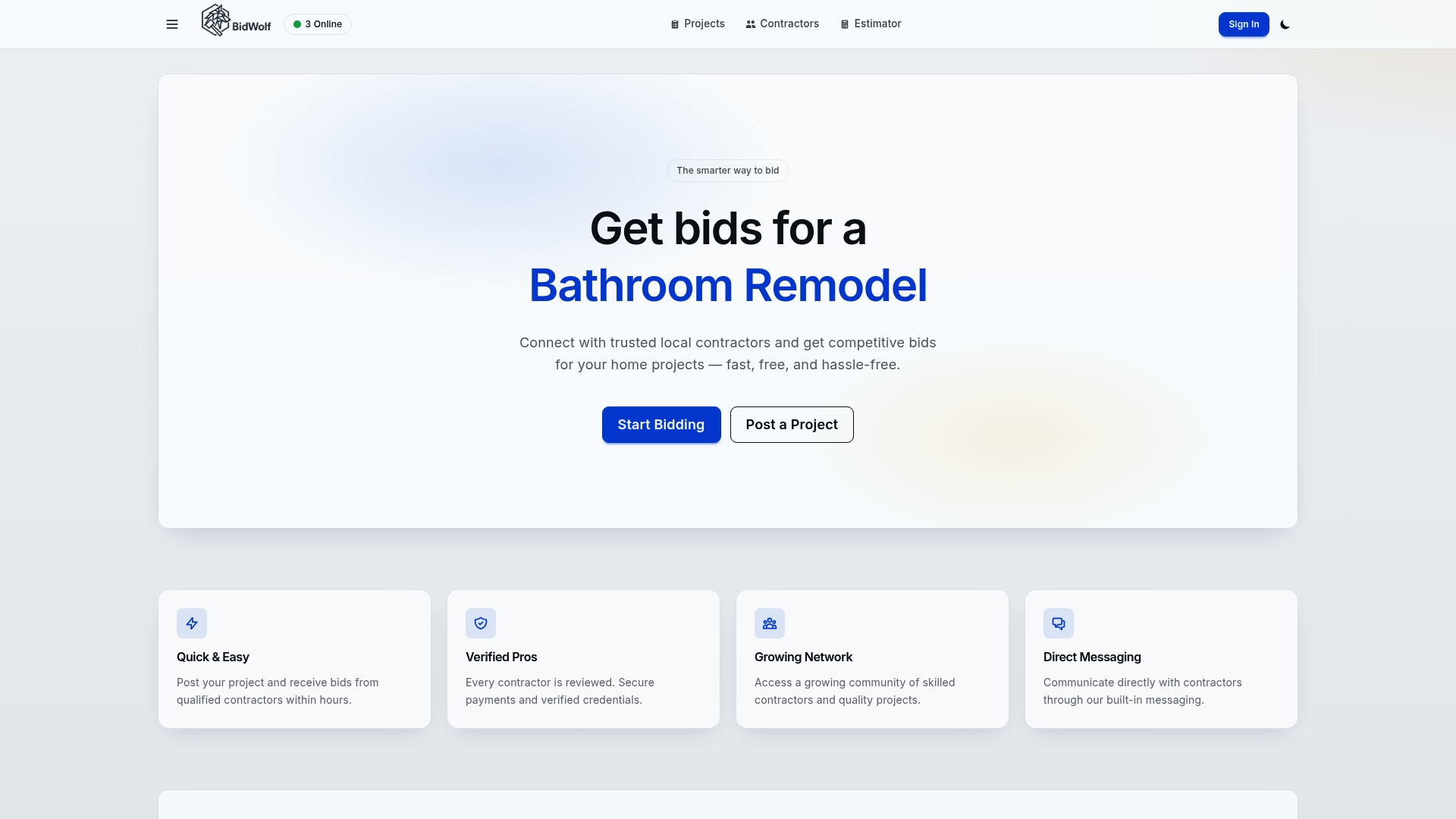
Bidwolf is a verified project marketplace built for contractors across Texas. Homeowners post real projects, from bathroom remodels to roofing repairs, and you receive direct access to those leads through the platform. Every lead is tied to a verified project posting, so you’re not competing on vague inquiries. You can browse active local projects and submit competitive bids through a built-in messaging system that keeps communication organized in one place. Bidwolf also supports faster response through its mobile app, so you can review and respond to new project postings from anywhere. It’s a practical addition to any contractor’s lead generation mix, especially for contractors looking to build volume in new service areas. Join the Bidwolf network and start receiving verified project leads today.
FAQ
What is contractor lead generation?
Contractor lead generation is the process of attracting homeowners who need construction or repair services and converting their interest into booked jobs. It includes every channel and tactic used to generate inquiries, from Google Ads to referrals to lead marketplaces.
How do I generate more contractor leads?
Combining local SEO, Google Local Services Ads, and a referral system while using a CRM to track follow-up is the most reliable approach. How Texas homeowners find contractors fast shows what homeowners actually look for when choosing a contractor.
What is the 5-minute rule in lead generation?
The 5-minute rule refers to research showing that responding to a lead within 5 minutes makes you 21 times more likely to qualify that lead compared to waiting 10 or more minutes.
Are lead marketplaces worth it for contractors?
They can be, depending on exclusivity. Shared leads go to multiple contractors at once, which increases competition and reduces conversion rates. Exclusive leads cost more but eliminate that competition, making them more cost-effective when your follow-up system is strong.
What is the difference between lead volume and lead quality?
Lead volume measures how many inquiries you receive. Lead quality measures how many of those convert into paying jobs. A smaller number of high-intent leads from referrals or targeted SEO will almost always outperform a large volume of unqualified inquiries from broad ad campaigns.