

What Defines a Reliable Contractor for Homeowners
TL;DR:
- Hiring a reliable contractor requires verifying active licensing, insurance, and positive references to ensure quality work. Clear communication, detailed written contracts, and fair payment structures protect homeowners from common pitfalls. Trusted contractors are typically booked in advance; immediate availability may signal potential reliability issues.
Hiring a contractor is one of the most financially significant decisions a homeowner makes. And yet, 40% of homeowners report serious problems including poor workmanship, abandoned projects, or outright fraud when they hire the wrong person. Understanding what defines a reliable contractor goes well beyond finding someone with a decent price and a friendly handshake. The right contractor shows up on time, communicates clearly, holds proper credentials, and treats your home with respect from day one. This guide breaks down exactly what to look for so you can hire with confidence.
Table of Contents
- Key takeaways
- What defines a reliable contractor: credentials and legal standing
- Reputation and references: looking beyond star ratings
- Communication and transparency throughout the project
- Financial integrity and contract clarity
- Practical checklist for hiring a reliable contractor
- My perspective: what really separates great contractors from the rest
- Find reliable contractors faster with Bidwolf
- FAQ
Key takeaways
| Point | Details |
|---|---|
| Credentials are non-negotiable | Verify active licensing and insurance before any conversation about pricing or timelines. |
| References reveal real reliability | Ask for 3 to 5 recent local references and actually call them to get specific answers. |
| Contracts protect your investment | A trustworthy contractor provides written contracts with scope, materials, timeline, and payment milestones clearly defined. |
| Communication signals quality | Contractors who respond promptly and explain problems clearly are far more likely to finish projects on time and on budget. |
| Red flags save you money | Cash-only requests, vague bids, and immediate availability often signal serious reliability problems. |
What defines a reliable contractor: credentials and legal standing
The most reliable contractors are not just skilled tradespeople. They operate as legitimate businesses with verifiable credentials that protect both their clients and themselves.
Licensing matters more than most homeowners realize
A license is not just paperwork. Licensed contractors meet minimum standards and provide legal recourse if something goes wrong. Without licensing, you lose access to formal complaint processes, and in many states, your homeowner’s insurance may refuse to cover damage caused by unlicensed work. That is a significant exposure when a bathroom remodel or roof repair goes sideways.
Each state sets its own licensing requirements, so your first step is verifying license status through your state’s contractor licensing board website. Most boards offer a free online lookup tool. You want to confirm the license is active, covers the trade you need, and has no recent disciplinary actions on record.
Insurance requirements you should not skip
At minimum, a reliable contractor should carry general liability insurance, typically at least $1 million in coverage, along with workers’ compensation if they employ a crew. Verifying active license and insurance protects you from liability if a worker is injured on your property or if the work causes property damage.
Ask for a certificate of insurance directly from the contractor and contact the insurer to confirm the policy is current. Never accept a verbal assurance or a document you cannot verify independently.
Here is what to confirm before signing any contract:
- Active state contractor’s license with no suspensions
- General liability insurance with at least $1M in coverage
- Workers’ compensation insurance covering all crew members
- Permit-pulling responsibility confirmed in writing
- Bond coverage for any contract above your state’s threshold
Pro Tip: Ask your contractor who pulls the permits for the job. A reliable professional handles this process themselves. If they expect you to pull your own permits, treat it as a warning sign about how they approach accountability.
Reputation and references: looking beyond star ratings
Online reviews are useful, but they tell an incomplete story. A contractor with 4.8 stars and 12 reviews is not necessarily more reliable than one with 4.4 stars and 85 reviews. Volume, consistency, and how a contractor responds to negative feedback all matter more than a single number.

How to vet references the right way
Trusted referrals weigh more than online reviews because they allow for real conversation. When you call a reference, you can ask follow-up questions that no review platform allows. Ask specifically whether the project finished on schedule, whether the final cost matched the original bid, and whether they would hire that contractor again for a larger job.
The characteristics of trustworthy contractors tend to show up clearly in these conversations. References will tell you things like: “He showed up every day at 8 a.m.” or “She called us immediately when there was a plumbing issue we hadn’t anticipated.” Those details are far more informative than a five-star rating with a one-line comment.
Here is what to ask when checking references:
- Did the project finish on time and within the quoted budget?
- How did the contractor handle unexpected problems or changes?
- Was the job site kept clean and organized throughout?
- Were subcontractors professional and respectful?
- Would you hire this contractor again for a larger or more complex project?
Reading online reviews with more precision
Look for patterns rather than individual comments. A contractor with five negative reviews, all mentioning communication problems, is telling you something consistent and credible. Pay attention to how the contractor responds to criticism. A professional response that acknowledges the concern and explains what was done to address it signals maturity and accountability. A defensive or dismissive reply tells you exactly what working with that person will feel like.
You can also check for contractor reviews through the Better Business Bureau and your local licensing board’s complaint history. These sources surface problems that customers sometimes hesitate to post publicly.
Communication and transparency throughout the project
Many homeowners discover after the fact that their biggest frustrations were not about the finished work. They were about not knowing what was happening while the work was in progress. Reliable contractors treat your project like a priority, not a side job.
Good project management includes transparency and clear communication at every phase. A contractor who keeps you informed about delays, permit timelines, and inspection schedules is one who respects your time and your investment. A contractor who goes quiet for days at a time and only surfaces when they need more money is a serious problem, even if the work itself looks acceptable.
Here is what professional communication looks like in practice:
- Scheduled updates. A reliable contractor checks in at agreed intervals, whether daily or weekly, without you needing to chase them down.
- Permit transparency. They explain what permits the project requires, who pulls them, and when inspections are scheduled.
- Problem disclosure. When they discover an unexpected issue, like old wiring behind a wall or water damage under flooring, they document it, explain the options, and present a clear path forward with pricing.
- Responsive messaging. You should receive replies to calls or messages within one business day, at most. Contractors who routinely take three to five days to respond will do the same when an issue arises mid-project.
- Professional job site management. Crews arrive when they say they will, the site is left reasonably clean each day, and subcontractors are briefed on your expectations.
Pro Tip: During your initial interview, ask the contractor how they prefer to communicate and how often you can expect updates. Their answer reveals a lot. A confident professional will give you a specific, structured response. Vague answers like “I’ll keep you posted” are usually exactly as informative as they sound.
Communicating clearly with your contractor throughout the project is a two-way responsibility. But it starts with hiring someone who prioritizes it from day one.
Financial integrity and contract clarity
Money is where many contractor relationships fall apart. Understanding what a trustworthy financial arrangement looks like before you sign anything is one of the most protective steps you can take.
Understanding fair payment structures
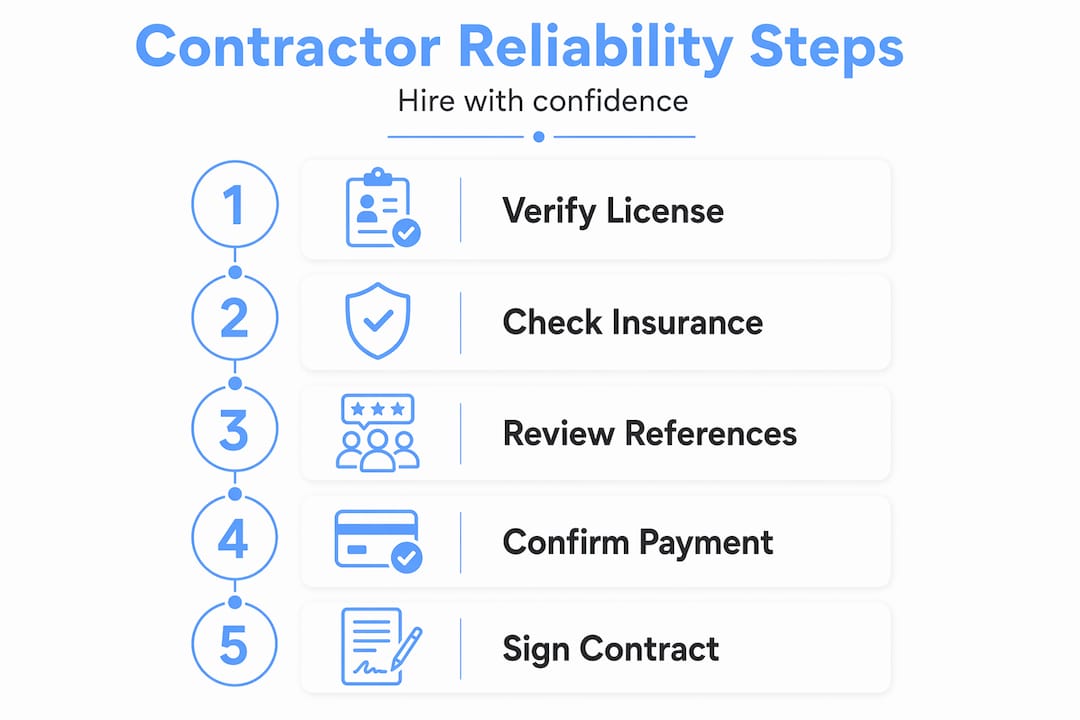
Payment schedules tied to verifiable milestones are the clearest sign of a contractor who manages their business responsibly. You pay when work is completed and inspected, not on arbitrary calendar dates. A contractor who asks for 50% of the total contract value before a single tool is unpacked is often using your money to fund other jobs or cover business expenses they should have managed independently.
California offers a strong consumer protection model worth knowing: California law caps down payments at $1,000 or 10% of the contract price, whichever is less. Even if you live outside California, this benchmark is a useful reference for what a reasonable upfront payment looks like. Anything significantly above it warrants a direct conversation.
Contractors who push for large upfront payments often signal financial distress or poor organization, both of which create real risk for your project.
What a solid contract includes
The following comparison shows the difference between what a reliable contract contains and the warning signs in a weak one:
| Reliable contract | Red flag contract |
|---|---|
| Defined project scope with specific materials | Vague scope like “bathroom remodel, materials included” |
| Payment schedule tied to completed milestones | Large lump-sum payments tied to calendar dates |
| Start and estimated completion dates | No timeline or open-ended completion language |
| Change order process with written approval required | Verbal agreements for additions or changes |
| Cancellation rights and terms clearly stated | No mention of cancellation or early termination |
| Contractor’s license number on document | No license number or company information |
Signs you should walk away from a contractor before signing:
- Requests for cash-only payments
- Pressure to sign immediately without time to review
- No written contract offered at all
- Bid that is 30% or more below every other estimate without a clear explanation
- Refusal to provide proof of licensing or insurance
Defining scope, materials, and function before discussing pricing is what reliable contractors do. If someone is quoting you a number before they fully understand the project, that number is likely to change significantly once the work begins.
Practical checklist for hiring a reliable contractor
Knowing the qualities of a good contractor is only useful when you can translate that knowledge into a concrete hiring process. Here is a step-by-step reliable contractor checklist you can apply to any project.
You can also find a Texas-specific hiring checklist if you are working on a project in that region.
- Define your project scope first. Know what you need before you contact anyone. A clearly defined project attracts accurate bids and filters out contractors who are not the right specialty fit.
- Source candidates from multiple channels. Use trusted referrals from neighbors or friends alongside vetted platforms. Do not rely on a single source.
- Verify licensing and insurance independently. Use state licensing board tools and contact the insurer directly. Do not rely only on documents the contractor provides.
- Schedule in-person or video meetings. How a contractor presents themselves, answers questions, and handles uncertainty tells you a great deal about how they will behave on your job site.
- Request itemized written bids from at least three contractors. Compare line by line, not just total price. Significant differences in material costs or labor hours deserve an explanation.
- Ask about subcontractors. Many general contractors use subs for electrical or plumbing. Confirm those subs are also licensed and insured, and ask how the general contractor supervises their work.
- Review all documentation before signing. Contract, license certificate, insurance certificate, and payment schedule should all be in hand and reviewed before any work begins.
- Know when to walk away. If a contractor resists any of these steps, becomes defensive, or pushes you to decide before you are ready, that behavior will not improve once they are on your property.
Learning how to choose a reliable contractor takes practice, but following this process consistently eliminates most of the risk before it starts.
My perspective: what really separates great contractors from the rest
I have looked at a lot of contractor relationships over the years, from simple repairs to six-figure renovations, and one pattern keeps appearing. The homeowners who had the worst experiences almost always hired someone who was immediately available.
Reliable contractors are often booked months ahead. When someone can start your job next week, I always want to know why. In most trades, the best professionals have full schedules because other homeowners already figured out they are good. Immediate availability is not a benefit. It is a data point that needs explaining.
The second thing I have come to believe is that reliability is a system, not a personality. A contractor can be charming, enthusiastic, and genuinely likable while also being completely disorganized. Likability does not protect you when they mismanage cash flow and abandon your project in week three. What protects you is a contractor who defines scope before pricing, structures payments around completed work, and documents everything in writing. Those are process behaviors, and they indicate that the person runs their business with discipline.
I also pay close attention to a contractor’s financial character. Clear accounting, reasonable payment expectations, and proof of bonding for larger jobs all signal stability. A contractor who cannot explain their payment terms or gets evasive when you ask for an insurance certificate is telling you something about how they handle money on every job they run.
Finally, communication is the single most predictive trait I have seen. The contractors who answer questions directly, admit when they do not know something, and follow up without being asked are consistently the ones whose projects finish well. That quality cannot be faked for long, and it shows up clearly in the first conversation if you know what questions to ask.
— Devin
Find reliable contractors faster with Bidwolf
Applying everything in this guide takes time, but finding the right contractor does not have to be a frustrating process. Bidwolf connects homeowners with verified local contractors who have been vetted for licensing and insurance before they ever appear on the platform. You post your project, receive competitive bids from qualified professionals in your area, and compare them side by side with full transparency.
Every contractor in the Bidwolf network carries verified credentials, so you spend less time chasing down license numbers and insurance certificates and more time evaluating the actual bids. Built-in messaging keeps all communication in one place, and the structured bidding process naturally encourages contractors to provide detailed, itemized proposals rather than vague estimates. When you are ready to move forward, you can post your project and start receiving bids from licensed, insured local pros today. Bidwolf makes the vetting process faster, more transparent, and far less stressful for homeowners who want quality work done right the first time.
FAQ
What are the most important signs of a reliable contractor?
The clearest signs are an active license, current insurance coverage, verifiable references from recent projects, a detailed written contract, and payment terms tied to completed milestones rather than arbitrary dates.
How do I verify a contractor’s license?
Visit your state’s contractor licensing board website and use their free license lookup tool. Confirm the license is active, covers the correct trade, and has no disciplinary actions on record.
What should a reliable contractor’s contract include?
A trustworthy contract defines the full project scope, materials, start and completion dates, a milestone-based payment schedule, a written change order process, and clear cancellation terms.
Is immediate contractor availability a red flag?
Yes, in most cases. Reliable contractors are typically booked weeks or months ahead because they are in demand. A contractor who can start immediately without explanation may have a history of incomplete or problematic projects.
How much should I pay upfront to a contractor?
Reasonable upfront deposits are typically small and tied to material procurement. California’s consumer protection law limits down payments to $1,000 or 10% of the contract value, whichever is less. Use that as a practical benchmark regardless of your state.