

How to Price Renovation Projects: A 2026 Budget Guide

TL;DR:
- Accurate renovation project pricing includes detailed line-item bids, correct contingencies, and full soft cost accounting.
- Homeowners should compare bids by scope, allowances, permits, and contingency to prevent budget overruns and scope creep.
Renovation project pricing is the process of calculating all direct and indirect costs before a single wall comes down. Knowing how to price renovation projects accurately separates homeowners who finish on budget from those who run out of money mid-project. A well-priced renovation covers labor, materials, subcontractors, permits, overhead, profit, and a contingency reserve. Average remodeling costs range from $19,000 to $88,000 nationally, and that wide spread proves that scope and finish level matter far more than square footage alone. Getting the numbers right from the start protects your budget and your relationship with your contractor.
How to price renovation projects: the core cost components
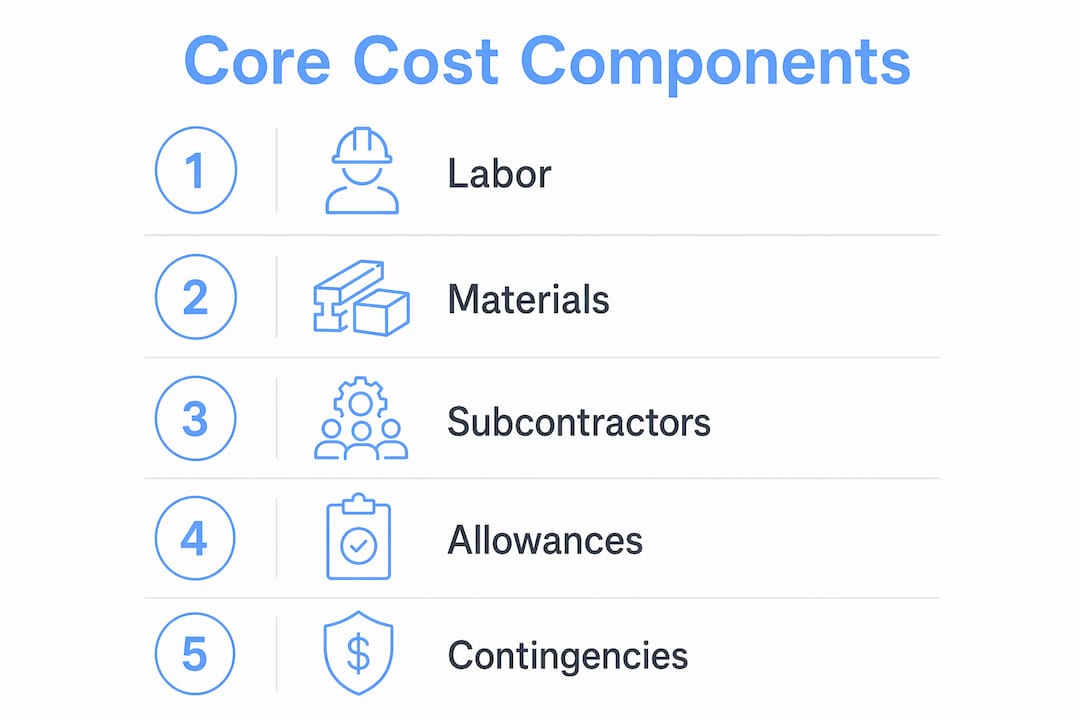
Every accurate renovation estimate starts with the same five building blocks: labor, materials, subcontractors, allowances, and soft costs. Understanding each one prevents the budget gaps that cause projects to stall.

Labor: more than just hourly wages
Labor cost includes wages, benefits, insurance, and overhead spread across every job a contractor runs. That is why a contractor billing $85 per hour is not pocketing $85. A portion covers workers’ compensation, payroll taxes, vehicle costs, and office expenses. Homeowners who compare bids by labor rate alone miss this reality entirely.
Materials and finish level choices
Material costs shift dramatically based on finish level. A standard bathroom tile runs $3–$8 per square foot installed. A large-format porcelain tile can run $18–$30 per square foot installed. The finish level you choose at the start of a project sets the floor for your entire material budget. Locking in selections before bidding prevents cost escalations later.
Subcontractors and specialty trades
Electrical, plumbing, HVAC, and structural work almost always go to licensed subcontractors. General contractors mark up subcontractor costs to cover coordination, scheduling, and liability. That markup is legitimate and expected. When you see a line item for electrical rough-in, the number reflects the sub’s price plus the general contractor’s coordination cost.
Soft costs, permits, and allowances
Soft costs and contingencies are the most common source of budget overruns beyond direct labor and material costs. Soft costs include permit fees, architectural drawings, engineering reports, and inspections. A kitchen remodel permit in a Texas city can run $500–$1,500 depending on scope. Allowances are budget placeholders for items not yet selected, such as fixtures or countertops. Every allowance in a bid should carry a specific dollar amount and a unit description.
Pro Tip: Ask your contractor to list every allowance with a unit price and a product category. An entry like “countertop allowance: $80 per square foot installed quartz” gives you a real number to work with, not a vague placeholder.
Markup versus profit margin
Markup and profit margin are not the same number, and confusing them leads to bad bid comparisons. A 25% markup on $100,000 in costs produces a $125,000 bid. A 25% profit margin on a $125,000 bid means the contractor keeps $31,250. The margin calculation uses the final selling price as the base. NAHB data shows remodelers averaged a 29.9% gross profit margin and 6.3% net profit margin in 2024. That context explains why contractor bids include overhead and profit well above the raw cost of labor and materials.
How can homeowners use line-item bids to build accurate budgets?
A line-item bid lists every cost category separately with quantities, unit prices, and totals. A lump-sum bid gives you one number with no breakdown. The difference matters enormously when you need to compare two contractors or manage a change order.
What a strong line-item bid looks like
A well-structured bid follows a clear formula. Contractors build bids by adding labor, materials, subcontractors, and allowances, then applying a contingency, then adding overhead and profit. The formula looks like this:
Bid = (Labor + Materials + Subs + Allowances) × (1 + Contingency) × (1 + Overhead) ÷ (1 – Profit)
Each layer serves a purpose. Contingency covers unknowns. Overhead covers business operating costs. Profit is the contractor’s return for risk and management. When you see these layers in a bid, you can evaluate each one independently.
Four steps to compare bids fairly
- Align the scope. Confirm every bid covers the same work. A bid that excludes demo or painting will look cheaper but is not a fair comparison.
- Check every allowance. If one contractor uses a $40 per square foot tile allowance and another uses $80, the lower bid is not actually lower. It just defers the cost to a change order.
- Verify permit and inspection costs. Some contractors include permits; others pass them through as a separate line. Standardize this before comparing totals.
- Confirm the contingency is included. A bid without a contingency line is a bid that will grow. Ask directly whether the number includes a reserve for unknowns.
Pro Tip: Request at least three detailed bids for any project over $15,000. Multiple quotes validate your budget range and reveal which contractors have actually priced the full scope.
Detailed line-item bids with clear allowances reduce scope creep and change order disputes, giving you real control over your budget from day one. A project listing for home renovation bids that clearly defines scope and materials makes it far easier for contractors to price accurately.
| Bid element | What to check |
|---|---|
| Labor line items | Are hours and rates listed separately by trade? |
| Material allowances | Does each allowance include a unit price and product type? |
| Subcontractor costs | Are specialty trades broken out or bundled? |
| Permit and inspection fees | Are they included or billed separately? |
| Contingency reserve | Is a percentage explicitly stated in the bid? |
How to set and manage contingencies to minimize budget surprises
A contingency is a reserved percentage of your total project budget set aside for costs that cannot be predicted at the time of bidding. It is not a slush fund. It is a risk management tool with a specific purpose.
Sizing your contingency correctly
Contingency recommendations vary by project type and home age. The standard guidance is:
- New construction or gut renovation of a newer home: 10% contingency
- Standard remodel of a home built after 1980: 10–15%
- Remodel of a home built between 1950 and 1980: 15–20%
- Remodel of a home over 50 years old: 20–30%
Older homes hide problems behind walls. Knob-and-tube wiring, galvanized pipes, and deteriorated subfloors are common discoveries that add real cost once work begins. A 10% contingency on a $60,000 project in a 1940s bungalow is almost certainly not enough.
Sequencing contingency in the bid
Contingency belongs in the bid before overhead and profit are applied. Applying contingency before overhead and profit, sized by scope and home age, minimizes disputes and better reflects actual project risk. If contingency is added after markup, the contractor is charging overhead and profit on money that may never be spent. That is a legitimate concern to raise when reviewing a bid.
“A contingency is not a sign that a contractor is padding the bid. It is a sign that they have done this work before and know what surprises look like.”
Avoiding contingency misuse
Contingency should only be spent on genuine unknowns, not on scope additions you decide to make during construction. If you choose to add a bathroom tile upgrade mid-project, that is a change order, not a contingency draw. Keeping these two categories separate protects your reserve for real surprises and keeps your final cost predictable.
What tools and methods help estimate renovation costs effectively?
Accurate renovation cost estimation uses a combination of national benchmarks, local market adjustments, and detailed quantity takeoffs. No single method works alone.
Square footage pricing: useful but limited
Cost per square foot is a fast way to get a ballpark number. A mid-range kitchen remodel might run $150–$250 per square foot in many Texas markets. The problem is that square footage pricing ignores layout complexity, ceiling height, finish level, and existing conditions. Use it to set an initial range, not to finalize a budget.
Line-item quantity takeoffs by trade yield better budgets than top-down square footage estimates alone. A quantity takeoff counts actual materials needed: linear feet of cabinet runs, square feet of tile, number of electrical circuits, and linear feet of plumbing rough-in. That level of detail makes contingency defensible and reduces the gap between bid and final cost.
Using national benchmarks with local adjustments
National cost data from sources like the National Association of Home Builders gives you a starting framework. Local labor markets, material supply chains, and permit costs then adjust that number up or down. Texas markets like Austin and Dallas carry higher labor costs than smaller cities in the same state. A remodeling cost breakdown by project type helps you calibrate national figures to your specific location.
Pro Tip: Use a national cost benchmark to set your budget ceiling, then use detailed bids from local contractors to find your actual number. The gap between the two tells you whether your market is running hot or cool.
| Estimation method | Best use case | Key limitation |
|---|---|---|
| Cost per square foot | Initial budget range | Ignores finish level and complexity |
| Line-item quantity takeoff | Final bid validation | Requires detailed scope definition |
| National benchmark data | Setting budget ceiling | Does not reflect local labor markets |
| Multiple contractor bids | Market validation | Requires consistent scope across bids |
What common mistakes should homeowners avoid when pricing renovation projects?
The most expensive renovation mistakes happen before construction starts. They happen in the budgeting phase, when homeowners undercount costs or rely on incomplete information.
- Ignoring soft costs. Permits, architectural drawings, engineering reports, and inspections add 5–15% to a project budget. A $50,000 kitchen remodel can carry $5,000–$7,500 in soft costs before a single cabinet is ordered.
- Skipping lead paint compliance costs. EPA Renovation, Repair and Painting rules apply when work disturbs painted surfaces in pre-1978 homes, requiring lead safety clearances and dust controls. Lead clearance testing costs $300–$700 plus lab fees of $30–$185 per sample. These costs are real and often absent from initial bids.
- Relying only on square footage pricing. A price per square foot does not account for the difference between a simple paint-and-floor refresh and a full gut renovation. Always request a line-item bid before committing to a budget.
- Not getting multiple detailed bids. A single bid gives you no reference point. Three bids on the same scope tell you whether the first number was fair, high, or suspiciously low.
- Letting scope creep go undocumented. Every addition or change during construction should be captured in a written change order with a price before work begins. Verbal agreements during construction are the leading cause of end-of-project disputes.
Understanding fair bidding practices before you start collecting quotes puts you in a much stronger position to evaluate what you receive.
Key Takeaways
Accurate renovation pricing requires line-item bids, correctly sized contingencies, and a full accounting of soft costs, overhead, and profit before any work begins.
| Point | Details |
|---|---|
| Use line-item bids | Request itemized bids that separate labor, materials, allowances, and contingency for fair comparison. |
| Size contingency by home age | Set 10–15% for newer homes and 20–30% for homes over 50 years old to cover hidden conditions. |
| Account for soft costs | Include permits, design fees, and compliance costs like EPA lead testing in every budget. |
| Understand markup vs. margin | A 25% markup and a 25% margin produce different final prices; confirm which method your contractor uses. |
| Get at least three bids | Multiple detailed quotes on the same scope validate your budget and reveal pricing outliers. |
Why most renovation budgets fail before the first hammer swings
After reviewing hundreds of renovation projects, the pattern is clear: budget failures are almost never caused by construction surprises alone. They are caused by budgets that were never complete to begin with.
Homeowners consistently undercount three things. The first is soft costs. Permits, drawings, and inspections feel like paperwork, but they carry real dollar amounts. The second is allowances. A bid with a vague “tile allowance” is not a real budget. It is a placeholder that will be replaced by a change order the moment you pick a tile that costs more than the contractor assumed. The third is contingency. A 5% contingency on a 1960s ranch house is wishful thinking. The walls in older homes hold surprises that no inspector can see from the outside.
The homeowners who finish on budget share one habit: they insist on detail before they sign anything. They ask for line-item bids. They ask what every allowance covers. They ask where the contingency sits in the bid formula. That level of engagement is not micromanagement. It is the minimum standard for protecting a five or six-figure investment.
One more thing worth saying directly: the lowest bid is rarely the best bid. A contractor who bids $40,000 on a project that two others priced at $65,000 has either missed scope, used thin allowances, or priced no contingency. You will pay the difference. You will just pay it in change orders instead of in the original contract.
The goal is not the cheapest bid. The goal is the most accurate bid from a contractor you trust.
— Devin
Bidwolf makes getting accurate renovation bids straightforward
Getting three detailed, comparable bids used to mean weeks of phone calls and follow-up. Bidwolf changes that by connecting homeowners directly with vetted local contractors who compete for your project with itemized quotes.

When you post your project on Bidwolf, contractors receive your full scope description and respond with competitive bids you can compare side by side. The platform keeps all communication, documents, and bids in one place, so you never lose track of allowances or change orders. Bidwolf’s network covers multiple Texas cities, and every contractor is verified before they can bid. If you are ready to collect accurate, detailed renovation bids without the back-and-forth, find local contractors on Bidwolf and get your project priced correctly from the start.
FAQ
What should a renovation bid always include?
A complete renovation bid includes line-item labor, materials, subcontractor costs, allowances with unit prices, permit fees, contingency, overhead, and profit. Bids missing any of these categories will likely grow through change orders.
How much contingency should I budget for a renovation?
Budget 10–15% for homes built after 1980 and 20–30% for homes over 50 years old. Older homes carry a higher risk of hidden damage that only becomes visible once walls are opened.
Why is a contractor’s bid higher than my material cost estimate?
Labor cost includes wages, benefits, insurance, and overhead beyond the hourly wage, and contractors also add overhead and profit to cover business operating costs. NAHB data shows remodelers averaged a 29.9% gross profit margin in 2024.
What is an allowance in a renovation bid?
An allowance is a budget placeholder for an item not yet selected, such as tile, fixtures, or countertops. Always confirm the unit price and product category for every allowance before signing a contract.
How do I compare two renovation bids fairly?
Align the scope, match every allowance line by unit price, confirm permit costs are treated the same way, and verify both bids include a contingency reserve. Comparing totals without checking these details produces a misleading result.